Zing Forum

Reading

Building a House Price Prediction Neural Network from Scratch: Pure NumPy Implementation Reveals Core Deep Learning Principles

This article deeply analyzes a house price prediction neural network project built entirely from scratch using NumPy and Pandas, covering implementation details of custom backpropagation, Adam optimizer, mini-batch training, and ReLU activation function, helping readers understand the core mechanisms behind deep learning frameworks.

神经网络NumPy深度学习房价预测反向传播Adam优化器机器学习回归问题从零实现
Published 2026-06-12 23:44Recent activity 2026-06-12 23:48Estimated read 6 min
Building a House Price Prediction Neural Network from Scratch: Pure NumPy Implementation Reveals Core Deep Learning Principles
1

Section 01

Introduction: Building a House Price Prediction Neural Network from Scratch with NumPy, Revealing Core Deep Learning Principles

This article introduces a house price prediction neural network project built entirely from scratch using NumPy and Pandas, covering implementation details such as custom backpropagation, Adam optimizer, mini-batch training, and ReLU activation function, helping readers understand the core mechanisms behind deep learning frameworks. The project was published by ebukagerald on GitHub (link: https://github.com/ebukagerald/housing-predictor-from-scratch, published on June 12, 2026). By implementing it "by hand", developers face mathematical operations and gradient calculations directly, establishing a deep understanding of the underlying mechanisms of neural networks.


2

Section 02

Project Background and Motivation

The abstract APIs of deep learning frameworks lead to insufficient understanding of underlying principles among practitioners. This project aims to fill this gap. By choosing the classic regression problem of house price prediction and implementing a complete neural network from scratch using only NumPy and Pandas, developers are forced to face every step of mathematical operations and gradient calculations, thus deeply understanding the internal working mechanisms of neural networks.

3

Section 03

Network Architecture Design

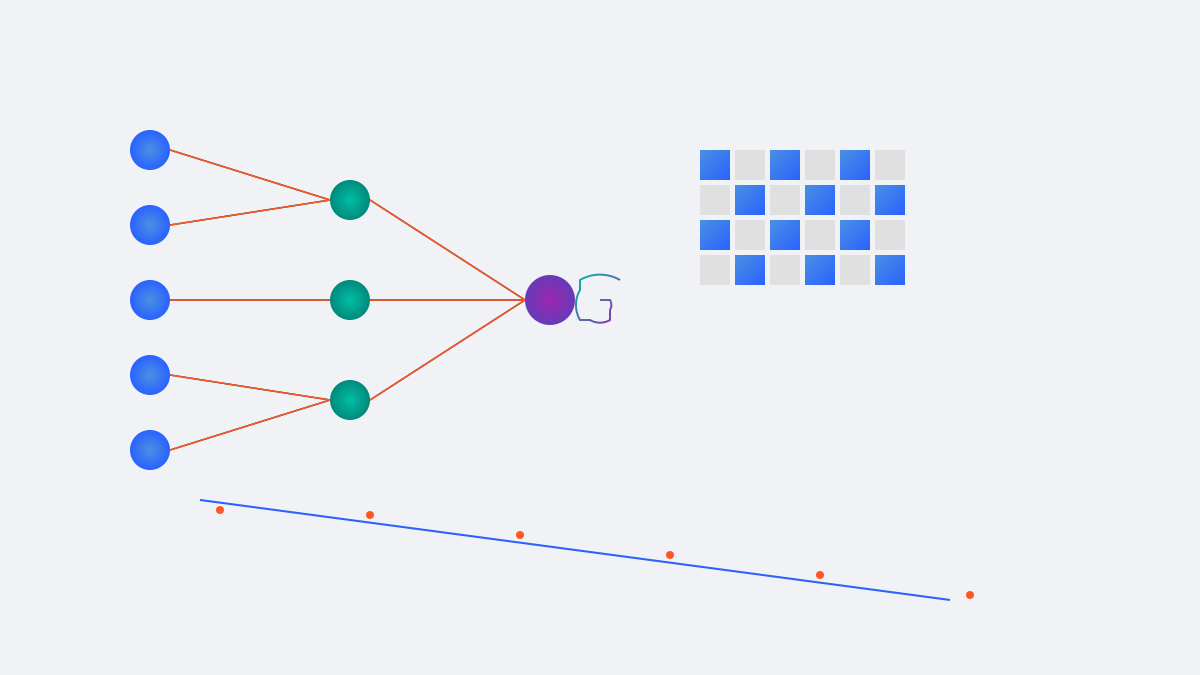
A classic Multi-Layer Perceptron (MLP) architecture is adopted: the input layer receives preprocessed features, the hidden layer uses the ReLU activation function to introduce non-linearity, and the output layer directly outputs the predicted house price. Advantages of choosing ReLU: linear in the positive interval, alleviates the gradient vanishing problem in deep networks, and simplifies the complexity of backpropagation implementation.

4

Section 04

Implementation of Custom Backpropagation Mechanism

Manually derive and implement the complete backpropagation process: forward propagation to calculate predicted values → loss function to compute errors → error backpropagation from the output layer to previous layers (application of chain rule) → accurately track gradient flow and parameter updates. Manual implementation allows developers to clearly understand the gradient flow and parameter update process, which is crucial for debugging and architecture design.

5

Section 05

Optimization Strategies: Adam Optimizer and Mini-Batch Training

  1. Adam optimizer implementation: Maintain first moment (exponential moving average of gradients) and second moment (exponential moving average of squared gradients), adaptively adjust learning rate, and include bias correction to handle initial instability; 2. Mini-batch training strategy: Randomly shuffle the dataset, flexibly configure batch size, handle incomplete batches, balance computational efficiency and convergence stability, laying the foundation for subsequent expansion of training techniques.
6

Section 06

Experimental Results and Performance Analysis

After training, the network achieved an R² accuracy of 85% on the test set, verifying the correctness of various components (backpropagation, optimizer, etc.). Moreover, this result was obtained without using regularization techniques (such as Dropout, weight decay), indicating that the basic architecture is solid and there is still room for optimization.

7

Section 07

Practical Significance and Learning Recommendations

Project value: For learners, it is an 'anatomical specimen' to understand underlying mechanisms; for developers, it provides a starting point for customized networks. Recommendations: Study the source code and implement it by hand, complete the backpropagation code personally, and gain a thorough understanding of the working principles of neural networks, which cannot be replaced by advanced frameworks.

