Zing Forum

Reading

NeuralLinearSolve.jl: A Neural Network-Enhanced Linear System Solver

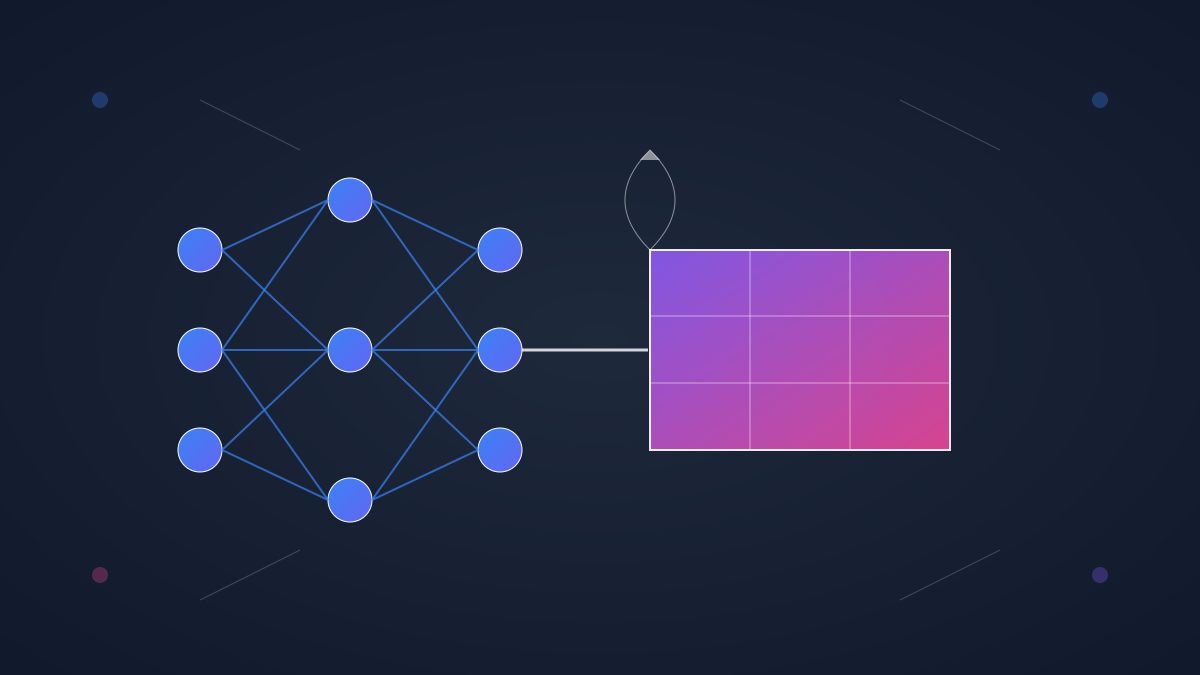
A Julia package from the SciML ecosystem that uses neural network technology to accelerate and enhance traditional linear solvers, providing a new solution paradigm for large-scale scientific computing.

JuliaSciML神经网络线性求解器科学计算预处理器迭代法机器学习
Published 2026-07-13 04:45Recent activity 2026-07-13 05:01Estimated read 8 min
NeuralLinearSolve.jl: A Neural Network-Enhanced Linear System Solver
1

Section 01

NeuralLinearSolve.jl: Introduction to the Neural Network-Enhanced Linear System Solver

NeuralLinearSolve.jl is a Julia package from the SciML ecosystem, designed to use neural network technology to accelerate and enhance traditional linear solvers, providing a new solution paradigm for large-scale scientific computing. Linear system solving is a core problem in scientific computing, engineering simulation, and machine learning. Traditional methods face challenges such as slow convergence and high memory usage when dealing with ultra-large-scale or specially structured matrices. This post will introduce it from aspects such as background and motivation, core mechanisms, technical implementation, application scenarios, limitations, and summary and outlook.


2

Section 02

Project Background and Motivation

In scientific computing, small-scale dense matrices can be solved accurately using direct methods, but large-scale sparse matrices (such as PDE discretization problems) rely more on iterative methods. The convergence speed of iterative methods is highly dependent on the quality of preconditioners, and designing preconditioners requires deep domain knowledge. In recent years, the scientific machine learning (SciML) paradigm has emerged. As powerful function approximators, neural networks are expected to learn matrix structure features to accelerate solving or provide better initial guesses. NeuralLinearSolve.jl was born in this context to explore the combination of neural networks and traditional numerical linear algebra.

3

Section 03

Core Mechanisms and Implementation Ideas

The core mechanisms of NeuralLinearSolve.jl include:

  1. Neural Preconditioner: Learns the mapping from matrix A to preconditioner matrix M, making the spectral distribution of M⁻¹A more favorable to accelerate iterative convergence, suitable for matrix structures like specific PDE discretizations;
  2. Neural Initial Guess: For time-dependent or parameterized problems, learns the mapping from parameters to solutions, providing initial guesses close to the true solution to reduce the number of iterations;
  3. Hybrid Solving Strategy: First uses neural networks for fast approximation, then uses the results as initial values for traditional solvers or the basis for preconditioners, balancing the reliability of traditional methods and the expressive power of neural networks.
4

Section 04

Technical Implementation and Integration with the Julia Ecosystem

As a Julia project, NeuralLinearSolve.jl fully leverages Julia's advantages:

  • Deep Integration with the SciML Ecosystem: Seamlessly interfaces with DifferentialEquations.jl, ModelingToolkit.jl, Lux.jl, etc., collaborating with differential equation solvers and automatic differentiation tools;
  • Automatic Differentiation Support: Uses Zygote.jl, ForwardDiff.jl, etc., to enable efficient training of neural preconditioners/solvers;
  • GPU Acceleration: Uses CUDA.jl and AMDGPU.jl to accelerate matrix operations and neural network inference with GPUs.
5

Section 05

Application Scenarios and Potential Value

Potential application scenarios of NeuralLinearSolve.jl include:

  1. Real-Time Simulation and Digital Twins: Provides fast and accurate approximate solutions for real-time response scenarios (such as digital twins, real-time control);
  2. Parameterized Design and Optimization: Learns the mapping from parameters to solutions, enabling amortized inference to accelerate design space exploration;
  3. Large-Scale Scientific Computing: Provides acceleration that traditional preconditioners are hard to achieve for ultra-large-scale sparse linear systems (such as climate simulation, quantum chemistry calculations).
6

Section 06

Limitations and Challenges

The technical route faces the following challenges:

  1. Generalization Ability: Whether neural network strategies can perform well on problems outside the training distribution;
  2. Training Cost: Balancing training resource consumption and inference benefits;
  3. Interpretability: The internal mechanism of neural preconditioners is difficult to interpret, which may hinder safety-critical applications;
  4. Competitive Advantage: Needs to prove superiority over decades-optimized traditional solvers on specific problems.
7

Section 07

Summary and Outlook

NeuralLinearSolve.jl represents an interesting direction of integration between scientific computing and machine learning, using data-driven methods to solve classic problems in numerical linear algebra and providing new tools for large-scale scientific computing. Researchers and engineers engaged in SciML, large-scale simulation, or high-performance computing should pay attention to it. It can serve as a supplement to existing solvers and inspire new paradigms. Julia scientific computing users are advised to try integrating it, and the active discussions and rich documentation in the SciML community will provide support.

