Zing 论坛

正文

NeoOLAF:融合符号语义与大语言模型的下一代本体学习框架

NeoOLAF 是一个创新的本体学习框架,通过结合符号语义、大语言模型和智能体推理工作流,实现从非结构化文本中自动构建面向应用的本体知识库。

本体学习知识图谱大语言模型智能体符号推理神经符号融合自然语言处理知识工程
发布时间 2026/05/12 00:33最近活动 2026/05/12 00:48预计阅读 5 分钟
NeoOLAF:融合符号语义与大语言模型的下一代本体学习框架
1

章节 01

NeoOLAF: Next-Generation Ontology Learning Framework Fusing Symbolic Semantics and Large Language Models

NeoOLAF is an innovative open-source ontology learning framework that combines symbolic semantics, large language models (LLM), and agent reasoning workflows. Its core goal is to automate the construction of application-oriented ontology knowledge bases from unstructured text, addressing traditional ontology building's inefficiency and LLM's hallucination and lack of interpretability issues. Hosted on GitHub and implemented in Python, it features modularity and scalability.


2

章节 02

Background: Challenges in Ontology Learning and NeoOLAF's Inception

Ontology is a core foundation for intelligent systems, but traditional manual construction is time-consuming and hard to scale. While LLMs have enabled automated ontology learning exploration, they suffer from hallucination, poor interpretability, and lack of symbolic reasoning. NeoOLAF emerged to fuse symbolic semantics and neural network advantages, solving these pain points.

3

章节 03

NeoOLAF's Core Architecture: Three Synergistic Components

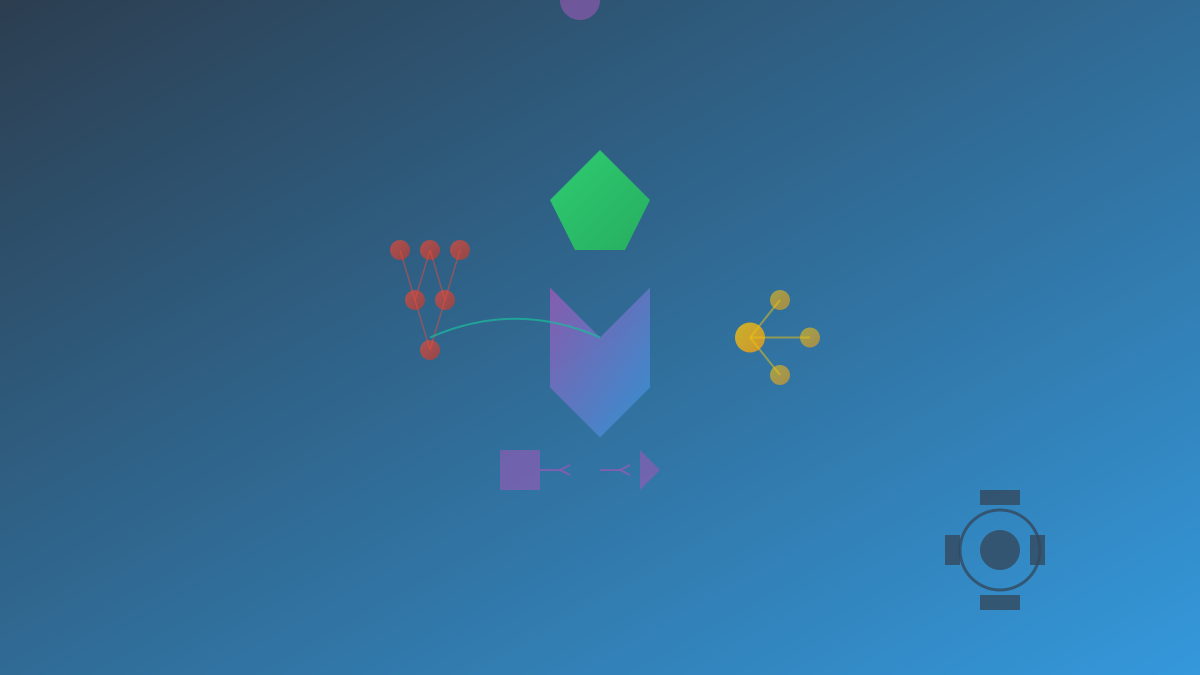
NeoOLAF's architecture consists of three key components: 1) Symbolic Semantic Layer (provides formal knowledge representation via OWL for logical consistency), 2) LLM Layer (handles natural language understanding tasks like entity extraction and context comprehension), and 3) Agent Reasoning Workflow (coordinates symbolic and neural reasoning dynamically).

4

章节 04

Technical Details: How Components Collaborate

The Symbolic Semantic Layer uses OWL to define concept hierarchies, constraints, and rules, ensuring ontology consistency and interpretability. The LLM Layer leverages strong semantic understanding to process complex language from unstructured text. The Agent Reasoning Workflow uses multi-agent collaboration to choose strategies: symbolic reasoning for precise logic, LLM for semantic generalization.

5

章节 05

Practical Application Scenarios of NeoOLAF

NeoOLAF applies to multiple scenarios:

  • Enterprise Knowledge Management: Build enterprise knowledge graphs from internal docs/reports.
  • Academic Research: Help researchers organize literature concepts and research脉络.
  • Medical Info Extraction: Construct medical ontologies from clinical records/literature.
  • Legal Text Analysis: Extract legal concepts/relations from laws and cases.
6

章节 06

Key Technical Advantages of NeoOLAF

NeoOLAF's hybrid reasoning architecture offers four main advantages:

  1. Interpretability: Symbolic layer ensures traceable and verifiable reasoning.
  2. Robustness: LLM handles noise and incomplete data.
  3. Flexibility: Agent architecture customizes reasoning strategies for tasks.
  4. Scalability: Modular design allows integrating new algorithms/models.
7

章节 07

Project Significance and Future Outlook

NeoOLAF represents a key direction in ontology learning—neuro-symbolic fusion. It provides an extensible platform for developers to explore new algorithms and lowers the threshold for building domain knowledge graphs. Future prospects include leveraging advancing LLM and agent technologies to expand its role in knowledge engineering and NLP.

