Zing Forum

Reading

MovieRec-NeuMF: Architectural Practice of a Movie Recommendation System Based on Neural Matrix Factorization

A neural network collaborative filtering recommendation system integrating GMF and MLP dual channels, using a hybrid Java Spring WebFlux + Python FastAPI architecture. It supports automatic switching between cold start and personalized recommendation modes, and has multi-level caching, circuit breaking and degradation, and real-time data feedback mechanisms.

推荐系统NeuMF协同过滤神经网络冷启动Spring WebFluxPyTorch机器学习个性化推荐微服务架构
Published 2026-05-30 17:14Recent activity 2026-05-30 17:31Estimated read 5 min
MovieRec-NeuMF: Architectural Practice of a Movie Recommendation System Based on Neural Matrix Factorization
1

Section 01

MovieRec-NeuMF: A Production-Grade Neural Matrix Factorization Movie Recommendation System

Source: GitHub by Tomatos32 (2026-05-30)

MovieRec-NeuMF is a movie recommendation system combining GMF and MLP dual channels (NeuMF algorithm) with a hybrid Java Spring WebFlux + Python FastAPI architecture. Key features include auto-switch between cold start and personalized modes, multi-level caching, circuit breaking, and real-time data feedback, addressing core recommendation challenges while ensuring production stability.


2

Section 02

Key Challenges in Movie Recommendation: Cold Start & Real-Time Adaptation

Two major issues plague movie recommendation systems:

  1. Cold start: New users/films lack historical data, rendering traditional collaborative filtering ineffective.
  2. Real-time: User interests change dynamically, requiring quick recommendation adjustments.

MovieRec-NeuMF solves these via elastic architecture, auto mode switching, and real-time learning.

3

Section 03

Hybrid Tech Stack: Separating Business Logic & Model Inference

The system uses a layered design:

  • Business layer: Java 17 + Spring WebFlux (non-blocking I/O), R2DBC (async DB), Reactive Redis, Spring Kafka, Resilience4j (stability).
  • Model layer: Python + FastAPI + PyTorch (deep learning inference).
  • Frontend: Vue3 + Vite + Element Plus + Pinia + Tailwind CSS.

This separation lets Java handle concurrency/stability and Python focus on ML inference.

4

Section 04

Core Algorithm: NeuMF Dual-Channel Neural Collaborative Filtering

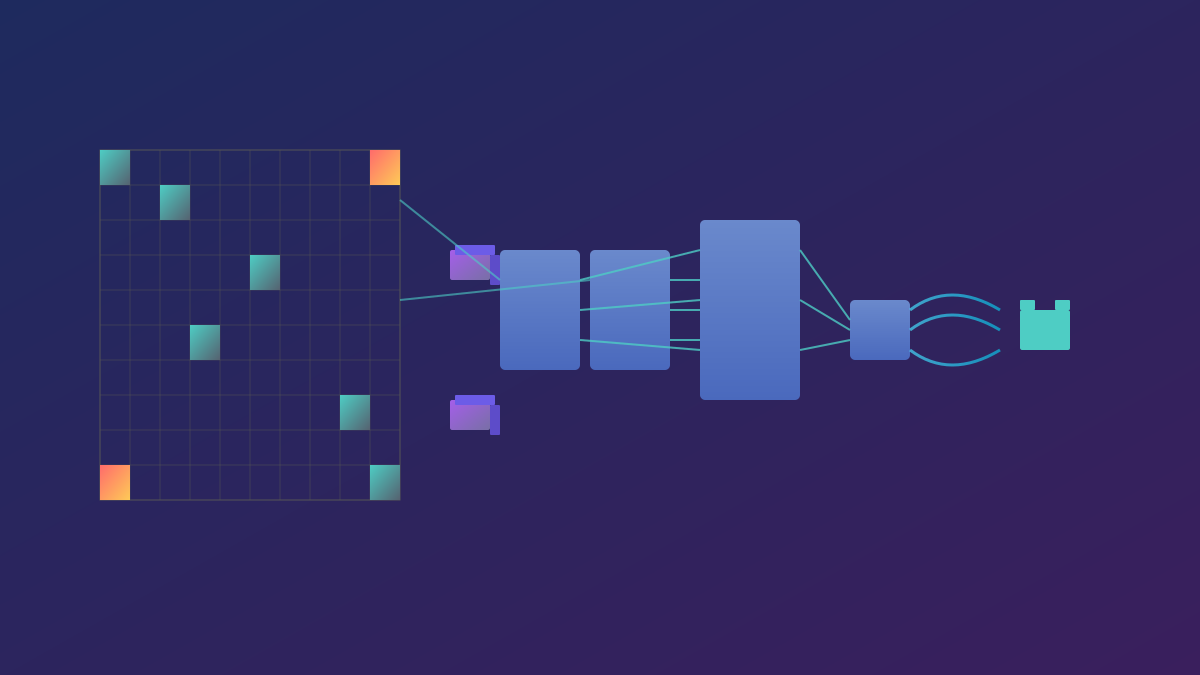
NeuMF merges GMF and MLP:

  • GMF: Generalized Matrix Factorization, captures linear user-item interactions via element-wise embedding multiplication.
  • MLP: Multi-Layer Perceptron, learns non-linear interactions via concatenated embeddings and FC layers.
  • Fusion: Concatenate GMF/MLP outputs, pass through FC layer then sigmoid for prediction scores.

Balances memory (GMF) and generalization (MLP) capabilities.

5

Section 05

Smart Mode Switch: Cold Start vs Personalized Recommendations

Auto-switch based on user interaction data:

  • Cold start: For new users/little data, uses hot lists, content similarity (Redis data).
  • Personalized: For users with enough data, uses PyTorch model inference (user profile + real-time computation).
  • Switch logic: Threshold-based (below → cold start, above → personalized).
6

Section 06

Stability Guarantees & Real-Time Data Feedback Loop

Stability: Resilience4j (150ms timeout → circuit break, fallback to hot lists), multi-level cache (Redis short-term, local, MySQL). Data loop: Kafka collects user behavior (online → Redis, offline → MySQL). Uses MovieLens 32M dataset with 1:4 sampling and Leave-One-Out split. Supports incremental training for model evolution.

7

Section 07

Deployment Steps & Project Insights

Deployment:

  1. Start infra via docker-compose.
  2. Initialize DB with schema.sql.
  3. Process data with data_processor.py.
  4. Train model to get model.pth.
  5. Start backend (mvn spring-boot:run) and frontend (npm run dev).

Takeaways: Demonstrates engineering best practices for production recommendation systems—architecture decoupling, cold start handling, stability mechanisms, and data closed loop. A valuable reference for developers.