Zing Forum

Reading

ml-decision-surfaces-lab: A Zero-Code Interactive Experiment Platform for Visualizing Machine Learning Decision Boundaries

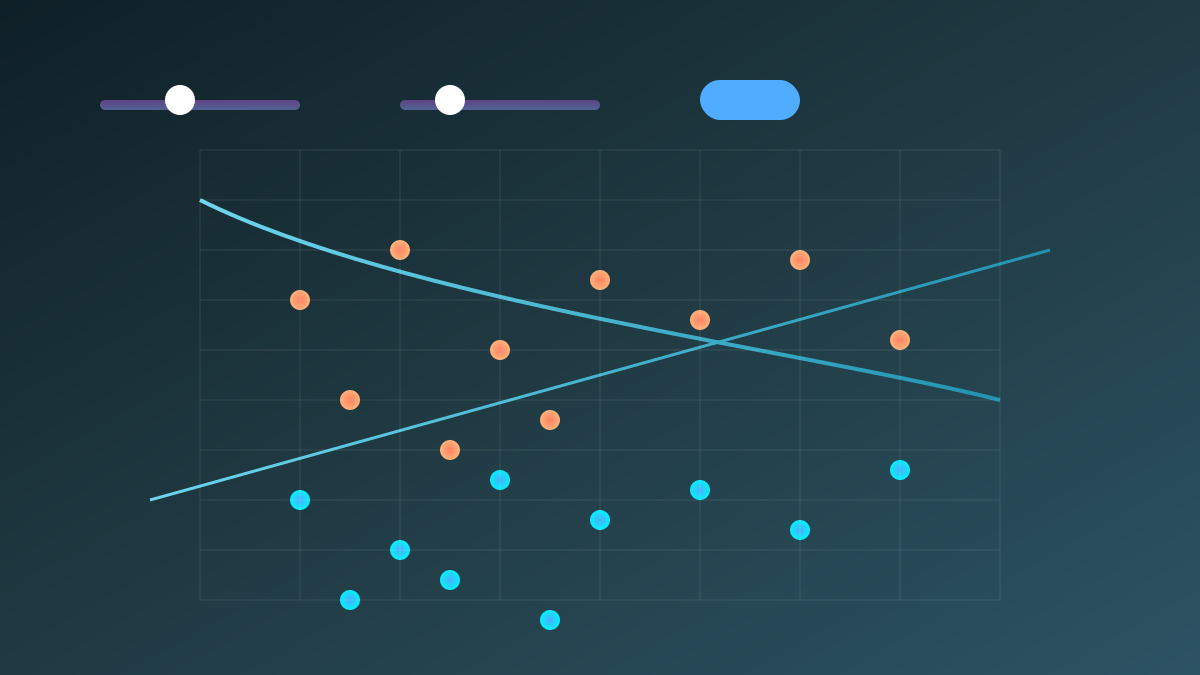
An open-source tool based on Gradio and scikit-learn that allows beginners to intuitively understand the decision boundaries and regression surfaces of algorithms like decision trees, SVM, and logistic regression without programming.

机器学习可视化决策边界教学工具Gradioscikit-learn零代码交互式学习
Published 2026-05-10 09:56Recent activity 2026-05-10 10:34Estimated read 5 min
ml-decision-surfaces-lab: A Zero-Code Interactive Experiment Platform for Visualizing Machine Learning Decision Boundaries
1

Section 01

ml-decision-surfaces-lab: Zero-Code Interactive Platform for ML Decision Boundary Visualization

This is an open-source tool based on Gradio and scikit-learn, designed to help beginners intuitively understand the decision boundaries and regression surfaces of machine learning algorithms (like decision trees, SVM, logistic regression) without writing any code. It addresses the 'black box' barrier faced by ML learners by providing an interactive visual experience.


2

Section 02

Background: The Black Box Problem in ML Learning

Machine learning algorithms' abstract nature often hinders beginners. Questions like how decision trees split data, where SVM's hyperplane lies, or why neural network boundaries are complex are hard to grasp. This project aims to solve this pain point by turning abstract concepts into visual, interactive experiences.

3

Section 03

Project Overview & Core Positioning

Created by developer dheepatel01, the project uses Gradio, scikit-learn, and Matplotlib. It follows the MIT open-source license and supports Windows, macOS, and Linux. Users can run it locally with pre-compiled packages (no setup needed), making it ideal for teaching, self-learning, and algorithm demos.

4

Section 04

Core Features: Interactive Visualization & Flexibility

  1. Decision Boundary Visualization: Supports algorithms like decision trees, SVM, logistic regression. Users can adjust parameters (e.g., SVM's C value, decision tree's max depth) to see real-time changes in boundaries.
  2. Regression Surface Exploration: Allows exploring regression tasks (linear, polynomial) and understanding bias-variance tradeoff via parameter adjustments.
  3. Dataset Support: Built-in classic datasets plus custom CSV uploads for personalized experiments.
5

Section 05

Educational Value & Application Scenarios

  • Classroom Teaching: Teachers can preset parameters for demos, invite student interaction, or export visuals for courseware.
  • Self-Learning: Provides a safe environment to focus on algorithm essence without code errors.
  • Algorithm Selection: Helps predict the suitability of linear models, the need for kernel tricks, or an algorithm's sensitivity to outliers in real projects.
6

Section 06

Technical Architecture & Extensibility

The tech stack includes Gradio (web interface), scikit-learn (algorithm backend), and Matplotlib (plotting). This design makes it easy for Python developers to extend: add new algorithms, customize visuals, or contribute via open-source community.

7

Section 07

Limitations & Future Outlook

Current limitation: Focuses on 2D feature space (hard to visualize high dimensions directly; uses low-dimensional projections for high-dimensional data). Future plans: Support PCA/t-SNE for high-dimensional data, add deep learning model exploration, animate training process, and include more metrics (ROC curves, confusion matrices).

8

Section 08

Conclusion & Project Link

ml-decision-surfaces-lab turns complex ML principles into intuitive visual experiences, lowering the learning barrier for AI talent. Whether you're a teacher, student, or practitioner, it's worth trying. Project link: https://github.com/dheepatel01/ml-decision-surfaces-lab

