Zing Forum

Reading

MADRE: A Model-Agnostic Delayed Reasoning Agent System Architecture

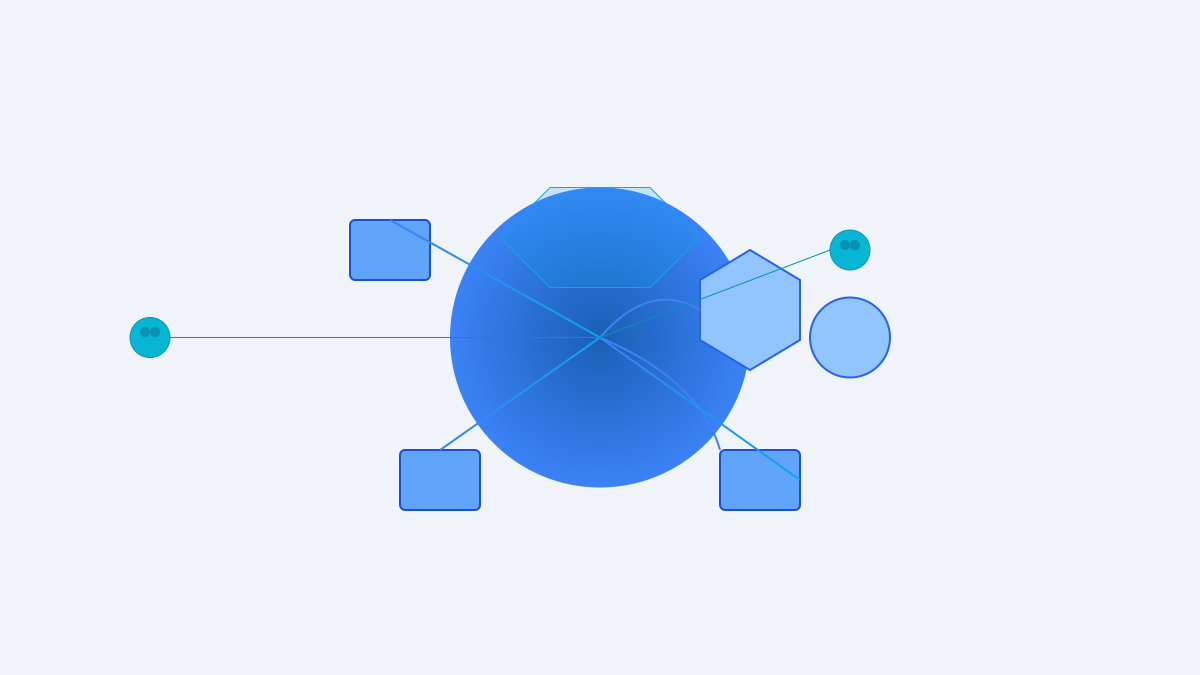
MADRE proposes a local-first agent runtime architecture that treats language models as replaceable components rather than the system core. It unifies the management of context, strategy, memory, learning, and auditing through a kernel to achieve secure, autonomous, and scalable agent behaviors.

智能体系统Agentic AI模型无关架构本地优先延迟推理LLM 架构AI 安全可观测性工具编排
Published 2026-05-24 23:23Recent activity 2026-05-24 23:50Estimated read 8 min
MADRE: A Model-Agnostic Delayed Reasoning Agent System Architecture
1

Section 01

MADRE: A Model-Agnostic Delayed Reasoning Agent System Architecture (Introduction)

MADRE is a local-first agent runtime architecture. Its core idea is to treat language models as replaceable components rather than the system core. It unifies the management of capabilities such as context, strategy, memory, learning, and auditing through a kernel to achieve secure, autonomous, and scalable agent behaviors. This article will introduce it from aspects like background, architecture, model agnosticism, and application scenarios.


2

Section 02

Background and Motivation: Pain Points in Current LLM Application Development

Current LLM application development often treats models as the core, relying on prompt engineering and fine-tuning to make models take on excessive responsibilities, leading to issues like unpredictable outputs, ambiguous security boundaries, difficult context management, and hard-to-audit behaviors. MADRE proposes a new idea: useful agent behaviors should come from software architecture rather than the model itself, repositioning models as replaceable runtime components.

3

Section 03

Core Architectural Concepts: Local-First and Seven Kernel-Managed Capabilities

MADRE adopts a local-first design and builds a governed agent kernel to manage the following key capabilities:

  1. Context Management: Proactively decide to retain, compress, or discard historical information
  2. Policy Execution: All actions must pass policy layer checks to ensure compliance with security rules and authorization
  3. Delayed Reasoning: Separate quick responses from deep thinking; integrate after deep reasoning is completed in the background
  4. Memory and Knowledge Management: Support short-term working memory and long-term knowledge storage to maintain session coherence
  5. Tool Execution and Orchestration: The kernel orchestrates tool calls based on goals and context to reduce the risk of misoperations
  6. Observability and Auditing: Record all state changes, decision paths, and tool calls to form a complete audit trail
  7. Recovery Mechanism: Trigger recovery processes when anomalies are detected, roll back to a safe state, or request user intervention
4

Section 04

Significance of Model Agnosticism: Advantages of Flexibility and Openness

The model-agnostic feature of MADRE is a key advantage. By abstracting models as pluggable components, the system can:

  • Flexibly switch models: Switch based on task requirements, cost, or availability
  • Avoid vendor lock-in: Do not rely on the API or unique capabilities of a specific model
  • Progressive upgrade: Upgrade models by replacing the runtime layer without reconstructing the system
  • Multi-model collaboration: Call the most suitable model for different subtasks to achieve heterogeneous collaboration
5

Section 05

Runtime Contracts and Extensibility: Ensuring System Security and Scalability

MADRE defines clear runtime contracts to standardize interactions between the kernel and models, tools, and storage backends:

  • Security Contract: Define authentication, permission checks, and data isolation standards
  • Autonomy Contract: Standardize decision boundaries without human intervention
  • Extension Contract: Provide a plugin mechanism that allows adding custom tools, storage backends, and policy rules
6

Section 06

Application Scenarios: Suitable for Enterprise-Grade and Long-Running Systems

The MADRE architecture is particularly suitable for the following scenarios:

  1. Enterprise-grade agent applications: Require strict security auditing, compliance requirements, and fault recovery
  2. Long-running autonomous systems: Such as monitoring agents, automated workflow coordinators
  3. Multi-tenant SaaS platforms: Kernel-level isolation and policy execution support multi-tenancy
  4. Edge deployment: Local-first design is suitable for resource-constrained edge devices
7

Section 07

Technical Implementation: Code Structure and Open Source License

The MADRE project code structure includes key modules:

  • agents/: Agent implementations showing how to build applications on the kernel
  • devboard/: Development panel for debugging and monitoring runtime status
  • docs/tex/: Authoritative technical specification documents written in LaTeX
  • AGENTS.md: Agent development guide The project uses the GPL-3.0 open source license and is committed to building an open agent ecosystem.
8

Section 08

Industry Insights and Conclusion: Paradigm Shift from Model-Centric to Architecture-Centric

MADRE represents a paradigm shift: from "model-centric" to "architecture-centric". Insights for the industry:

  • Do not over-rely on model intelligence: Clear architectural constraints are needed, and responsibilities like security and auditing should be delegated to specialized software layers
  • Emphasize observability: In production environments, the reason for a decision is more important than the result
  • Design for failure: Agent systems will fail; the key is to recover gracefully and maintain user trust Conclusion: MADRE provides a reliable agent architecture blueprint, emphasizing robust software engineering practices, laying the foundation for next-generation agent applications. Its documents and code are worth in-depth study by developers.

