Zing 论坛

正文

世界模型演进史:从符号推理到自主智能体的范式跃迁

本文深入解析世界模型在自主智能体架构中的核心地位,梳理从显式符号模型到潜空间神经动力学,再到大语言模型驱动系统的三代范式演进,揭示物理基础缺失对当前系统的结构性制约。

世界模型自主智能体大语言模型符号推理潜空间表征物理基础认知架构范式演进
发布时间 2026/05/09 18:14最近活动 2026/05/09 18:18预计阅读 7 分钟
世界模型演进史:从符号推理到自主智能体的范式跃迁
1

章节 01

World Model Evolution: From Symbolic Reasoning to Autonomous Agents—A Paradigm Shift

The article delves into the core position of world models in autonomous agent architectures,梳理 the three-generation paradigm evolution from explicit symbolic models to latent space neural dynamics and then to large language model-driven systems, and reveals the structural constraints of current systems due to the lack of physical foundations. The GitHub open-source project "World-Model-with-Autonomous-Agent" offers a systematic perspective to understand the deep meaning of related issues.


2

章节 02

Why World Models Are Critical for Autonomous Agents

In cognitive science, world models are the core cognitive architecture for agents to understand the environment, predict the future, and make decisions. However, current mainstream LLM-based agent systems lack a solid physical foundation—they excel at handling symbols and text but have little knowledge of the causal mechanisms of the physical world. This "lack of physical foundation" is not a technical detail but a structural constraint, making pure statistical pattern matching insufficient to handle physical constraints, spatial relationships, and dynamic changes when interacting with the real world.

3

章节 03

First & Second Generation World Models: Symbolic and Latent Neural

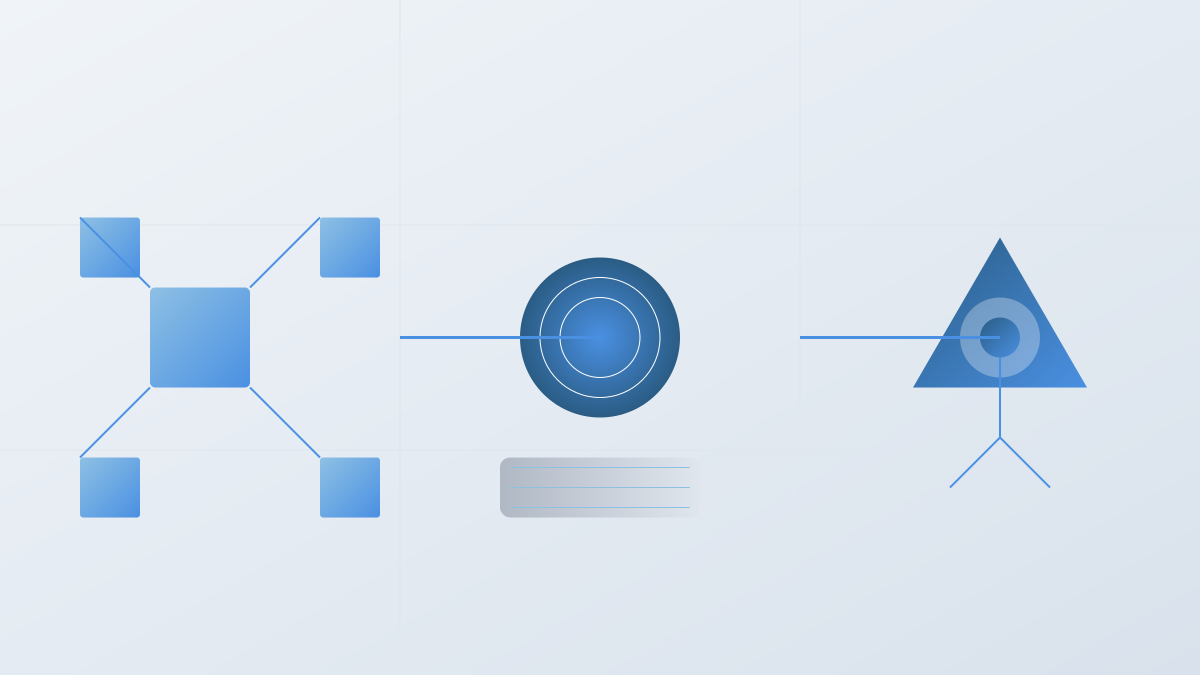
The project divides world model development into three main paradigms. First generation: Explicit symbolic world models—early AI systems relied on manually constructed symbolic representations and rule mappings (logical predicates, semantic networks, production rules). Advantages: high interpretability; limitations: knowledge acquisition bottleneck, difficulty handling uncertainty, fragility in open worlds. Second generation: Latent space neural world models—using encoder-decoder architectures to compress high-dimensional observations into low-dimensional latent spaces and learn state transition dynamics. Representatives: World Models (Ha & Schmidhuber,2018), PlaNet (Hafner et al.,2019), Dreamer series. Advantages: continuity and differentiability enabling gradient-based optimization; limitation: latent space is a "black box" with poor interpretability.

4

章节 04

Third Generation: Discrete Semantic World Models with LLMs

The cutting-edge direction combines large pre-trained language models with world modeling. Discrete semantic world models use tokenization to convert continuous experiences into discrete symbols while retaining neural network representation learning capabilities, aiming to fuse the interpretability of symbolic methods and the expressive power of neural methods. LLM-based agents like ReAct, Reflexion, and Generative Agents show great potential but raise a key question: do language models truly build internal world models or just perform complex pattern matching?

5

章节 05

Core Inquiry: Statistical Pattern Matching or Real Understanding?

The project raises a critical question: Are modern language-based agents really building internal world models, or are they merely driven by large-scale statistical patterns? Empirical studies provide mixed evidence: on one hand, LLMs exhibit amazing common sense reasoning and causal inference abilities; on the other hand, they still have obvious defects in physical intuition, spatial reasoning, and long-term planning. This suggests current systems may have a form of "weak world model" but are far from human-level physical understanding.

6

章节 06

Experimental Validation: From Theory to Practice

The project conducts small-scale experimental verification by reconstructing simplified scenarios inspired by "Generative Agents". The experiments focus on core issues of representation evolution: how different generations of agents define "intelligence" and how their internal representations differ when solving the same tasks. By comparing symbolic systems, latent space models, and LLM-based systems in the same environment, researchers can better understand the pros and cons of each paradigm.

7

章节 07

Future Directions: Toward Agents with Physical Foundations

The project points out key future research directions: 1) Strengthening physical foundations—explicitly integrating physical engines, geometric reasoning, and causal inference mechanisms into agent architectures; 2) Unifying representations—exploring how to fuse the interpretability of symbols, continuity of latent spaces, and richness of semantic representations into a unified framework;3) Innovating evaluation methods—developing strict test benchmarks that distinguish "true understanding" from "pattern matching". The evolution from symbolic to neural to hybrid architectures is not a simple replacement but a process of mutual learning and integration.

