Zing Forum

Reading

Multi-Agent LLM Education System: Intelligent Generation of Adaptive Multimodal Learning Content

Exploring how to use multi-agent architecture and large language models to build a personalized, adaptive educational content generation system

multi-agentLLMeducationadaptive learningmultimodalAI tutoring
Published 2026-05-22 12:36Recent activity 2026-05-22 12:52Estimated read 9 min
Multi-Agent LLM Education System: Intelligent Generation of Adaptive Multimodal Learning Content
1

Section 01

[Introduction] Multi-Agent LLM Education System: A New Paradigm for Adaptive Multimodal Learning Content Generation

This article explores the use of multi-agent architecture and large language models (LLM) to build a personalized and adaptive educational content generation system, aiming to solve the problem that the traditional "one-size-fits-all" teaching model is difficult to meet the personalized needs of learners. The core of the system is a cluster of intelligent agents with specialized division of labor and collaboration, supporting multimodal content generation and dynamic difficulty adjustment, covering the entire process from curriculum planning to motivation maintenance, and providing a new paradigm for educational intelligence.


2

Section 02

The Era Background of Educational Intelligence

The education field is undergoing an AI-driven transformation. Traditional teaching models cannot balance learners' knowledge backgrounds, learning styles, and cognitive rhythms. LLM brings possibilities for personalized education, but a single model is unable to cope with the complexity of educational scenarios (needs in multiple links such as content generation, assessment, and emotional support). Multi-agent systems, with their characteristics of specialized division of labor and collaboration, have become a key opportunity to solve this problem.

3

Section 03

Core Architecture of the Project: Design and Collaboration Mechanism of Specialized Agents

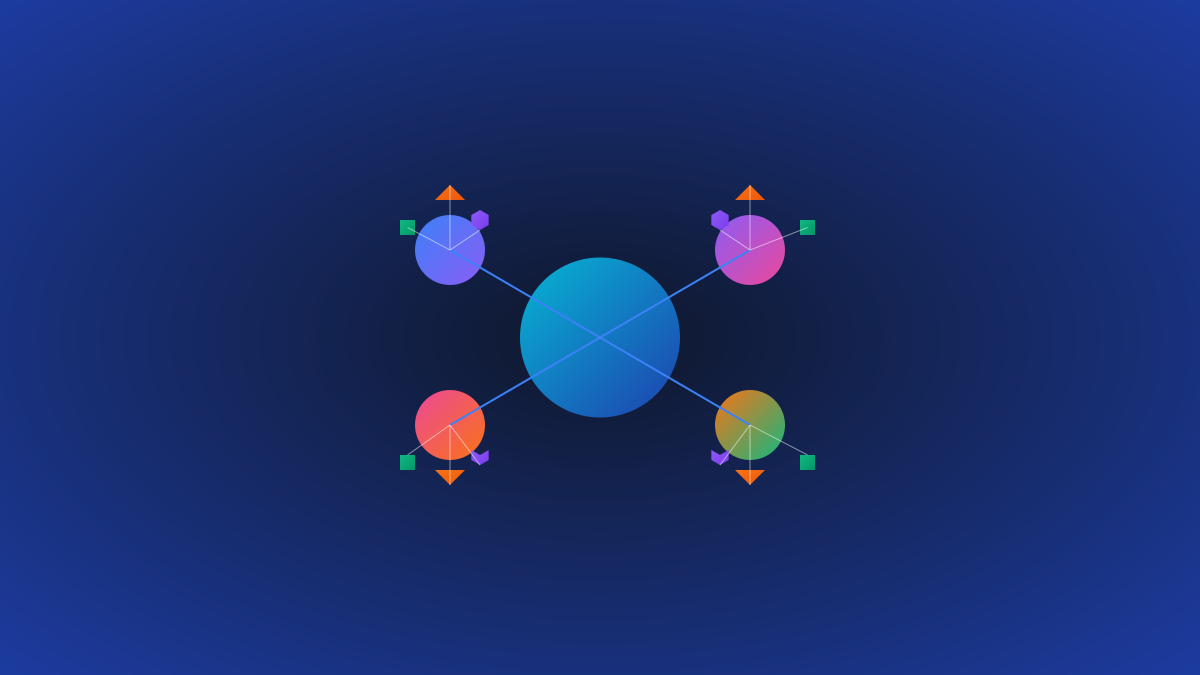
The project adopts the design concept of "specialized division of labor and collaborative work" to build a multi-agent collaboration framework:

Agent Roles

  • Curriculum Planner: Analyzes learners' goals and levels to formulate phased learning plans
  • Content Generator: Creates teaching materials (formulas, examples, dialogue scenarios, etc.) based on subject characteristics
  • Multimodal Designer: Converts text into multimodal forms such as schematic diagrams, interactive charts, and video scripts
  • Difficulty Adjuster: Monitors learning performance data (correct rate, dwell time, etc.) and dynamically adjusts content difficulty
  • Learning Assessor: Builds multi-dimensional ability profiles and identifies strengths and weaknesses
  • Motivation Maintainer: Monitors emotional states and provides encouragement or gamified elements to maintain engagement

Collaboration Mechanisms

  • Message Bus Architecture: Asynchronous communication decouples component dependencies
  • Consensus Decision: Key adjustments require consensus from relevant agents
  • Conflict Resolution: Meta-agent arbitrates disputes
  • Memory Sharing: All agents share long-term learner profiles
4

Section 04

Technical Implementation Highlights: Multimodal Generation and Adaptive Algorithms

Multimodal Content Generation

  • Text to Image: Generates visual explanations for abstract concepts
  • Code to Visualization: Converts mathematical formulas/data into interactive charts
  • Speech Synthesis: Generates audio readings for learning materials
  • Video Script Planning: Designs short video storyboards and voiceovers

Adaptive Algorithms

  • Knowledge Graph Tracking: Ensures progression only after prerequisite knowledge is mastered
  • Forgetting Curve Modeling: Arranges reviews at optimal time points
  • Learning Style Recognition: Judges visual/auditory/hands-on types by analyzing interaction patterns

Feedback Loop

  1. Deliver content to learners
  2. Collect interaction data (clicks, answers, expressions, etc.)
  3. The assessor updates the learner's profile
  4. The adjuster modifies subsequent content
  5. The generator creates new personalized materials
5

Section 05

Application Scenarios and Value: From Personalized Tutoring to Lifelong Learning

Personalized Tutoring

Provides 7x24 targeted tutoring for learners, applicable to scenarios such as resource scarcity in remote areas, fragmented learning for adults, and customized support for special needs

Corporate Training

Quickly generates job training content, dynamically adjusts plans, and reduces training costs

Language Learning

Multimodal comprehensive training (text, audio, images, dialogue) to simulate an immersive environment

Lifelong Learning Platform

Builds intelligent infrastructure to support on-demand personal learning assistants

6

Section 06

Challenges and Reflections: Ethics, Technical Limitations, and Human-AI Collaboration

Educational Ethics

  • Data Privacy: Learning data is sensitive and needs enhanced protection
  • Algorithm Bias: Biases in training data may be amplified
  • Over-Reliance: Need to avoid learners losing independent thinking ability

Technical Limitations

  • Hallucination Problem: LLM may generate incorrect content, which is high-risk in educational scenarios
  • Emotional Understanding: Recognition of learners' emotional states is rough
  • Creativity Cultivation: Standardized content may stifle creativity

Human-AI Collaboration

Design a "teacher dashboard" to allow human teachers to monitor AI decisions and intervene at key nodes, realizing AI empowerment rather than replacing teachers

7

Section 07

Future Outlook and Conclusion: The Infinite Possibilities of AI-Enabled Education

Future Outlook

  1. Embodied Intelligence Integration: Combine with robot hardware to support physical interactive teaching
  2. VR Integration: VR environments enable immersive scenario-based learning
  3. Group Learning Optimization: Extend to intelligent support for group collaborative learning
  4. Interdisciplinary Fusion: Build problem-oriented interdisciplinary learning experiences

Conclusion

The multi-agent LLM education system represents a new paradigm for AI education applications—from single models to collaborative systems, text to multimodal, uniform content to adaptive personalization. This is not only technological progress but also an innovation in educational concepts: cultivating critical thinking, creativity, and lifelong learning ability is the ultimate mission. This open-source project welcomes more people to join in exploring the possibilities of AI-enabled education.

