Zing Forum

Reading

LLM Dashboard: A Comprehensive Platform for Debugging and Performance Monitoring of Local Large Language Models

llm-dashboard is a debugging and monitoring dashboard designed specifically for local large language models (LLMs). It offers features such as instruction-following testing, tool call validation, token usage tracking, generation speed monitoring, and context window analysis, helping developers comprehensively evaluate and optimize the performance of local LLMs.

大语言模型本地部署性能监控调试工具Token用量上下文窗口工具调用
Published 2026-05-15 10:25Recent activity 2026-05-15 10:31Estimated read 9 min
LLM Dashboard: A Comprehensive Platform for Debugging and Performance Monitoring of Local Large Language Models
1

Section 01

[Introduction] LLM Dashboard: A One-Stop Solution for Debugging and Monitoring Local Large Language Models

LLM Dashboard is an open-source project created by developer aman2025, providing a comprehensive debugging and performance monitoring platform for local large language models. This tool integrates core features like instruction-following testing, tool call validation, token usage tracking, generation speed monitoring, and context window analysis. It addresses operational challenges in local LLM deployment, helps developers comprehensively evaluate and optimize model performance, and fills the gap in the ecosystem of debugging and monitoring tools for local LLMs.

2

Section 02

Operational Challenges in Local LLM Deployment

With the development of open-source large language models, local deployment offers advantages in data privacy, cost control, and customization flexibility, but it also faces new challenges: How to ensure model outputs meet expectations? How to evaluate performance? How to monitor resource consumption and generation efficiency? Compared to cloud APIs, the ecosystem of debugging and monitoring tools for local LLMs is immature. Developers need to write a lot of test code, collect metrics manually, leading to fragmented workflows with low efficiency, easy-to-miss issues, and difficulties in troubleshooting in production environments.

3

Section 03

Project Overview and Design Philosophy of LLM Dashboard

llm-dashboard is an open-source project aimed at providing a one-stop debugging and monitoring solution for local LLMs, covering the complete demand chain from basic capability testing to in-depth performance analysis. Its design philosophy emphasizes practicality and operability, focusing on the model's performance in real application scenarios (key indicators like instruction understanding, tool call reliability, generation latency) rather than academic benchmark rankings.

4

Section 04

Analysis of Core Features: From Instruction Testing to Context Evaluation

Instruction-Following Capability Testing

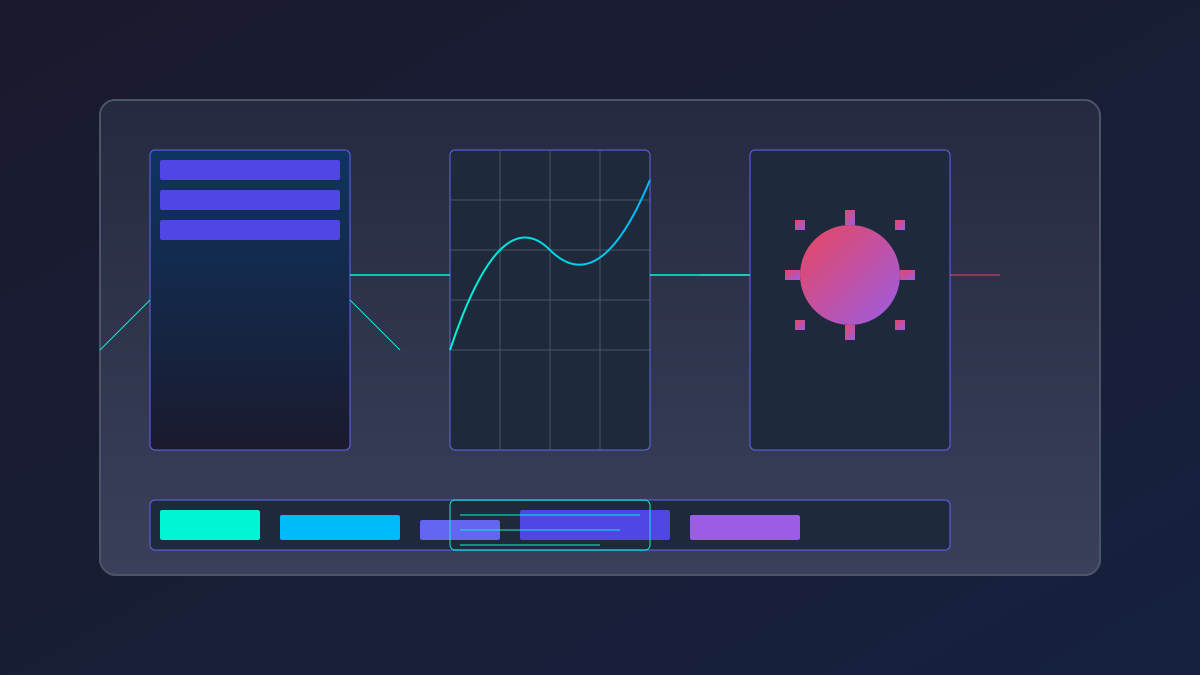
Provides a structured testing framework to verify the model's ability to understand and execute simple, compound, or constrained instructions. Results are visualized with success rates, error patterns, and cases, helping to adjust prompts or fine-tune the model in a targeted manner.

Tool Call Validation

Supports custom tool sets to test the model's ability in tool selection, parameter filling, and call sequence planning. It validates grammatical correctness and semantic understanding, helping to identify issues before deploying Agent systems and automated workflows.

Token Usage Monitoring

Real-time tracking of input and output token counts, calculation of cost equivalents, and multi-dimensional aggregate analysis (by model, time period, task type) to identify consumption hotspots and anomalies, optimizing prompts or parameters.

Generation Speed Analysis

Measures first-token latency and generation speed (Tokens per Second), records environmental factors (hardware load, concurrent requests), establishes performance baselines, and supports decision-making for real-time interaction scenarios.

Context Window Evaluation

Tests performance stability under different context lengths (long-distance dependencies, middle information forgetting, text coherence), uses a progressive pressure strategy to determine the actual usable boundaries of the model.

5

Section 05

Technical Implementation: Modular and Scalable Design

The architecture embodies modularity and scalability: The core engine connects to multiple inference backends (Ollama, llama.cpp, vLLM, etc.) with an abstracted unified interface layer; the frontend uses modern web technologies to build a responsive visualization interface; data persistence supports local storage and database backends; the plugin mechanism allows community contributions to extend functions and enrich the platform's capability boundaries.

6

Section 06

Application Scenarios: Covering Researchers, Developers, and Enterprise Teams

  • Model Researchers: Standardized evaluation environment to reproduce experimental results, compare model versions, and validate improvement effects with custom test sets.
  • Application Developers: Provides comparative data during model selection, accelerates problem localization during debugging, and supports capacity planning and anomaly warning during operation.
  • Enterprise IT Teams: Centralized monitoring view to grasp the status of deployed models, identify performance bottlenecks and resource waste, and provide data basis for hardware procurement.
7

Section 07

Limitations and Future Development Directions

Limitations: The current version is mainly for technical users, and the friendliness for non-developers needs to be improved; the preset test sets cover common scenarios, but professional tasks in vertical fields require user expansion.

Future Outlook: Introduce automated regression testing mechanisms; integrate A/B testing frameworks; develop mobile adaptation; explore integration with CI/CD processes to include LLM testing in standard software delivery links.

8

Section 08

Conclusion: Filling the Gap in Local LLM Operation Tools

llm-dashboard integrates scattered debugging tasks into a systematic workflow, converting subjective experiences into objective quantitative indicators. It is an indispensable observability tool for the production deployment of local LLMs. The project demonstrates the innovation capability of the open-source community in the AI infrastructure field and provides important support for the healthy development of the local AI ecosystem.


