Zing Forum

Reading

Deterministic Reflection Tree: A Psychological Decision Modeling System Without LLM

DT-Reflection-Tree achieves deterministic modeling of human reflection behaviors through JSON decision trees and rule engines. It generates structured psychological reflection paths without large models, providing a traceable decision support tool for mental health and self-awareness.

决策树心理健康确定性系统规则引擎自我反思心理学JSON配置无LLM
Published 2026-04-29 22:04Recent activity 2026-04-29 22:19Estimated read 5 min
Deterministic Reflection Tree: A Psychological Decision Modeling System Without LLM
1

Section 01

[Introduction] Deterministic Reflection Tree: A Psychological Decision Modeling System Without LLM

DT-Reflection-Tree is a psychological decision modeling system that does not require large language models (LLM). It achieves deterministic modeling of human reflection behaviors through JSON decision trees and rule engines, generating structured reflection paths and providing a traceable and interpretable decision support tool for mental health and self-awareness.

2

Section 02

Project Background and Philosophy

Most current intelligent systems rely on LLM, but the unpredictability and black-box nature of LLM are disadvantages in fields requiring interpretable, repeatable, and deterministic outputs. DT-Reflection-Tree proposes using purely rule-driven decision trees to simulate reflection, abandoning randomness to achieve fully predictable and traceable psychological decision modeling. This counter-trend design has unique value in specific scenarios.

3

Section 03

Core Design and Technical Architecture

The model is built based on three psychological dimensions: Locus (sense of control: Victim/Victor), Orientation (contribution orientation: Contribution/Entitlement), and Radius (scope of attention: Self/Others). These three combine to form a 3×3 decision space. Technically, a JSON decision tree (reflection-tree.json) is used to store predefined questions, options, and branches, and a rule engine calculates the path to ensure the output is completely deterministic and the process is transparent and interpretable.

4

Section 04

Comparative Analysis with LLM Solutions

Differences: 1. Determinism: Consistent output for the same input vs. randomness in LLM; 2. Privacy: Local processing without external APIs vs. potential data transmission to external parties; 3. Cost: No API fees vs. call costs. Limitations: Rule engines have low flexibility, cannot handle open-ended inputs, and their intelligence is limited by manual rules. However, they ensure output quality and consistency in structured scenarios.

5

Section 05

Applicable Scenario Analysis

Applicable to daily reflection journaling, decision support, team building (understanding members' thinking), and psychological counseling assistance (structured assessment framework). The deterministic feature is suitable for research data collection, ensuring consistent decision-making processes among participants and facilitating comparison and tracking.

6

Section 06

System Scalability and Customization Methods

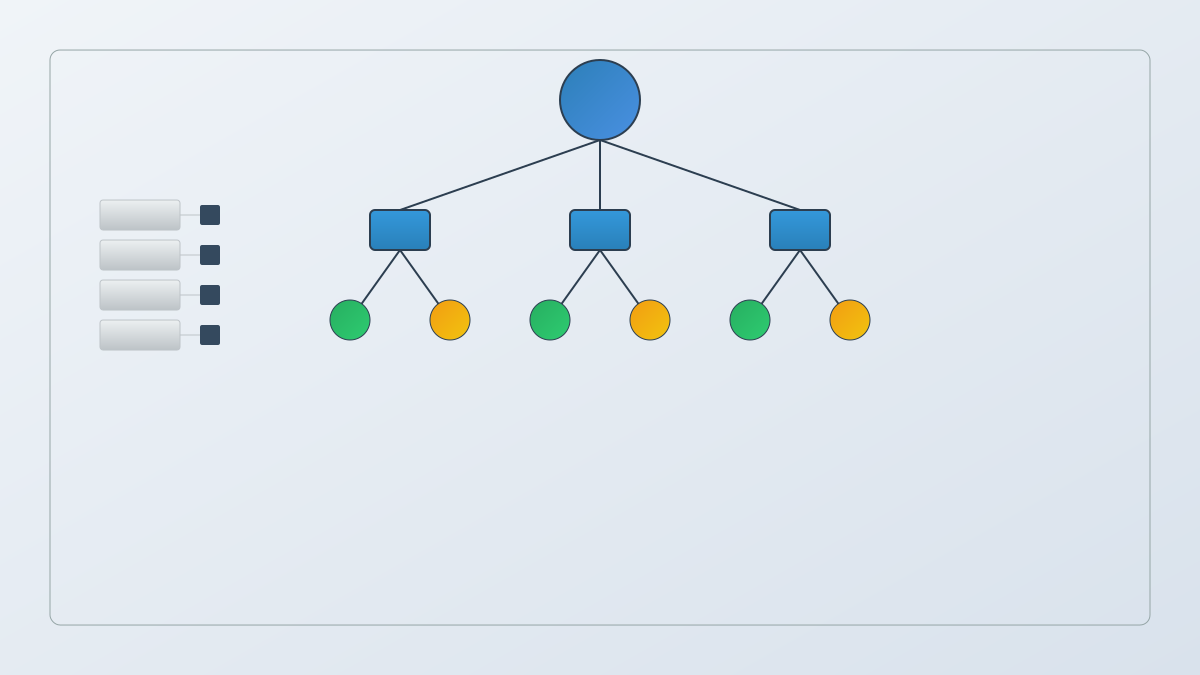
The JSON configuration design simplifies customization. Modifying reflection-tree.json allows adjusting questions, options, and branches without changing code. Non-technical personnel (e.g., psychology experts) can directly edit the JSON to create new dimensions or paths. A tree-diagram.png is provided to visualize the decision tree, and write-up.md records design details to assist in understanding and expansion.

7

Section 07

Design Philosophy and Insights

Technology selection should be based on scenario needs rather than trends. In scenarios requiring determinism, interpretability, and privacy protection, rule engines are more suitable than LLM. Simplicity does not equal backwardness; determinism is more valuable than intelligence in specific scenarios. For developers, this is a case of weighing technical solutions, demonstrating how to implement valuable functions with a simple technology stack.