Zing Forum

Reading

LLaDA2.0-Uni: A Diffusion-based Large Language Model for Unified Multimodal Understanding and Generation

This article introduces LLaDA2.0-Uni, a discrete diffusion diffusionusion large language model that nnatively integrates multimodal understandinganding and generation capabilities, achieving unified processing of text and visual content through the SigLIP-VQ visual tokenizer and MoE architecture.

多模态模型扩散模型大语言模型视觉理解图像生成MoE架构统一架构人工智能
Published 2026-04-23 01:20Recent activity 2026-04-23 20:23Estimated read 5 min
LLaDA2.0-Uni: A Diffusion-based Large Language Model for Unified Multimodal Understanding and Generation
1

Section 01

LLaDA2.0-Uni: A Unified Diffusion LLM for Multimodal Understanding & Generation (Introduction)

This post introduces LLaDA2.0-Uni, the first discrete diffusion large language model (dLLM) that natively integrates multimodal understanding and generation capabilities. It addresses the long-standing challenge of separate architectures in traditional multimodal models by using SigLIP-VQ visual tokenizer and MoE architecture to unify text and visual processing, marking a breakthrough in unified multimodal AI.


2

Section 02

Background: Challenges in Multimodal AI

Multimodal AI has been a frontier research hotspot, but the challenge of building a single model that can understand images, generate high-quality images, and maintain deep text comprehension has persisted. Traditional solutions use separate architectures—visual encoder for understanding, diffusion model for generation—connected by complex adapters, increasing system complexity and limiting deep cross-modal fusion.

3

Section 03

Core Architecture: Three Innovative Components

LLaDA2.0-Uni's architecture consists of three key parts:

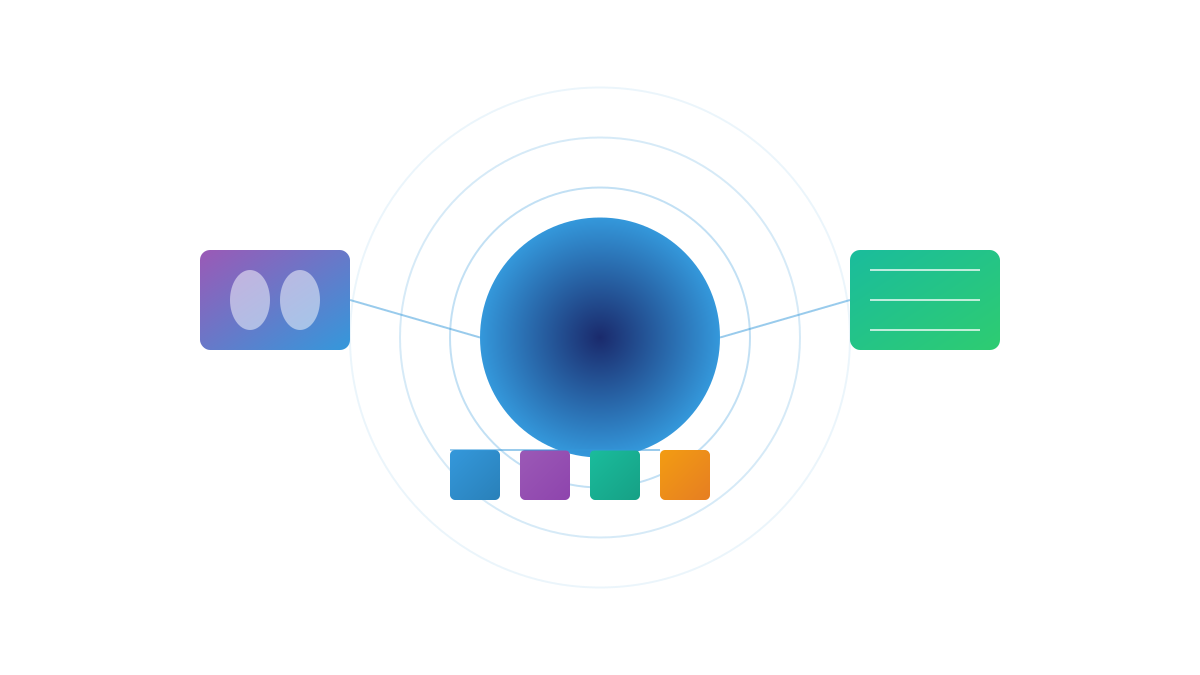
  1. SigLIP-VQ Visual Tokenizer: Converts continuous visual inputs into discrete semantic tokens while preserving high-level image semantics, enabling interaction with text tokens in a unified space.
  2. MoE-based Diffusion LLM Backbone: Uses Mixture of Experts (MoE) for sparse activation (expanding capacity without extra inference cost) and diffusion model (parallel token prediction for better efficiency).
  3. Diffusion Decoder: Uses few-step distillation to reduce inference steps while maintaining high-quality image generation from discrete tokens.
4

Section 04

Unified Processing of Text & Visual Content

LLaDA2.0-Uni unifies text and visual tokens in the same discrete space, allowing natural handling of interleaved multimodal content (e.g.,图文混排 documents). It uses Block-Level Masked Diffusion: random masking of input tokens (text for language modeling, visual for image reconstruction) to jointly optimize both tasks, promoting cross-modal knowledge transfer.

5

Section 05

Training Strategy: Progressive Multistage Learning

The model is trained in three stages:

  1. Single-modal Pretraining: On large text (web, books) and visual (LAION) datasets to build basic understanding.
  2. Multimodal Alignment: On image-text paired data (including high-quality instruction-following data) to link visual semantics with language concepts.
  3. Interleaved Generation Fine-tuning: On complex data (图文混排, multi-turn dialogue, visual reasoning) to enhance practical application ability.
6

Section 06

Performance: Leading in Multimodal Tasks

LLaDA2.0-Uni achieves strong results:

  • Understanding Tasks: Visual question answering, image captioning, visual reasoning (on par with top dedicated VLMs).
  • Generation/Editing Tasks: Text-to-image, image inpainting, style transfer, semantic editing (e.g., replacing a cat with a dog while keeping pose/lighting). Its unified understanding and generation enable context-aware intelligent edits.
7

Section 07

Applications, Limitations & Future Directions

Applications: Intelligent content creation, interactive visual assistants, multimodal education tools, creative design prototyping. Limitations: Focuses on image/text only (needs expansion to audio/video/3D), high computation cost (lightweight versions for edge devices needed). Future: Enhance causal reasoning (physical, temporal), expand to more modalities, optimize for edge deployment.

