Zing Forum

Reading

Juniper Canopy: Real-Time Monitoring and Diagnostic Dashboard for CasCor Neural Network Training

Introducing the Juniper Canopy project, a real-time monitoring and diagnostic dashboard designed specifically for CasCor neural network training, helping developers visualize the training process, diagnose issues, and optimize model performance.

CasCor神经网络实时监控训练可视化级联相关深度学习机器学习诊断工具仪表盘
Published 2026-05-21 15:44Recent activity 2026-05-21 15:58Estimated read 9 min
Juniper Canopy: Real-Time Monitoring and Diagnostic Dashboard for CasCor Neural Network Training
1

Section 01

Introduction to the Juniper Canopy Project: A Real-Time Monitoring and Diagnostic Tool for CasCor Neural Networks

Juniper Canopy is a real-time monitoring and diagnostic dashboard designed specifically for CasCor (Cascade-Correlation) neural network training. It aims to address the special needs that traditional visualization tools (such as TensorBoard) cannot meet during CasCor training, helping developers visualize dynamically changing network architectures, track key training metrics (like the correlation between candidate neurons and residual errors), diagnose overfitting or convergence issues, and optimize model performance. This tool fills the gap in the field of CasCor training monitoring, providing an intuitive training window for educators, researchers, and practitioners.


2

Section 02

The Black Box Dilemma in CasCor Neural Network Training and the Need for Tools

Training deep neural networks often faces the 'black box' dilemma. As a unique cascade-correlation neural network, CasCor's training mechanism (adding neurons layer by layer, two-level learning strategy, no backpropagation) is significantly different from traditional CNNs or Transformers. Traditional tools (like TensorBoard) cannot support CasCor's dynamic architecture changes and correlation monitoring needs, making it difficult for developers to track key metrics during training (such as residual error correlation). Therefore, a specialized monitoring and diagnostic tool is needed—this is the background behind the birth of Juniper Canopy.

3

Section 03

CasCor Neural Networks: Analysis of Dynamic Architecture and Two-Level Learning Strategy

CasCor was proposed by Scott Fahlman and Christian Lebiere in 1990. It features dynamically growing architecture (adding hidden neurons layer by layer), a two-level learning strategy (fixing input weights while training output weights; candidate neurons maximizing correlation with residual errors), and no need for backpropagation. Its training process includes iterative steps such as the initial phase (direct input-output training), adding candidate neurons, training candidates (maximizing correlation), selecting the best candidate, and retraining the output layer. Advantages include automatic determination of network size, fast training speed, and no gradient vanishing problem; limitations include easy overfitting, complex structure, and low efficiency for large-scale datasets.

4

Section 04

Juniper Canopy Design Philosophy: Targeted Solutions for CasCor Monitoring Needs

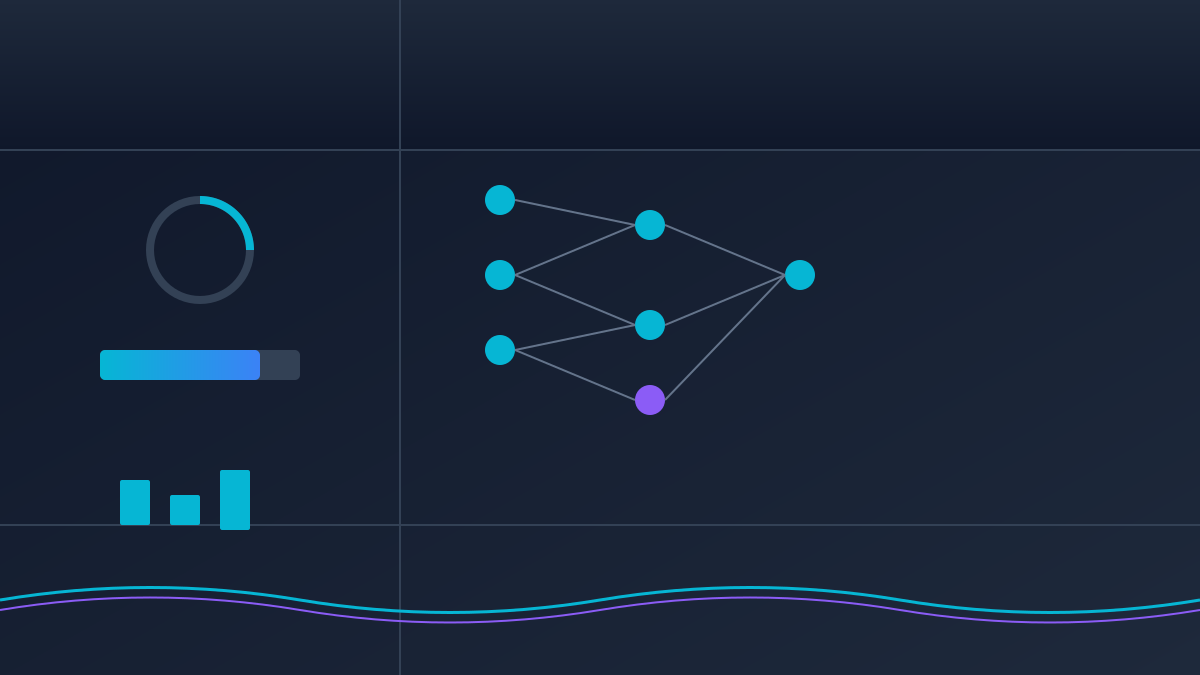
Juniper Canopy's design addresses CasCor's special monitoring needs: dynamic architecture visualization, correlation tracking, multi-level training state monitoring, and early diagnosis. Design goals include real-time performance (sub-second latency), intuitiveness (visualization of complex processes), interactivity (pause/adjust parameters), and extensibility (support for CasCor variants). Core functions cover real-time training monitoring (loss curves, correlation tracking, network structure visualization), diagnostic functions (overfitting detection, convergence analysis, neuron quality evaluation), and hyperparameter tuning assistance (recommendations for candidate pool size, correlation threshold, maximum number of neurons).

5

Section 05

Juniper Canopy Technical Architecture: Frontend-Backend and Deployment Solutions

The frontend uses React/Vue.js to build the interface, with D3.js/Cytoscape.js (network graphs) and Chart.js/Plotly.js (line charts) for visualization, and WebSocket for real-time communication. The backend implements the CasCor algorithm in Python (using NumPy/PyTorch for numerical computation, optional GPU acceleration), adopts an event-driven architecture to push training metrics, and provides RESTful APIs (for historical data) and WebSocket APIs (for real-time push). Deployment methods support local mode (single-machine debugging), server mode (remote distributed monitoring), and Jupyter integration (seamless workflow).

6

Section 06

Application Scenarios of Juniper Canopy and Comparison with Other Tools

Application scenarios include teaching demonstrations (visualizing network growth and correlation learning), research experiments (rapid iteration of configurations and collection of statistical data), and practical applications (embedded prototypes, real-time decision systems). Comparison with TensorBoard: Juniper Canopy is designed specifically for CasCor, supporting dynamic architecture and correlation monitoring; comparison with Weights & Biases: Juniper Canopy is open-source and free, supports local deployment, has stronger real-time performance, and requires no account. The two can complement each other in hybrid architecture scenarios.

7

Section 07

Current Limitations and Future Development Directions of Juniper Canopy

Current limitations include limited framework support (mainly Python), scale constraints (for small to medium-sized problems), and narrow function scope (only for CasCor). Future directions: architecture expansion (support for variants like Recurrent CasCor), intelligence (automatic hyperparameter recommendation, anomaly detection), collaboration features (experiment sharing, team collaboration), and performance optimization (large-scale data streaming, GPU acceleration, distributed training).

8

Section 08

Value of Juniper Canopy and Future Outlook for CasCor

Juniper Canopy provides key visualization support for CasCor training, filling the gap for special architectures in the deep learning tool ecosystem. Although CasCor is not mainstream, its fast learning characteristics still have value in resource-constrained scenarios. Juniper Canopy revives this classic algorithm, and it is recommended that developers who want to understand neural network training mechanisms, explore alternative algorithms, or deploy lightweight models pay attention to the combination of CasCor and Juniper Canopy.

