Zing Forum

Reading

IGO Framework: A New Paradigm for Algorithmic Governance of Multi-Model Collaborative Large Language Models

The Emílio Ribas team from Brazil's INPI Institute proposed the Observational Governance Infrastructure (IGO) framework, which achieves unified governance of cross-platform LLMs through four core indicators.

IGO框架大语言模型治理算法治理多模型评估生成式AIAI透明度模型审计GEO优化AI合规
Published 2026-04-25 08:00Recent activity 2026-04-26 17:48Estimated read 5 min
IGO Framework: A New Paradigm for Algorithmic Governance of Multi-Model Collaborative Large Language Models
1

Section 01

IGO Framework: Introduction to the New Paradigm for Algorithmic Governance of Multi-Model Collaborative LLMs

The Emílio Ribas team from Brazil's National Institute of Industrial Property (INPI) proposed the Observational Governance Infrastructure (IGO) framework, aiming to address the problem of unified governance of cross-platform Large Language Models (LLMs). With "observation" as its core, the framework builds an evaluation system through four key indicators, supports multi-model collaborative auditing, and provides a systematic solution for AI governance.

2

Section 02

Background and Challenges of Generative AI Governance

Generative AI has experienced explosive growth, and LLMs have become the core entry point for users to access information. However, traditional single-model evaluation methods cannot meet the governance needs of cross-platform and cross-model scenarios. Enterprises, research institutions, and regulatory authorities urgently need a unified monitoring and governance solution, and the IGO framework was proposed in this context.

3

Section 03

Core Concepts and Four Pillars of the IGO Framework

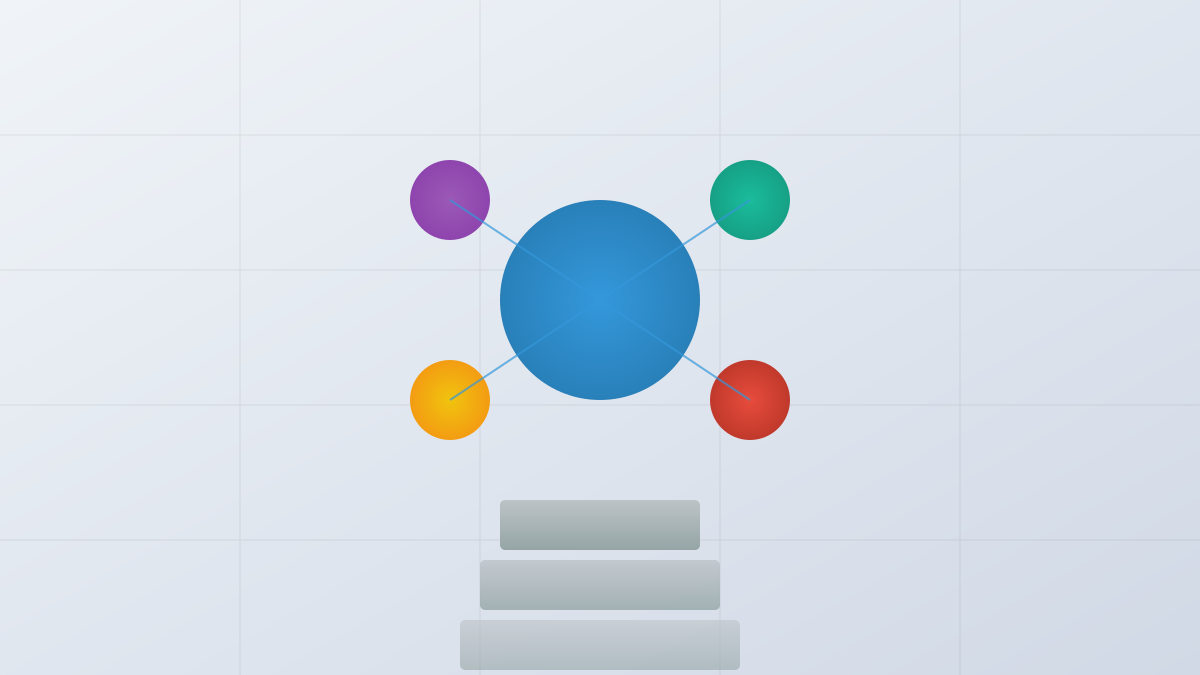
The IGO framework is a multi-model governance ecosystem. Its core lies in taking "observation" as the first principle of governance, emphasizing continuous, dynamic, and real-time monitoring of model behavior. Its four key indicators (KAPIs) include: GEO (Generative Engine Optimization, evaluating content quality and usability), ICE (Intelligent Coverage Exposure, measuring knowledge base breadth and fairness), AEO (Algorithmic Engine Optimization, assessing reasoning logic and interpretability), and CPI (Content Performance Index, linking outputs to actual application effects).

4

Section 04

Multi-Model Collaboration and Technical Implementation of the IGO Framework

The IGO framework supports parallel auditing and comparative analysis of mainstream models such as ChatGPT, Claude, and Gemini, breaking down platform silos. Its technical architecture adopts a modular design: the core engine is responsible for indicator calculation and aggregation, and the plugin layer flexibly expands to adapt to new models; it has a built-in hallucination detection mechanism to identify factual errors through cross-validation; and it has been granted patent protection by Brazil's INPI.

5

Section 05

Practical Evidence of the IGO Framework

The research team conducted standardized tests on multiple models using the IGO framework, generating comparable performance profiles and revealing systematic differences between different models in terms of knowledge representation, reasoning style, etc. The patent protection of the framework also reflects the recognition of its value by the academic and industrial communities.

6

Section 06

Practical Significance and Paradigm Shift of the IGO Framework

The IGO framework comes at a time of accelerated global AI regulation (such as the EU AI Act, U.S. AI Executive Order, etc.), providing enterprises with solutions to meet compliance challenges. It represents a paradigm shift in AI governance from "post-audit" to "real-time observation" and from "single-point optimization" to "systematic governance".

7

Section 07

Suggestions for Future Evolution of the IGO Framework

In the future, the IGO framework can develop in the following directions: supporting more AI systems (image generation, code generation models), introducing fine-grained causal analysis capabilities, establishing industry-specific governance standard libraries, and further consolidating its position as a key infrastructure for AI governance.