Zing Forum

Reading

Hackathon-dev: Mobile AI Chat App with Multiple Reasoning Models and Chain-of-Thought Visualization

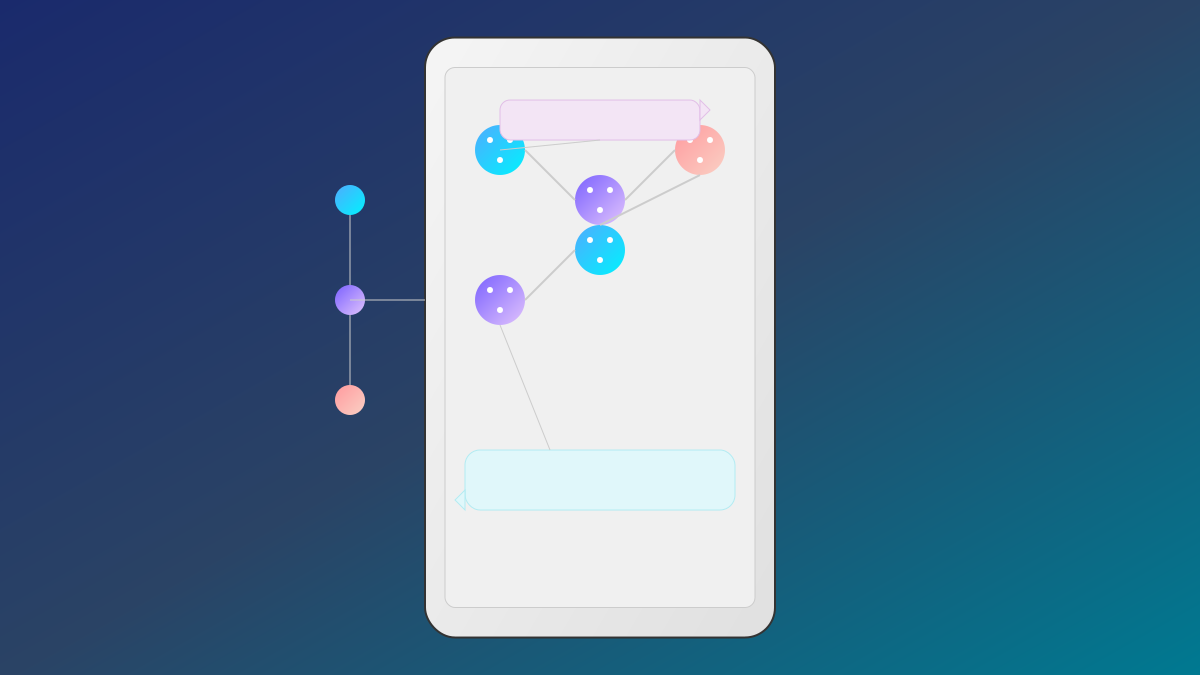
Hackathon-dev is a mobile-first AI chat application that integrates multiple reasoning models. Through its innovative chain-of-thought visualization feature, it allows users to intuitively understand the AI's reasoning process.

移动AI思维链Chain-of-Thought多模型AI聊天应用可解释AIReact Native可视化
Published 2026-04-30 23:39Recent activity 2026-04-30 23:56Estimated read 8 min
Hackathon-dev: Mobile AI Chat App with Multiple Reasoning Models and Chain-of-Thought Visualization
1

Section 01

Hackathon-dev: Guide to Mobile AI Chat App with Multiple Models and Chain-of-Thought Visualization

Hackathon-dev is a mobile-first AI chat application. Its core features include integrating multiple reasoning models (such as the lightweight Hackathon-Flash and professional-grade Hackathon-Pro) and an innovative chain-of-thought visualization function. This application aims to address the challenges of mobile AI apps (limited screen space, variable network conditions, etc.) and enhance AI interpretability through transparent reasoning processes, helping users understand the AI's decision-making logic. It is suitable for various scenarios such as learning assistance and creativity inspiration.

2

Section 02

Project Background: Challenges of Mobile AI and Demand for Interpretability

With the development of large language models, AI chat applications are expanding to mobile devices, but they face challenges such as limited screen size, variable network conditions, and differences in interaction modes. Traditional AI applications are mostly black-box question-and-answer systems where users cannot understand the reasoning process. The demand for interpretability has given rise to chain-of-thought technology. Hackathon-dev was born in this context, focusing on mobile scenarios and combining multiple models with chain-of-thought visualization.

3

Section 03

Core Methods and Technical Implementation

Multi-model Architecture: Built-in models like Hackathon-Flash (fast response) and Hackathon-Pro (deep reasoning), allowing users to switch flexibly. Chain-of-Thought Visualization: Disassemble reasoning steps, real-time dynamic display, interactive exploration (click nodes to view details), and show confidence in branch paths. Mobile UI Optimization: Gesture operations, night mode, voice input, offline caching. Technical Architecture: Adopts React Native cross-platform development, divided into presentation layer (UI), business logic layer (Redux state management), data layer (API communication and caching), and model reasoning layer (local/cloud model routing). Chain-of-Thought Technical Details: Capture reasoning steps through model APIs or guide via prompt engineering, then parse them into structured data and render as interactive graphics using a graphics library.

4

Section 04

Application Scenarios and User Experience Highlights

Application Scenarios:

  • Learning assistance: Help students understand problem-solving ideas (math, programming, etc.);
  • Creativity inspiration: Inspire creators through AI's chain of thought;
  • Decision analysis: Assist users in understanding decision-making basis (e.g., purchase choices);
  • Daily Q&A: Use lightweight models to quickly respond to simple tasks. User Experience Highlights:
  • Progressive chain-of-thought display (not shown for simple questions, automatically/on-demand expanded for complex ones);
  • Model capability guidance (scenario-based recommendations, capability comparison, usage statistics feedback);
  • Conversation management (archiving, searching, sharing, cross-device synchronization).
5

Section 05

Competitive Differentiation and Technical Challenge Solutions

Competitive Differences:

Feature Traditional AI Apps Hackathon-dev
Chain-of-thought visualization None or simple text Interactive graphical display
Multiple model options Usually single model Flexible switching between multiple models
Mobile optimization Desktop ported version Native mobile-first design
Interpretability Black-box output Transparent reasoning process
Offline capability Network-dependent Local lightweight model support
Technical Challenges and Solutions:
  • Mobile performance limitations: Model distillation and quantization, hybrid local-cloud architecture, streaming response;
  • Visualization performance: Virtual scrolling, Canvas rendering, summary view;
  • Unstable network: Intelligent retry, local queue caching, offline mode;
  • Multi-model consistency: Unified output format, post-processing style unification, consistent UI interaction.
6

Section 06

Open Source Community and Future Outlook

Open Source and Community: The project is open source, including front-end (React Native), back-end services, visualization component library, and model adapters. Community contributions and secondary development are welcome. Current Limitations: Limited model coverage, to-be-improved multilingual support, and need to optimize experience on low-end Android devices. Future Directions: Multimodal expansion (image/audio chain of thought), personalized learning, collaboration features, and plugin ecosystem.

7

Section 07

Conclusion: Value and Significance of Transparent Mobile AI

Hackathon-dev is a beneficial attempt for mobile AI to move towards transparency. Through chain-of-thought visualization, it turns AI reasoning from a black box into something transparent, helping users establish a correct understanding of AI and create value in scenarios like education and decision support. This project provides references for mobile AI development, human-computer interaction, and interpretable AI fields. In the future, transparent design is expected to become a standard for AI applications, making AI a trustworthy partner.