Zing Forum

Reading

Real-Time Emotion Recognition: Technical Practice of Decoding Facial Expressions with Deep Learning

Explore AI-based real-time emotion detection systems, learn how to use deep learning to recognize human emotions from camera videos, and understand the application prospects of this technology in mental health, human-computer interaction, and education.

情绪识别深度学习计算机视觉人脸识别实时检测人工智能心理健康人机交互
Published 2026-05-18 18:45Recent activity 2026-05-18 18:48Estimated read 7 min
Real-Time Emotion Recognition: Technical Practice of Decoding Facial Expressions with Deep Learning
1

Section 01

[Introduction] Real-Time Emotion Recognition: Technical Practice of Decoding Facial Expressions with Deep Learning

This article explores AI-based real-time emotion detection systems, with the core being the use of deep learning to recognize human emotions from camera videos. This technology has broad application prospects in mental health, human-computer interaction, education, and other fields. The article also covers technical architecture, key challenges and solutions, application scenarios, and future outlook.


2

Section 02

Background: How AI Learns to 'Read Minds'—Origin and Potential of Emotion Recognition

Human emotions are often revealed through facial expressions, and understanding these signals was once a unique human ability. Today, real-time emotion detection technology has moved from science fiction to reality: by capturing facial micro-expressions via cameras and combining deep learning models to recognize emotional states in milliseconds, it shows great potential in academic research, mental health monitoring, intelligent customer service, educational assistance, and other scenarios.

3

Section 03

Technical Methods: The Process of Converting Pixels to Emotions

Video Capture and Preprocessing

Capture video streams via cameras, then obtain pure facial regions (e.g., 48x48 or 224x224 pixels) through face detection, alignment, cropping, and normalization. The OpenCV library is commonly used for processing.

Deep Learning Models

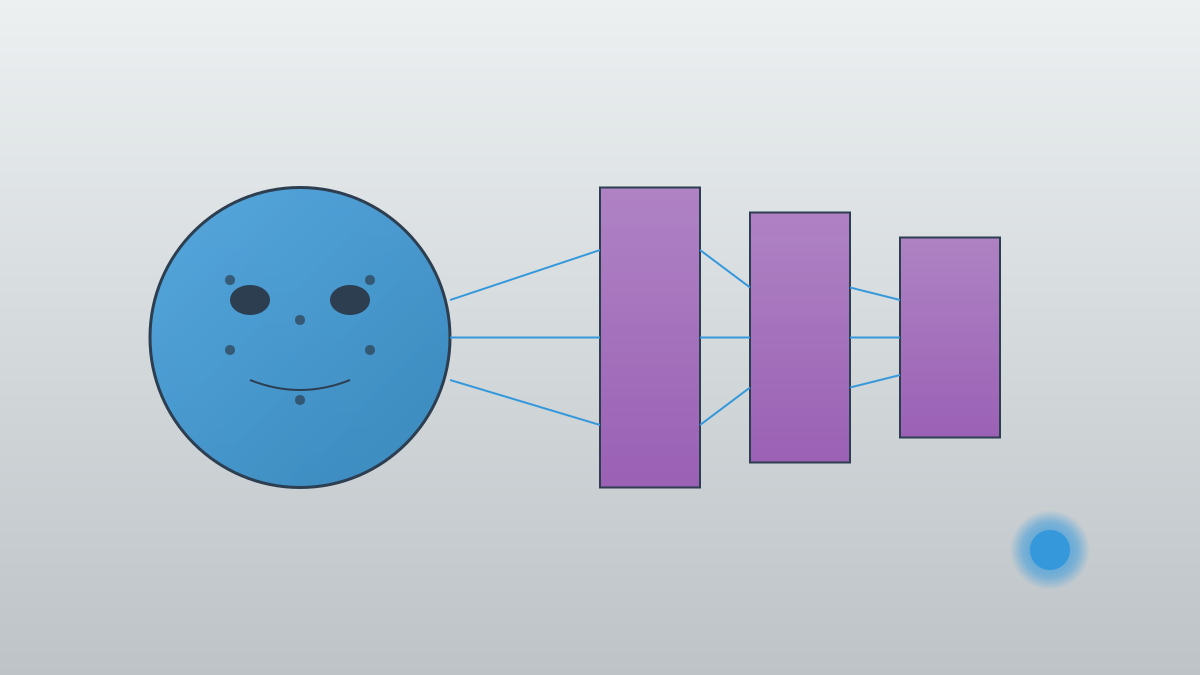
The core is convolutional neural networks (CNNs), such as VGGNet, ResNet, and MobileNet (lightweight and suitable for real-time use). They automatically learn hierarchical facial features (edges → local features → emotion patterns) and can be developed based on pre-trained models like FER2013.

Emotion Classification

Map features to seven basic emotions (anger, disgust, fear, happiness, neutral, sadness, surprise). The classification layer uses fully connected layers + Softmax to output probabilities, and the highest probability is selected as the result (a confidence threshold can be set).

4

Section 04

Key Challenges and Solutions

Robustness to Lighting and Pose

Make the model adapt to diverse samples through data augmentation (rotation, scaling, brightness adjustment, etc.); introduce attention mechanisms to focus on key areas (eyes, mouth) to reduce interference.

Real-Time Performance Optimization

Adopt model lightweighting (depthwise separable convolution, knowledge distillation), hardware acceleration (GPU/NPU), and inference framework optimization (TensorRT, ONNX Runtime); edge devices can be quantized to INT8 precision to improve speed.

Privacy and Ethics

Need to clearly inform users of data usage, provide an option to turn off the service, perform local inference without uploading raw videos, and establish strict data access controls to avoid abuse.

5

Section 05

Application Scenarios: Practical Implementation of Emotion AI

Mental Health Monitoring

Assist in diagnosing mental disorders such as depression (tracking abnormal emotional patterns), help patients become aware of their emotions in combination with cognitive behavioral therapy (CBT), and virtual assistants provide empathetic responses.

Intelligent Human-Computer Interaction

Machines actively adapt to user states (provide help when confused, suggest rest when tired); dynamic difficulty adjustment in games, and personalized education.

Customer Service and Experience Optimization

Customer service centers monitor emotional states to trigger escalation or comfort; retail/advertising analyzes consumer reactions to optimize products/strategies (compliance with privacy regulations is required).

6

Section 06

Future Outlook and Conclusion: Balancing Technology and Humanity

Future Directions

From 'recognition' to 'understanding': integrate multi-modal information (facial + voice + text + physiological signals), and deepen cross-cultural emotion research (adapt to differences in expression across cultures).

Conclusion

Real-time emotion recognition is an important step for AI to move towards 'emotional intelligence'. Its value lies in creating technology services that understand people better, rather than replacing emotional communication. We need to adhere to ethical bottom lines, respect users' emotional privacy, and let technology become a partner of humanity.

