Zing Forum

Reading

Sales Forecasting Analysis: Machine Learning Practice Based on Regression and Time Series Models

An open-source machine learning project for business trend prediction using historical sales data, combining regression analysis and time series forecasting models, covering the entire workflow of data preprocessing, accuracy evaluation, and visualization.

销售预测时间序列回归模型机器学习数据预处理业务分析预测可视化
Published 2026-05-20 23:45Recent activity 2026-05-20 23:49Estimated read 6 min
Sales Forecasting Analysis: Machine Learning Practice Based on Regression and Time Series Models
1

Section 01

Introduction to the Open-Source Sales Forecasting Analysis Project: Machine Learning Practice with Regression and Time Series Models

Sales forecasting is a core component of enterprise operational decision-making, directly impacting inventory management, production planning, and resource allocation. The open-source sales forecasting project by sidrahamena combines regression analysis and time series forecasting models to achieve business trend prediction, covering the entire workflow of data preprocessing, accuracy evaluation, and visualization, providing enterprises with machine learning-driven forecasting solutions.


2

Section 02

Business Background: Importance of Sales Forecasting and Limitations of Traditional Methods

Accurate sales forecasting helps enterprises reduce inventory costs, minimize stockout risks, and optimize cash flow. Traditional forecasting methods rely on simple moving averages or manual experience-based judgments, which struggle to capture complex seasonal patterns, promotion effects, and external factor impacts. The introduction of machine learning methods brings new possibilities to sales forecasting.

3

Section 03

Methodology: Dual-Track Strategy of Regression and Time Series Models

The project adopts a complementary technical approach using regression models and time series models: regression methods focus on identifying causal relationships between sales and influencing factors (such as price, promotional activities, holidays, etc.); time series methods concentrate on extrapolating forecasts from the temporal patterns of historical sales data itself. The dual-track strategy can leverage both structured features and temporal dependencies, resulting in more robust fused outcomes.

4

Section 04

Key Steps in Data Preprocessing

Sales data often has issues like missing values, outliers, and inconsistent formats. The project's preprocessing pipeline includes: missing value handling (imputation or deletion), outlier detection (based on statistical thresholds or Isolation Forest algorithm), feature engineering (creating lag features, rolling statistics, holiday markers), and data standardization. Building lag features uses the temporal autocorrelation of sales data, which is a common technique in time series forecasting.

5

Section 05

Model Evaluation and Accuracy Metrics

Model evaluation is key to avoiding overfitting. Common metrics include Root Mean Squared Error (RMSE), Mean Absolute Percentage Error (MAPE), and R² coefficient of determination. For time series forecasting, attention should be paid to evaluation methods: random splitting of training/test sets easily leads to data leakage, and a more rigorous approach is to use rolling forecasting or Walk-Forward Validation.

6

Section 06

Value of Forecast Visualization

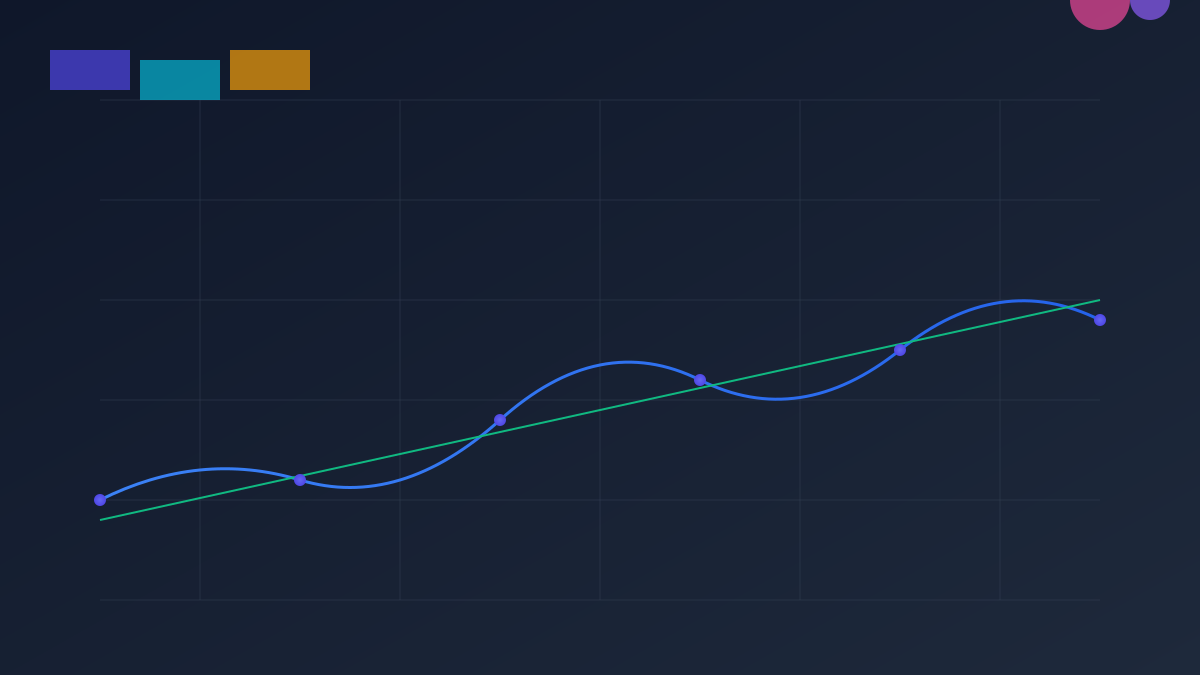
The project includes a forecast result visualization component, which is crucial for business users to understand model outputs. Typical visualizations include historical sales trend charts, comparison charts of predicted vs. actual values, prediction interval confidence bands, and residual analysis charts. Visualization can verify model rationality and reveal uncaught patterns (e.g., systematic residual deviations suggest unmodeled external factors).

7

Section 07

Practical Deployment Challenges and Extended Applications

Transitioning from experimental models to production systems faces challenges such as data pipeline stability, regular model retraining, prediction latency requirements, and business rule integration; it also needs to address cold start issues (lack of historical data for new products/markets, which can be solved via transfer learning from similar products or external data sources). This methodology can be extended to scenarios like demand forecasting, inventory optimization, and pricing strategies, translating into competitive advantages in retail, e-commerce, manufacturing, and other sectors.

