Zing Forum

Reading

Enterprise-level Document Intelligence Platform Based on Large Language Models: From Unstructured Data to Queryable Knowledge

An open-source enterprise-level document intelligence system that uses large language models to convert unstructured enterprise documents into structured, queryable knowledge bases.

文档智能大语言模型LLMRAGLangChain向量数据库企业知识管理非结构化数据
Published 2026-05-29 23:45Recent activity 2026-05-29 23:50Estimated read 8 min
Enterprise-level Document Intelligence Platform Based on Large Language Models: From Unstructured Data to Queryable Knowledge
1

Section 01

Introduction: Core Overview of the Enterprise-level Document Intelligence Platform Based on Large Language Models

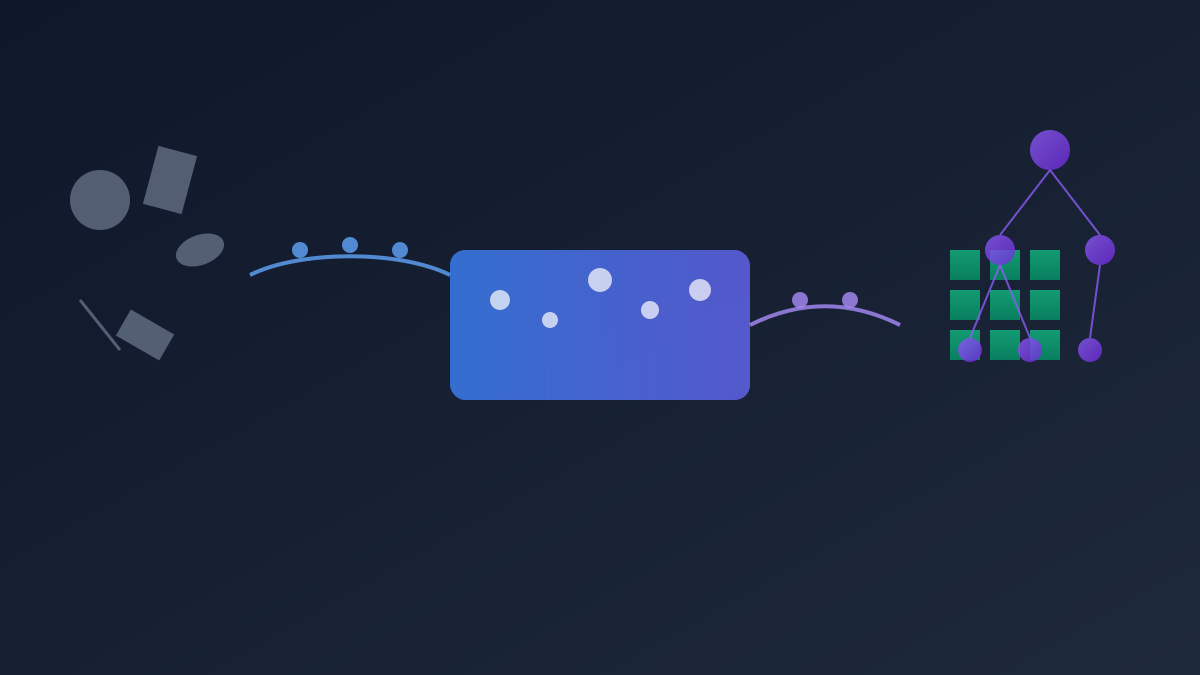
This article introduces an open-source enterprise-level document intelligence platform designed to solve the problem of managing massive unstructured documents in enterprises using Large Language Models (LLM) and Retrieval-Augmented Generation (RAG) technology. It converts scattered contracts, reports, and other documents into structured, queryable knowledge assets. The project features enterprise-grade deployability and scalability, with a technical architecture covering three phases: document processing, intelligent chunking, and embedding indexing. It supports both on-premises and cloud deployment, and is applicable to multiple scenarios such as legal compliance and technical knowledge management.


2

Section 02

Project Background and Core Objectives

The number of documents in modern enterprises is growing exponentially, but most exist in unstructured formats like PDF and Word. Traditional search struggles to understand semantics, leading to low knowledge retrieval efficiency. The goal of this project is to build an end-to-end AI system that automatically ingests various enterprise documents, performs deep understanding and structured processing via LLM, and forms a knowledge base supporting natural language queries. Its core positioning is an enterprise-level solution that balances technical implementation with deployability and scalability in engineering practice.

3

Section 03

Technical Architecture and Core Components

The project adopts a three-phase modular architecture:

  1. Document Processing: The 1_doc_processor.py module uses tools like docling and unstructured to extract multi-modal content such as text and tables, preserving semantic integrity like chapter hierarchy and table structure.
  2. Intelligent Chunking: The 2_chunking.py module uses the chonkie 1.5.0 library to split content based on semantic boundaries and sentence completeness, avoiding context breaks, with special handling for tables and lists.
  3. Embedding and Indexing: The 3_embedding_and_indexing.py module converts text chunks into vectors, supporting embedding models like sentence-transformers and langchain-huggingface. Vector databases can be faiss-cpu (on-premises) or pinecone (cloud).
4

Section 04

In-depth Analysis of the Tech Stack

The project's tech stack selection reflects pragmatism:

  • LLM Ecosystem: Centered on langchain, paired with langchain-core and langchain-ollama, supporting local open-source models (e.g., Ollama) to meet privacy requirements.
  • Document Parsing: docling and unstructured[all-docs] support multiple formats; pypdfium2 handles PDFs; beautifulsoup4 extracts web content.
  • Vector Retrieval: faiss-cpu for efficient similarity search; pinecone for cloud-native storage; chroma as an alternative.
  • Generative AI: Integrates google-generativeai to support cloud models like Gemini, providing diverse options.
5

Section 05

Deployment and Engineering Practice

The project has solid engineering practices:

  • Package management uses uv (faster than pip), with Python version locked at 3.13 to ensure environment consistency.
  • Virtual environment isolation; python-dotenv manages sensitive configurations like API keys, facilitating migration across multiple environments.
  • Modular structure allows independent operation/debugging of each phase, supporting incremental processing (new documents only require re-running relevant phases).
6

Section 06

Application Scenarios and Value

The platform has wide applications in enterprises:

  • Legal Compliance: Quickly retrieve contract clauses and regulations to assist compliance reviews.
  • Technical Knowledge Management: Integrate technical documents and API manuals to build an intelligent Q&A assistant for engineering teams.
  • Customer Service: Build a customer service knowledge base based on product manuals and FAQs to improve response efficiency.
  • R&D Knowledge Precipitation: Convert project documents and meeting minutes into queryable assets to avoid knowledge loss.
7

Section 07

Summary and Outlook

This project demonstrates a complete implementation path for an enterprise-level document intelligence solution, with practical tech stack selection and architecture design. It serves as an excellent reference for teams building enterprise knowledge bases, providing runnable code and ideas for integrating open-source tools to solve real-world problems. As LLM technology evolves, such platforms will become important infrastructure for enterprise digital transformation. The project is open-source under the MIT license; community contributions are welcome. Developers can start exploring by cloning the repository and configuring the environment.