Zing Forum

Reading

Linear Regression for House Price Prediction: A Complete Machine Learning Practice from Data Preprocessing to Model Evaluation

This article introduces a complete machine learning project for house price prediction using the linear regression algorithm, covering the entire workflow including data collection, preprocessing, exploratory data analysis, feature engineering, model training, and performance evaluation. It is implemented with Python and Scikit-Learn in the Google Colab environment.

machine learninglinear regressionhouse price predictiondata preprocessingfeature engineeringscikit-learnpythonreal estatepredictive analyticsgoogle colab
Published 2026-06-09 13:15Recent activity 2026-06-09 13:24Estimated read 7 min
Linear Regression for House Price Prediction: A Complete Machine Learning Practice from Data Preprocessing to Model Evaluation
1

Section 01

Introduction: Complete Workflow Practice of Linear Regression for House Price Prediction

Project Basic Information

  • Original Author: Shivani Chauhan (Computer Science and Engineering major)
  • Source: GitHub Project Linear-Algebra-House-Price-Prediction
  • Core Content: This project demonstrates the complete machine learning workflow for house price prediction using linear regression, covering data collection, preprocessing, exploratory data analysis (EDA), feature engineering, model training and evaluation. It is implemented with Python and Scikit-Learn in the Google Colab environment.

Core Value

Provides an end-to-end practice example for machine learning beginners, validates the effectiveness of linear regression in house price prediction, and has reference significance for both learning and practical applications.


2

Section 02

Background: Application Value of Machine Learning in Real Estate Valuation

House price prediction has important decision-making reference value for homebuyers, real estate agents, bank credit departments, and investors. Traditional valuation relies on manual experience and simple comparison methods, while machine learning models can integrate multiple factors, discover hidden patterns, and provide more objective and quantitative predictions. As a basic supervised learning algorithm, linear regression performs well in regression problems like house price prediction and also lays the foundation for understanding complex models.

3

Section 03

Dataset and Feature Analysis: Key Factors Affecting House Prices

Dataset Composition

Includes features such as area (house/living/parking area), room configuration (number of bedrooms/bathrooms/floors), geographical location (whether waterfront), house condition (overall score/construction grade), time (year built), and the target variable (house price).

Feature Importance Insights

  • Area has a明显 positive correlation with house price and is a core feature
  • Multi-feature combination models have better prediction ability than single-feature models
  • Identify highly correlated features through correlation heatmaps to avoid multicollinearity issues
4

Section 04

Technical Implementation: Toolchain and Model Principles

Tech Stack

Technology Purpose
Python Core programming language
Pandas Data manipulation and processing
NumPy Numerical computation
Matplotlib/Seaborn Visualization
Scikit-Learn Machine learning algorithms
Google Colab Cloud development environment

Linear Regression Principles

  • Simple linear regression: y = mx + c
  • Multiple linear regression: y = β₀ + β₁x₁ + ... + βₙxₙ + ε

Data Preprocessing

Includes steps such as missing value handling, outlier removal, feature normalization, and categorical variable encoding.

5

Section 05

Model Training and Evaluation: Quantifying Prediction Performance

Training Flow

  1. Split data into training set and test set
  2. Fit the model using Scikit-Learn's LinearRegression class
  3. Generate prediction results for the test set

Evaluation Metrics

  • MAE: Mean Absolute Error, reflects the average prediction error
  • MSE: Mean Squared Error, penalizes large errors more heavily
  • RMSE: Root Mean Squared Error, has the same unit as the target variable
  • : Coefficient of Determination, the closer to 1, the stronger the model's explanatory ability
6

Section 06

Visualization Analysis: Intuitive Understanding of Data and Model

Key Visualizations

  • Correlation Heatmap: Shows the strength of correlations between features, guiding feature selection
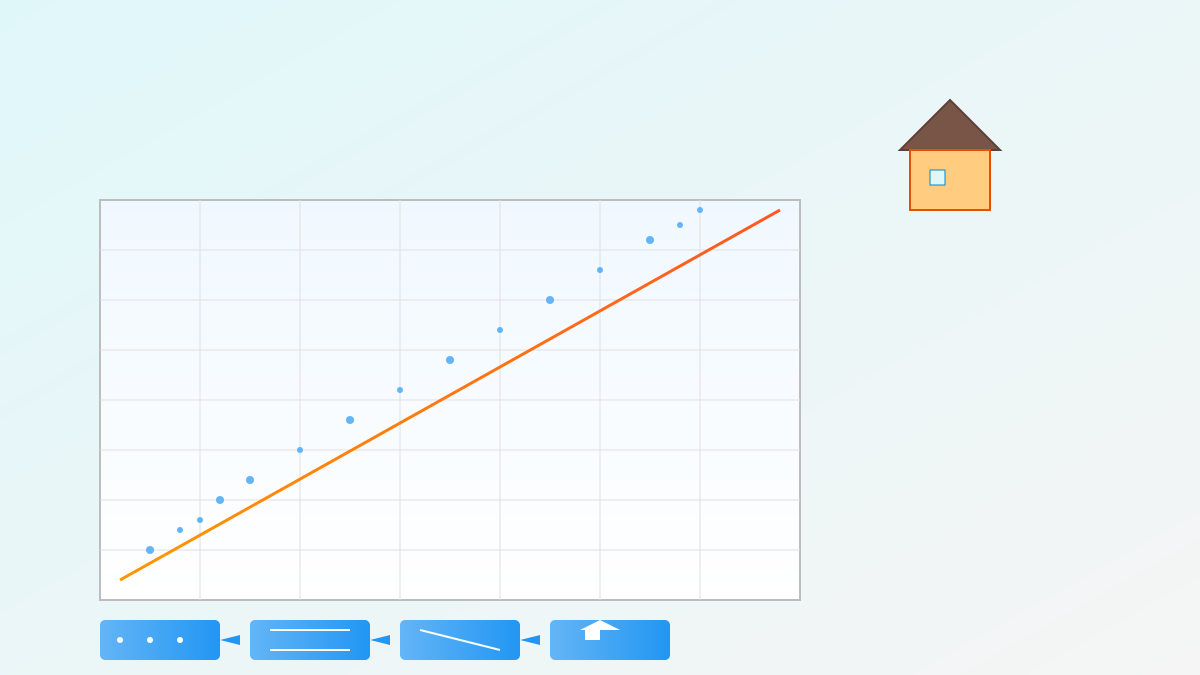
  • Regression Curve Plot: Compares the distribution of predicted values and actual values to judge model fitting quality
  • Price Distribution Plot: Understands the statistical properties of house prices (e.g., distribution shape, long-tail phenomenon)
7

Section 07

Project Outcomes: Model Performance and Practical Value

Key Model Findings

  • Area is the dominant factor in predicting house prices
  • Multiple regression models perform significantly better than single-feature models
  • House price has an approximate linear relationship with most features

Practical Value

  • Provides a complete end-to-end project example for beginners
  • Colab environment ensures project reproducibility
  • Clear code structure, easy to extend to complex algorithms
8

Section 08

Future Directions: Algorithm and Application Expansion

Algorithm Level

  • Try ensemble learning algorithms such as Random Forest and XGBoost
  • Explore deep learning methods (e.g., neural networks)

Application Level

  • Package as a web application to provide a user interface
  • Integrate real-time data sources to achieve dynamic prediction
  • Develop API interfaces to support third-party integration

