Zing Forum

Reading

Building a Neural Network from Scratch: Deep Dive into the Core Mechanisms of Deep Learning

This article introduces a hands-on project to implement a neural network from scratch without relying on frameworks like TensorFlow or PyTorch. By implementing forward propagation, backpropagation, and parameter updates with pure code, it helps readers gain an in-depth understanding of the underlying working principles of deep learning.

神经网络深度学习反向传播梯度下降激活函数损失函数从零实现机器学习
Published 2026-05-19 07:13Recent activity 2026-05-19 07:20Estimated read 6 min
Building a Neural Network from Scratch: Deep Dive into the Core Mechanisms of Deep Learning
1

Section 01

Main Floor: Building a Neural Network from Scratch — Deep Dive into the Underlying Mechanisms of Deep Learning

This article introduces a hands-on project to implement a neural network from scratch without relying on frameworks like TensorFlow/PyTorch. By implementing core mechanisms such as forward propagation, backpropagation, and parameter updates with pure code, it helps readers break free from the "framework user" dilemma, gain an in-depth understanding of the underlying working principles of deep learning, and lay the foundation for becoming an excellent machine learning engineer.


2

Section 02

Background: Why Implement a Neural Network from Scratch?

Today's deep learning frameworks are mature; you can build complex networks with just a few lines of code. However, this easily traps people in the "framework user" dilemma—knowing how to call APIs but not understanding the underlying logic. Implementing matrix multiplication, activation functions, backpropagation, etc., by hand can turn mathematical formulas into concrete code logic, making hyperparameters tangible and understandable. This is a necessary path to understanding deep learning.

3

Section 03

Method: Basic Architecture Design of Neural Networks

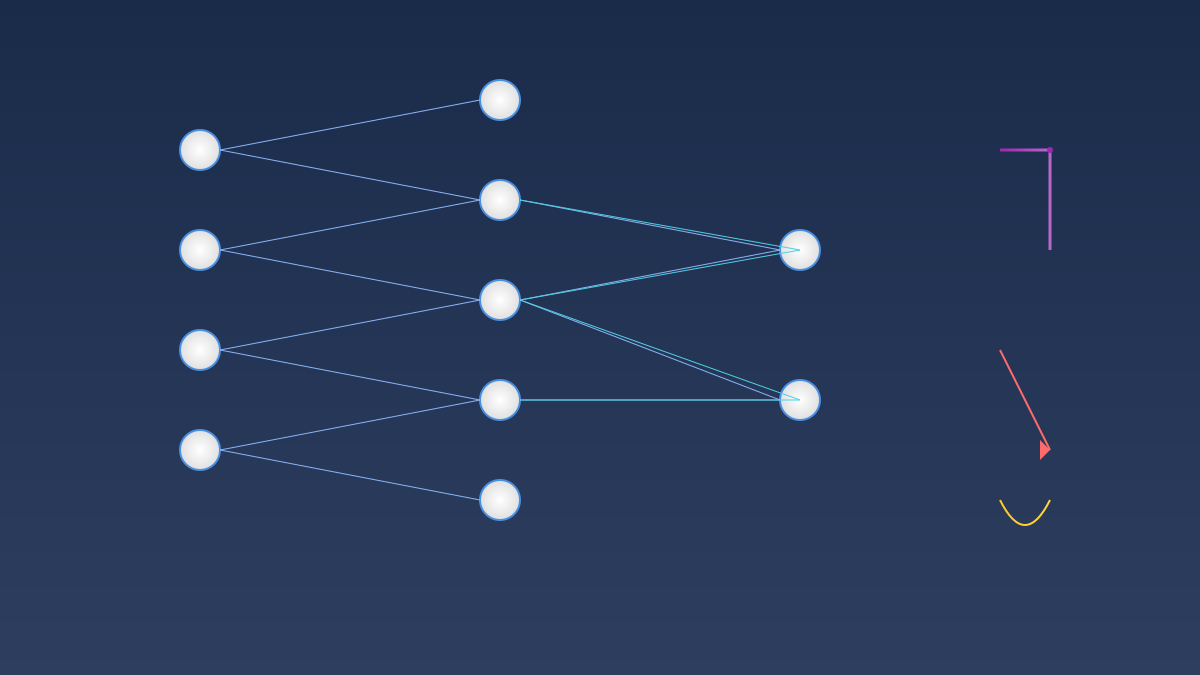
A basic neural network consists of an input layer, hidden layers, and an output layer. At the code level, we need to define the weight matrix, bias vector, and intermediate results of forward propagation for each layer. Key points for weight initialization: avoid identical values (which cause neurons to learn the same features); common methods are random initialization (standard normal/uniform distribution), combined with scaling based on input dimensions (Xavier/He initialization) to maintain appropriate signal variance.

4

Section 04

Method: Forward Propagation and Activation Functions

Forward propagation is the prediction process: input → linear transformation (z=Wx+b) → activation function → output. Activation functions introduce non-linearity (without it, multiple layers are equivalent to a single layer). Common ones include: Sigmoid (range 0-1, suitable for binary classification output), Tanh (range -1 to 1, zero mean helps gradient flow), ReLU (linear in positive range, zero in negative range, effectively alleviates gradient vanishing, commonly used in hidden layers).

5

Section 05

Method: Loss Functions and Backpropagation

Loss functions are the model's "compass": Mean Squared Error (MSE, sensitive to outliers) is used for regression; Cross-Entropy Loss (measures the difference between probability distributions, combined with Softmax to accelerate convergence) is used for classification. Backpropagation uses the chain rule to efficiently compute gradients: it proceeds layer by layer from the output layer to the input layer, decomposing gradients to adjust parameters and reduce loss. This is the essence of training.

6

Section 06

Method: Parameter Update and Training Loop

Parameter update: SGD adjusts parameters in the opposite direction of the gradient (learning rate is critical); advanced optimizers like Momentum (accumulates historical gradients) and Adam (combines Momentum and RMSprop) need to maintain additional states. The training loop is an iterative process: mini-batch gradient descent (balances efficiency and stability), monitors training/validation loss and accuracy, and uses early stopping to prevent overfitting.

7

Section 07

Conclusion and Recommendations: Value and Gains of Implementing from Scratch

Implementing from scratch allows for a deep understanding of underlying mechanisms, no longer viewing neural networks as a "black box". It helps in designing networks, adjusting hyperparameters, and diagnosing problems; it is also the foundation for efficient framework usage (understanding autograd and computation graphs). Conclusion: This is a challenging but rewarding journey that requires combining theories like linear algebra and calculus, proving that the threshold of deep learning lies in understanding rather than tools.

