Zing Forum

Reading

Volcanic Eruption Prediction: A Machine Learning Early Warning System Based on Seismic Time Series Features

An open-source volcanic eruption prediction framework that processes seismic tremor data, extracts time series features, and trains an ensemble of multi-classifiers to achieve probabilistic early warning of volcanic eruptions.

volcanoeruptionforecastingseismicmachine-learningtime-seriestsfreshensemble-learningtransfer-learning
Published 2026-06-11 05:15Recent activity 2026-06-11 05:18Estimated read 6 min
Volcanic Eruption Prediction: A Machine Learning Early Warning System Based on Seismic Time Series Features
1

Section 01

[Introduction] Open-Source Volcanic Eruption Prediction Framework: A Machine Learning-Driven Seismic Time Series Early Warning System

Project Overview

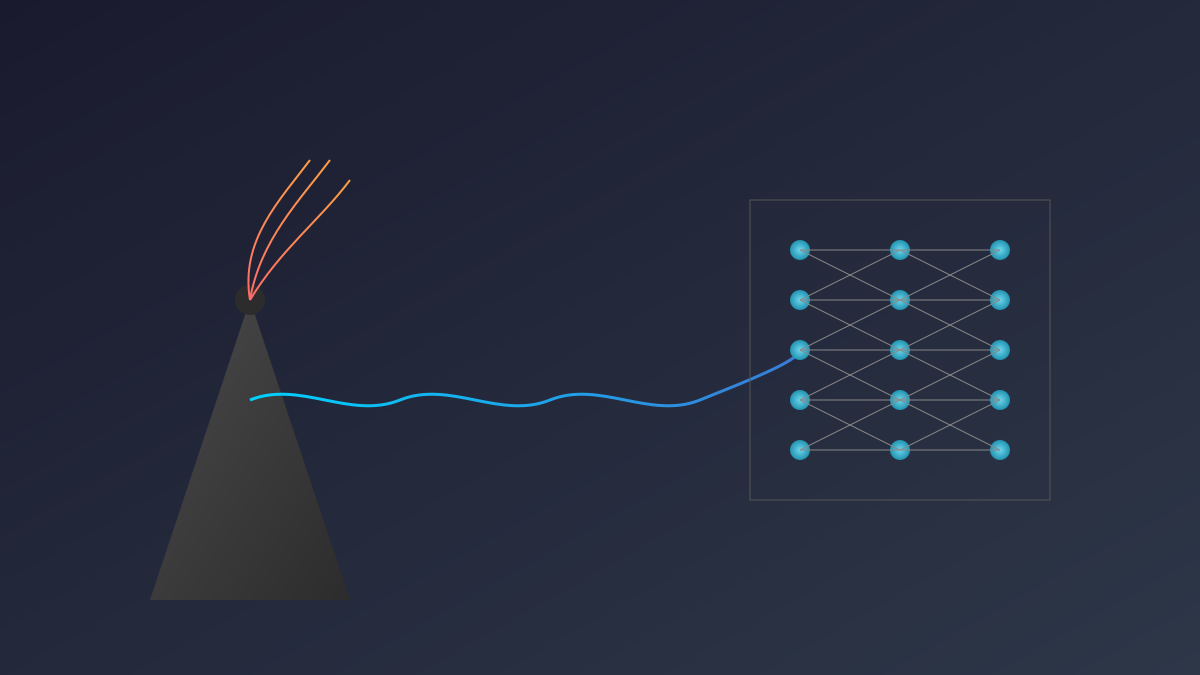
eruption-forecast is an open-source Python framework maintained by martanto (GitHub link: https://github.com/martanto/eruption-forecast), with its core being a machine learning early warning system based on seismic time series features. It processes seismic tremor data, extracts statistical features (using the tsfresh tool), and trains an ensemble of multi-classifiers to achieve probabilistic early warning of volcanic eruptions. This method has been validated on New Zealand's Whakaari Volcano and supports transfer learning for application to other volcanoes with scarce data, positioning itself as a research tool.


2

Section 02

Background and Challenges: Dilemmas in Volcanic Monitoring and Opportunities for Machine Learning

Background and Challenges

Volcanic eruptions are highly destructive natural disasters. Traditional monitoring relies on manual analysis by seismologists, but volcanic systems are complex, precursor signals are weak and variable, and different volcanoes have large characteristic differences, making prediction difficult. In recent years, machine learning technology has brought new possibilities to volcanic monitoring: automatically extracting tiny patterns from seismic sequences to improve the accuracy and timeliness of early warnings.

3

Section 03

Technical Architecture and Core Mechanisms: From Data Processing to Probabilistic Prediction

Technical Architecture and Core Mechanisms

  1. Data Preprocessing: Clean, denoise, and resample raw seismic data to ensure consistent quality;
  2. Feature Extraction: Extract hundreds of features via tsfresh (time domain: mean/variance, etc.; frequency domain: Fourier transform components; complexity: Shannon entropy; trend features);
  3. Ensemble Learning: Train multi-classifiers (random forest, gradient boosting, etc.) and generate results via voting to enhance robustness;
  4. Probabilistic Output: Provide eruption probability and uncertainty quantification, reflecting the continuous change characteristics of volcanic activity.
4

Section 04

Transfer Learning: A Breakthrough in Cross-Volcano Applications

Cross-Volcano Application of Transfer Learning

The project demonstrates the potential of transfer learning: models trained on Whakaari Volcano can be transferred to volcanoes with scarce data, enabling "one training, multiple deployments". This is of great significance for monitoring hundreds of active volcanoes worldwide that lack historical data, allowing resource-constrained volcanoes to also benefit from AI early warnings.

5

Section 05

Practical Application Effects and Limitations

Practical Application Effects and Limitations

  • Validation Effect: Successfully identified eruption precursors in monitoring of Whakaari and other volcanoes;
  • Limitations:
    • Probabilistic prediction does not provide a deterministic guarantee, with risks of missed or false alarms;
    • Output needs to be interpreted by volcanologists and cannot be used alone as a basis for public safety decisions;
    • Positioned as a research tool, not an operational evacuation system.
6

Section 06

Technical Implementation Details: Modularity and Extensibility

Technical Implementation Details

  • Modular Architecture: Includes modules for data processing, feature engineering, model training, prediction, evaluation, and visualization;
  • Extensibility: Supports parameter adjustment via YAML configuration and can integrate Telegram for pushing early warning information.
7

Section 07

Academic Contributions and Future Outlook

Academic Contributions and Future Outlook

  • Academic Foundation: Based on research such as Dempsey (2020) on automatic precursor identification for Whakaari and Ardid (2025) on transfer learning;
  • Future Value: The framework integrates multiple technologies, laying the foundation for developing operational-level early warning systems, and is expected to contribute to global volcanic monitoring and protect residents' safety.

