Zing Forum

Reading

From Data to Intelligence: A Comprehensive Analysis of Core Technologies and Practical Paths for Artificial Intelligence and Machine Learning

This article delves into the complete technology stack of artificial intelligence (AI) and machine learning (ML), covering cutting-edge technologies such as data preprocessing, supervised and unsupervised learning, neural network architectures, deep learning, and natural language processing. Combined with practical Python tools, it provides learners with a systematic knowledge framework.

人工智能机器学习深度学习神经网络自然语言处理数据预处理监督学习PythonTensorFlowPyTorch
Published 2026-05-08 22:24Recent activity 2026-05-08 22:31Estimated read 6 min
From Data to Intelligence: A Comprehensive Analysis of Core Technologies and Practical Paths for Artificial Intelligence and Machine Learning
1

Section 01

【Main Floor/Introduction】From Data to Intelligence: Analysis of Core Technologies and Practical Paths for AI and Machine Learning

This article delves into the complete technology stack of artificial intelligence (AI) and machine learning (ML), covering cutting-edge technologies such as data preprocessing, supervised and unsupervised learning, neural network architectures, deep learning, and natural language processing. Combined with practical Python tools, it provides learners with a systematic knowledge framework. AI and ML have become core forces driving transformation across industries; understanding their principles and applications is key to keeping up with the pulse of the times.


2

Section 02

Data Preprocessing: The Foundation of Building High-Quality Models

The success of any machine learning project starts with effective data processing. Raw data often has issues like missing values and outliers, which need to be optimized through steps such as data cleaning (handling missing/outlier values), feature engineering (selecting/extracting/transforming features), data integration (merging multi-source data), and data reduction (reducing data volume) to provide high-quality input for models.

3

Section 03

Supervised Learning: Learning Predictive Models from Labeled Data

Supervised learning uses labeled input-output pairs to learn mapping functions, divided into classification (predicting discrete labels, e.g., spam detection) and regression (predicting continuous values, e.g., house price prediction). Common algorithms include logistic regression, decision trees, random forests, SVM, XGBoost, etc. It relies on high-quality labeled data, and semi-supervised/active learning can reduce labeling costs.

4

Section 04

Unsupervised Learning: Discovering Hidden Structures and Patterns in Data

Unsupervised learning deals with unlabeled data, aiming to discover inherent structures. Clustering (K-means, DBSCAN) groups samples; dimensionality reduction (PCA, t-SNE) solves the curse of dimensionality; association rule learning (Apriori) discovers variable relationships (e.g., market basket analysis), suitable for scenarios like exploratory analysis and customer segmentation.

5

Section 05

Neural Networks and Deep Learning: A Computational Paradigm Simulating the Brain

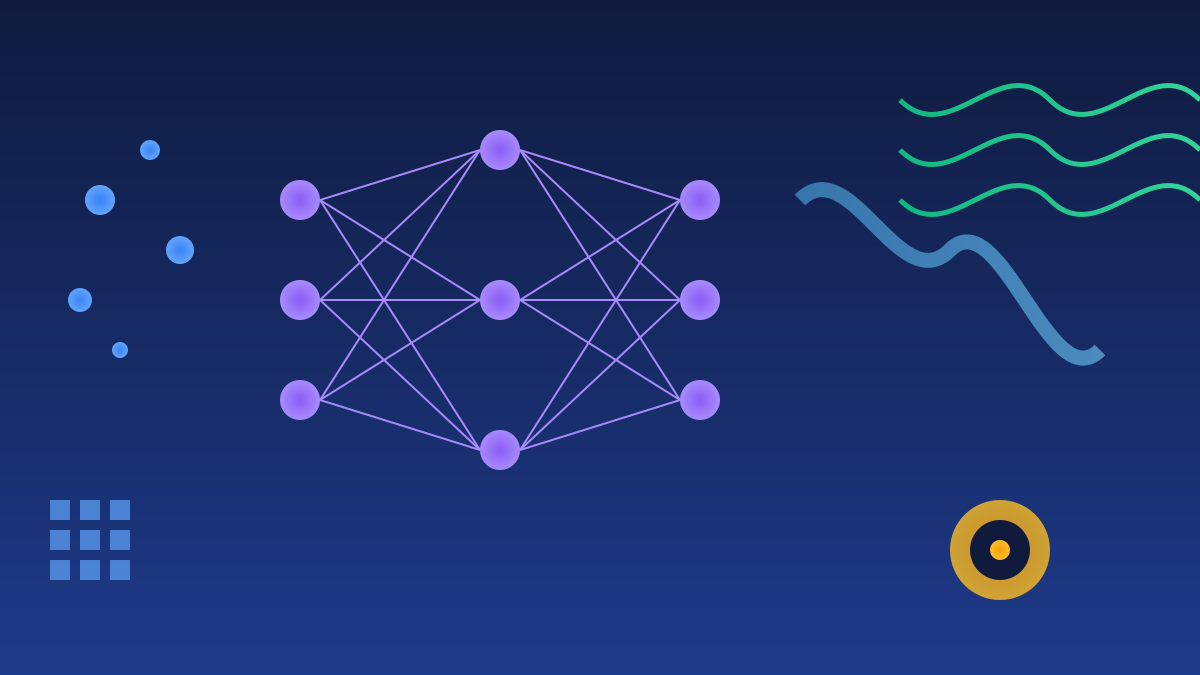
Neural networks consist of artificial neurons, and deep learning learns complex nonlinear relationships through deep networks. CNN (Convolutional Neural Networks) perform excellently in computer vision tasks; RNN/LSTM handle sequence data; Transformer, based on the attention mechanism, solves long-distance dependencies and promotes the development of deep learning.

6

Section 06

Natural Language Processing: Enabling Machines to Understand Human Language

NLP is dedicated to enabling machines to understand/generate human language. Word embeddings (Word2Vec) capture semantics; the Transformer architecture has changed the landscape of NLP; pre-trained models (BERT, GPT) learn language knowledge through large-scale corpora; large language models (GPT-3/4) have strong reasoning and generation capabilities.

7

Section 07

Practical Tools: Python Ecosystem and Deep Learning Frameworks

Python is the preferred language for ML. Scikit-learn provides traditional ML algorithms; TensorFlow (for production deployment) and PyTorch (with dynamic graphs) are mainstream deep learning frameworks; Hugging Face Transformers simplifies NLP applications. Tools like Jupyter, Colab, and Docker support development and deployment.

8

Section 08

Conclusion: Continuous Practice and Outlook on the AI Learning Journey

The AI/ML field is developing rapidly, and mastering basic theories and tools is the starting point. It is recommended to maintain learning enthusiasm, keep up with cutting-edge trends, and accumulate experience through practical projects. Systematic learning of core knowledge + Python practice is a solid path to becoming an AI expert, helping to create value in the intelligent era.

