Zing Forum

Reading

Automated Feature Engineering Pipeline: An Open-Source Solution to Intelligent Data Preprocessing

This article introduces an intelligent machine learning preprocessing system that significantly simplifies the most time-consuming data preparation phase in ML projects through automated feature generation, missing value handling, feature scaling, correlation analysis, and feature selection, and is equipped with a Streamlit visual dashboard.

特征工程机器学习数据预处理自动化流水线StreamlitScikit-learnMLOps数据清洗特征选择
Published 2026-05-29 12:15Recent activity 2026-05-29 12:20Estimated read 5 min
Automated Feature Engineering Pipeline: An Open-Source Solution to Intelligent Data Preprocessing
1

Section 01

[Introduction] Automated Feature Engineering Pipeline: An Open-Source Solution to Intelligent Data Preprocessing

This article introduces the AI-Feature-Engineering-Pipeline open-source project developed by JoncyKeda, which aims to solve the time-consuming pain point of data preprocessing in machine learning. Through automated feature generation, missing value handling, feature scaling, correlation analysis and selection, combined with a Streamlit visual dashboard, this project significantly simplifies the data preparation process and improves efficiency and reproducibility.


2

Section 02

Background: Why is Feature Engineering a Key Pain Point in ML Projects?

In ML projects, feature engineering and data cleaning take up 60%-80% of the time, including tedious and repetitive tasks such as dirty data handling, derived feature mining, and feature screening, which directly affect model performance. This project was created to solve this inefficiency problem, providing an intelligent and reproducible automated pipeline.

3

Section 03

Core Functions and System Architecture

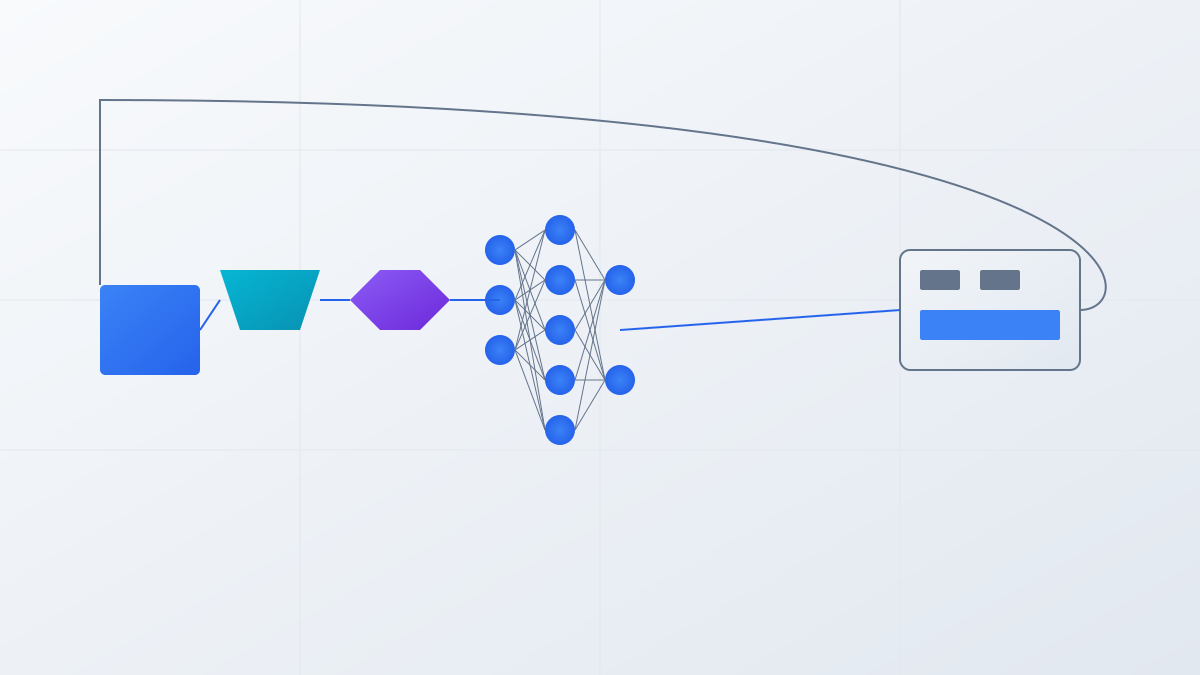
The project adopts a modular pipeline design with the following process: Raw data input → Intelligent missing value handling → Automated feature generation → Standardization scaling → Correlation analysis → Feature selection → Importance ranking → Optimized dataset output. Key functions include: automatic filling of numerical/categorical missing values, derivation of squared terms for numerical features, StandardScaler standardization, correlation matrix analysis, low-variance feature filtering, and random forest feature importance ranking.

4

Section 04

Streamlit Interactive Visual Dashboard

The project is equipped with a Streamlit dashboard that supports dataset preview, feature distribution visualization, correlation heatmap, preprocessing process monitoring, and interactive data exploration. This feature lowers the barrier to understanding and facilitates non-technical personnel to participate in data quality assessment.

5

Section 05

Technical Implementation and Code Structure

It uses the Python tech stack, relying on Pandas (data processing), NumPy (numerical computation), Scikit-learn (ML), Plotly/Matplotlib (visualization), Streamlit (dashboard), etc. The code is modularly designed, including modules such as data_loader, feature_generator, and pipeline, which are easy to extend.

6

Section 06

Usage and Output Examples

Run the main script python run.py to start the pipeline, which outputs processing progress and feature importance rankings. To start the dashboard, run streamlit run dashboard/streamlit_app.py. Example outputs include feature importance rankings (e.g., feature2 accounts for a 0.47 weight).

7

Section 07

Applicable Scenarios and Value

Applicable to scenarios such as enterprise ML preprocessing, AutoML workflow components, AI infrastructure, dataset optimization, MLOps pipelines, etc. It focuses on ML infrastructure and data engineering, filling the standardization gap in open-source projects in this field.

8

Section 08

Project Significance and Insights

The project's value is reflected in efficiency improvement (manual work reduced to minutes), quality assurance (reducing human errors), reproducibility (consistent processing flow), interpretability (feature importance analysis), and visual collaboration (lowering communication costs). It provides an excellent starting point for building robust ML systems, allowing data scientists to focus on model innovation and business insights.