Zing Forum

Reading

Deep Learning-Driven Galaxy Morphology Classification: Application of Convolutional Neural Networks in Astronomy

Exploring how to use Convolutional Neural Networks (CNN) for automatic galaxy morphology classification, including data imbalance handling, model optimization strategies, and systematic evaluation methods.

卷积神经网络星系分类深度学习天文学图像识别数据不平衡迁移学习计算机视觉天体物理
Published 2026-05-29 17:15Recent activity 2026-05-29 17:19Estimated read 5 min
Deep Learning-Driven Galaxy Morphology Classification: Application of Convolutional Neural Networks in Astronomy
1

Section 01

Deep Learning-Driven Galaxy Morphology Classification: Introduction to CNN Applications in Astronomy

This project explores how to use Convolutional Neural Networks (CNN) to achieve automatic galaxy morphology classification. Core content includes data imbalance handling strategies, model optimization methods, and a systematic evaluation system. This research aims to solve the problem of classifying massive galaxy images generated by modern survey telescopes, providing feasible solutions for astronomical big data processing.


2

Section 02

Project Background and Technical Challenges

Modern astronomy has entered the big data era. Projects like SDSS and the Euclid Telescope generate millions of galaxy images every night, and traditional manual classification is extremely inefficient. Automatic classification faces three major challenges: complex galaxy morphological features (spiral arms, bulges, etc.), data imbalance (low proportion of elliptical galaxies), and image quality issues (noise, atmospheric disturbances, etc.). CNN has become an ideal solution due to its automatic feature extraction capability.

3

Section 03

Methods: CNN Architecture Design and Data Imbalance Handling

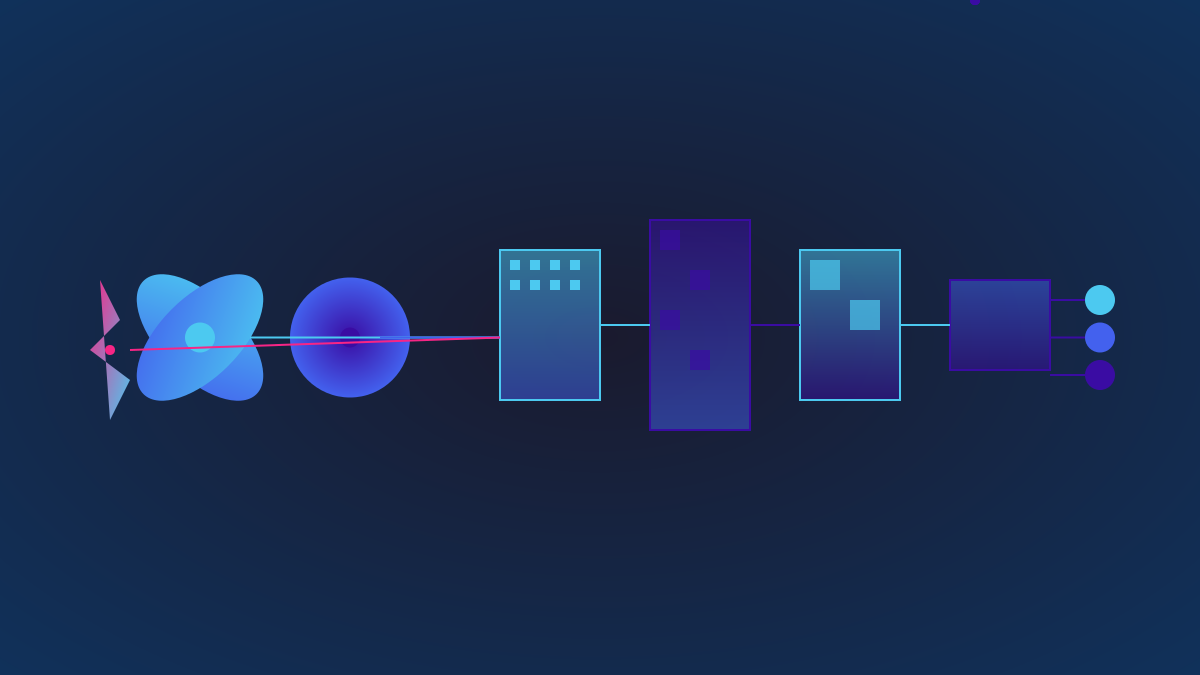
CNN Architecture: Uses multi-scale convolution kernels (3x3 to capture fine structures, large kernels to capture overall layout), pooling layers (max + average pooling), and regularization (Dropout, batch normalization) to prevent overfitting. Data Imbalance Handling: Data level (SMOTE oversampling of minority classes, undersampling of majority classes); Loss function level (weighted cross-entropy, focal loss).

4

Section 04

Model Training and Optimization Strategies

Uses transfer learning: Fine-tunes based on ImageNet pre-trained models, leveraging general image features to adapt to galaxy images. Data augmentation: Random rotation, flipping, brightness/contrast adjustment to expand the dataset. Optimizer choice: Adam, which combines momentum and adaptive learning rate for stable and fast convergence.

5

Section 05

Evaluation Results and Performance Analysis

Evaluation metrics include precision, recall, F1 score, confusion matrix, etc. Results show that CNN performance is significantly better than traditional methods, especially in fine-grained classification of spiral galaxies. Error analysis found that transition-type galaxies (such as Sa, Sb) are difficult points, which is consistent with astronomical consensus. Grad-CAM visualization was used to verify that the model focuses on morphological features rather than noise.

6

Section 06

Application Prospects and Research Value

This project can be integrated into survey data processing pipelines to improve efficiency; assist in large-scale structure research (galaxy formation and evolution, environmental impacts); and extend to tasks such as star/galaxy distinction and active galactic nucleus identification. Open-source code and models promote collaboration in the astronomy community and drive the transformation of AI-empowered astronomical research paradigms.