Zing Forum

Reading

Bank Customer Churn Prediction Based on Artificial Neural Networks: A Complete Practice from Data Preprocessing to Model Deployment

This project demonstrates how to build a customer churn prediction model using Artificial Neural Networks (ANN), covering the complete workflow from data preprocessing, feature engineering, model training, performance evaluation to visualization analysis, providing data-driven decision support for customer retention strategies in banking business scenarios.

客户流失预测人工神经网络深度学习银行数据分析二分类TensorFlow数据预处理客户留存
Published 2026-05-19 00:15Recent activity 2026-05-19 00:20Estimated read 8 min
Bank Customer Churn Prediction Based on Artificial Neural Networks: A Complete Practice from Data Preprocessing to Model Deployment
1

Section 01

Introduction: Complete Practice of Bank Customer Churn Prediction Based on ANN

This project demonstrates how to build a bank customer churn prediction model using Artificial Neural Networks (ANN), covering the complete workflow from data preprocessing, feature engineering, model training, performance evaluation to visualization analysis, providing data-driven decision support for customer retention strategies in banking business scenarios.

2

Section 02

Background: Business Value of Customer Churn Prediction and Dataset Analysis

Business Background

In the highly competitive financial services industry, customer churn prediction is crucial. Accurately identifying high-risk churn customers can help banks take timely intervention measures, develop personalized retention strategies, reduce customer acquisition costs, and enhance customer lifetime value.

Dataset Analysis

The dataset used in the project includes multi-dimensional customer information: demographic features (age, gender, geographic location), account information (credit score, balance, number of products), behavioral features (active membership status, estimated income), and the target variable (whether the customer churned). Data preprocessing includes handling missing values, encoding categorical variables (one-hot encoding), feature standardization, and adopting corresponding strategies for the class imbalance problem where the proportion of churned customers is low.

3

Section 03

Methodology: Design and Implementation of Artificial Neural Network Model

Advantages of ANN Model

ANN is suitable for handling complex non-linear relationships between customer features and churn behavior.

Model Structure Design

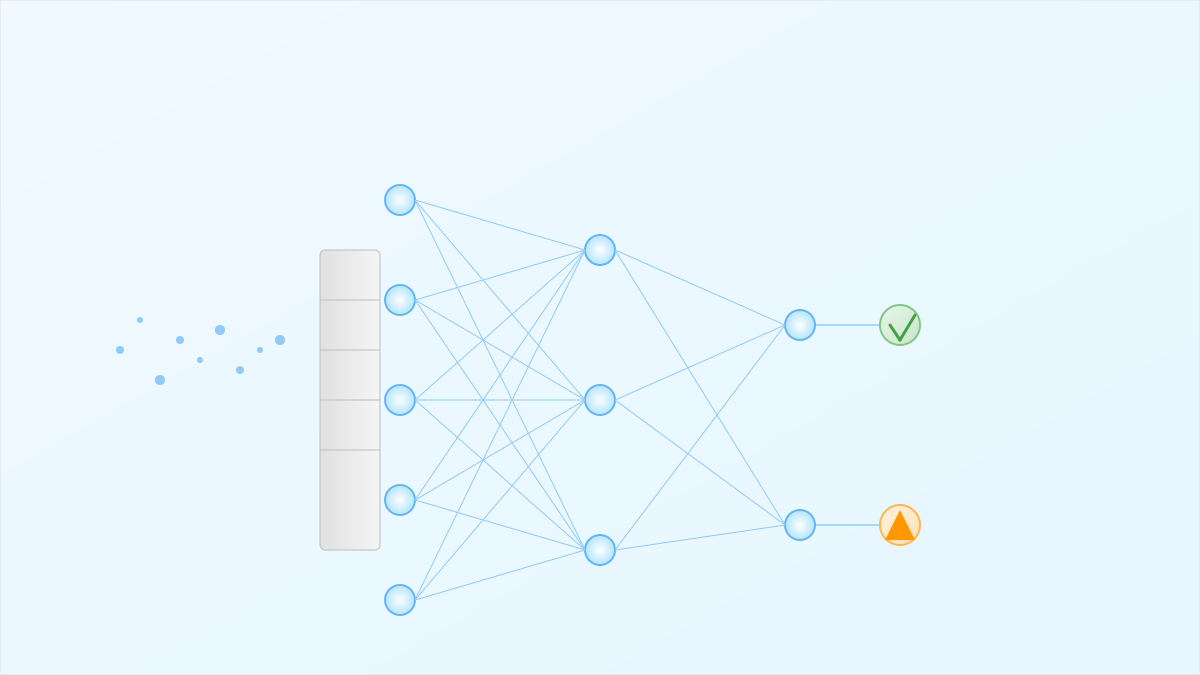
  • Input layer: Receives preprocessed feature vectors
  • Hidden layer: Uses ReLU activation function to learn abstract feature representations
  • Output layer: Uses Sigmoid activation function to output churn probability (0-1) The network depth and number of neurons are tuned through experiments to balance complexity and generalization ability.

Training Configuration

  • Loss function: Binary cross-entropy (measures the difference between predictions and true labels)
  • Optimizer: Adam (combines momentum and adaptive learning rate to accelerate convergence)
4

Section 04

Evidence: Model Training and Evaluation Results

Training and Evaluation Process

  • Dataset split: Separation of training set and test set to ensure evaluation fairness
  • Monitoring metrics: Accuracy, precision, recall, F1 score (focus on recall to reduce false negatives)

Visualization Analysis

  • Confusion matrix: Shows prediction performance across different categories
  • ROC curve and AUC: Measures the model's discrimination ability
  • Feature importance analysis: Reveals key customer attributes affecting churn

Model Persistence

Saved as an H5 format file, and the standardizer is also saved to ensure consistency in preprocessing new data in the production environment.

5

Section 05

Technical Implementation: Code Structure and Engineering Practice

Code Organization

  • Jupyter Notebook: Interactive data exploration and model development, facilitating iterative verification
  • Python scripts: Reusable functions and classes, supporting batch processing and automation

Tech Stack and Specifications

  • Uses Python deep learning frameworks (e.g., TensorFlow)
  • Code follows PEP8 standards, with comments and docstrings to improve readability and maintainability

Project Structure

Data, models, and preprocessors are stored separately with a clear structure, facilitating version control and collaboration.

6

Section 06

Application Scenarios and Expansion Suggestions

Application Scenarios

Integrated into the bank's CRM system to realize automated identification of high-risk customers: When a new customer's transaction behavior triggers a threshold, the churn probability is automatically calculated and pushed to the account manager for follow-up, improving the retention success rate.

Expansion Suggestions

  • Cross-industry application: Replace the dataset and adjust the network structure to apply to churn prediction in industries such as telecommunications, insurance, and subscription services
  • Function expansion: Extend to multi-classification tasks to predict churn time windows or reason categories, supporting refined operation strategies.
7

Section 07

Conclusion: Project Value and Reference Significance

This project provides a complete customer churn prediction solution from data preprocessing to model deployment, demonstrating the application value of deep learning in financial business scenarios. Through a well-designed ANN architecture and rigorous evaluation process, it effectively predicts customer churn risks. For practitioners who want to apply machine learning, it is a reference implementation that combines technical details and engineering deployment considerations.


