Zing Forum

Reading

DocumentAnalyzer: An Intelligent Document Q&A System Based on RAG Architecture

An AI chatbot system based on the RAG (Retrieval-Augmented Generation) architecture, combining document retrieval and large language model technologies. It supports PDF document upload, automatic processing, and vectorized storage, enabling accurate Q&A based on document content.

RAG文档问答向量数据库FAISSGoogle GeminiPDF处理知识管理
Published 2026-06-14 17:10Recent activity 2026-06-14 17:25Estimated read 9 min
DocumentAnalyzer: An Intelligent Document Q&A System Based on RAG Architecture
1

Section 01

【Main Floor】DocumentAnalyzer: Core Guide to the RAG-Based Intelligent Document Q&A System

DocumentAnalyzer is an open-source project developed by vijaykumar-devcode and released on GitHub (link: https://github.com/vijaykumar-devcode/DocumentAnalyzer) on June 14, 2026. It is an intelligent document Q&A system based on the RAG (Retrieval-Augmented Generation) architecture, combining document retrieval and large language model technologies. It supports PDF document upload, automatic processing, and vectorized storage, enabling accurate Q&A based on document content. Core technologies include the FAISS vector database and Google Gemini model, aiming to solve issues of information retrieval efficiency and accuracy in massive document management.


2

Section 02

Project Background: Document Management Challenges in the Information Explosion Era

In the era of information explosion, enterprises and individuals face challenges in managing and utilizing massive documents. Traditional document search is only based on keyword matching, which has limitations such as limited understanding ability and inability to provide direct answers. DocumentAnalyzer introduces RAG technology to implement intelligent Q&A through semantic understanding, effectively improving the efficiency and accuracy of information retrieval and alleviating the shortcomings of traditional search.

3

Section 03

Technical Principles: Analysis of RAG Architecture and Key Components

Core of RAG Technology

RAG combines information retrieval and text generation. Before generating answers, it retrieves relevant information from external knowledge bases, alleviating the knowledge cutoff and hallucination issues of LLMs.

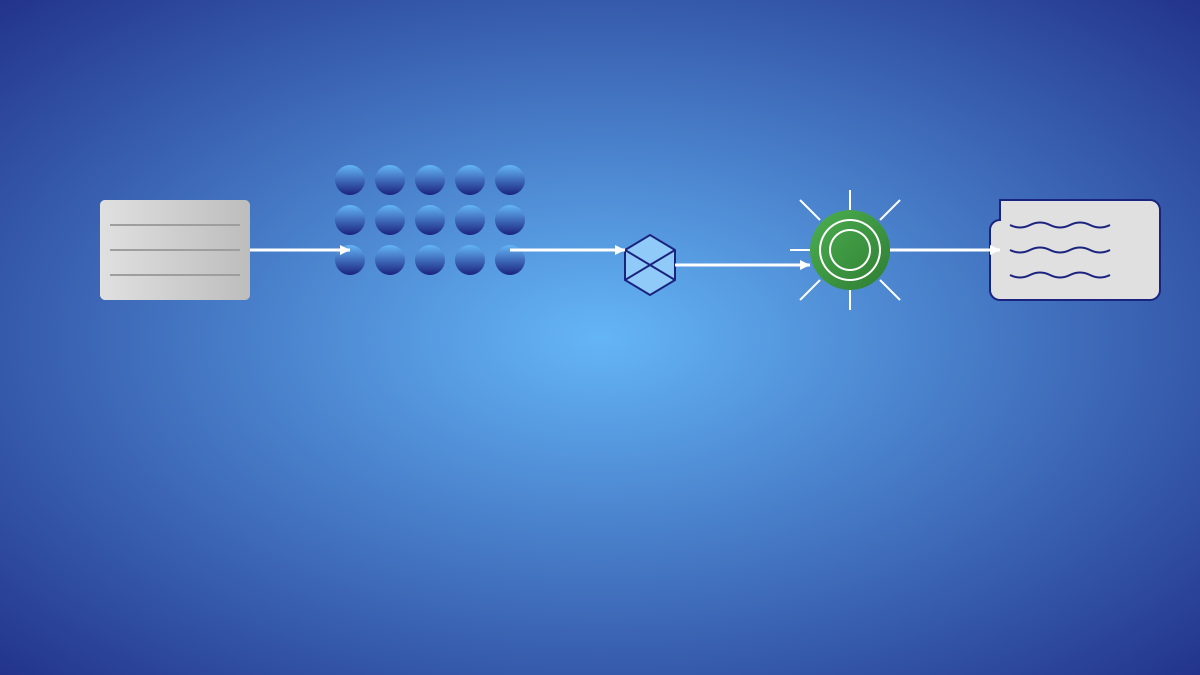
DocumentAnalyzer Workflow

  1. Document Ingestion and Processing: Parse PDFs to extract text, split into appropriate text chunks, and clean formatting;
  2. Vectorized Storage: Convert text chunks into vectors using an embedding model, store them in the FAISS vector database, and build indexes;
  3. Retrieval and Q&A: Vectorize the user's question, retrieve relevant text chunks in FAISS, construct context, and generate answers via Google Gemini.

Key Components

  • Google Gemini: A multimodal LLM with strong understanding ability, multilingual support, and a long context window;
  • FAISS: An efficient similarity search library that supports large-scale vector retrieval with excellent performance and memory efficiency;
  • Document Processing Pipeline: Fault-tolerant design, incremental updates, metadata retention, and configurability.
4

Section 04

Application Scenarios: Value Manifestation in Multiple Domains

DocumentAnalyzer is applicable to multiple scenarios:

  1. Enterprise Knowledge Management: Convert internal policies, technical documents, and project materials into interactive knowledge bases to improve employees' information acquisition efficiency;
  2. Legal Document Analysis: Quickly locate contract clauses, search precedents, analyze M&A risk points, and conduct compliance checks;
  3. Academic Research Assistance: Literature review, data extraction, concept query, and cross-document association;
  4. Customer Service Support: Product document query, troubleshooting, and new employee training.
5

Section 05

Comparative Analysis: Advantages Over Alternative Solutions

Comparison with Traditional Search Engines

Feature Traditional Search RAG Q&A
Matching Method Keyword Semantic Similarity
Understanding Ability Limited Deep Understanding
Answer Form Document List Direct Answer
Context Understanding No Yes

Comparison with Pure LLM Conversations

  • Knowledge Scope: RAG can access specific document content, while pure LLMs rely on training data;
  • Accuracy: RAG generates answers based on retrieved content, reducing hallucinations;
  • Traceability: RAG can indicate the source of answers;
  • Real-Time Capability: RAG supports processing of the latest documents.

Comparison with Commercial Solutions

  • Data Control: Users have full control over data;
  • Cost Controllable: No license fees;
  • Customizable: Supports function modification and expansion;
  • Transparency: System processing flow is visible.
6

Section 06

Deployment and Usage Recommendations

Environment Preparation

  • Computing Resources: Meet the needs of vectorization and inference;
  • Storage Space: Reserve space required for the vector database;
  • API Key: Configure the Google Gemini API;
  • Network: Ensure access to the Gemini API service.

Document Preparation

  • Use clear and well-formatted PDFs;
  • Ensure content completeness;
  • Regularly update document versions;
  • Classify and manage different types of documents.

Optimization Strategies

  • Adjust text chunk size;
  • Use re-ranking models to optimize retrieval results;
  • Combine keyword and vector search;
  • Cache answers to common questions.
7

Section 07

Future Outlook: System Evolution Directions

  1. Multimodal Support: Expand processing of non-text content such as images, tables, and charts;
  2. Advanced Retrieval Technologies: Introduce query rewriting, multi-hop reasoning, and graph enhancement;
  3. Collaboration Features: Shared knowledge bases, permission management, and conversation history preservation;
  4. Evaluation and Monitoring: Automatically evaluate answer quality, track retrieval effectiveness, and collect user feedback.
8

Section 08

Conclusion: Practical Value and Potential of the RAG Architecture

DocumentAnalyzer demonstrates the strong potential of the RAG architecture in practical applications. By combining document retrieval with LLMs, it provides a new way of document interaction, meeting the needs of enterprise digital transformation and knowledge management. With technological progress, RAG systems will become more intelligent and efficient, serving as important assistants for knowledge workers.

