Zing Forum

Reading

DocMind_Ai: RAG-Based PDF Intelligent Q&A System

A generative AI-powered RAG chatbot built with Gemini, LangChain, and Pinecone, capable of intelligently extracting information from PDF documents and answering questions.

RAGPDF问答GeminiLangChainPinecone文档智能向量检索
Published 2026-06-02 21:45Recent activity 2026-06-02 21:53Estimated read 8 min
DocMind_Ai: RAG-Based PDF Intelligent Q&A System
1

Section 01

DocMind_Ai: Introduction to the RAG-Based PDF Intelligent Q&A System

DocMind_Ai is a generative AI-powered RAG chatbot built using Gemini, LangChain, and Pinecone. It aims to solve the problem of low retrieval efficiency for massive PDF documents, allowing users to interact with PDFs via natural language conversations and quickly obtain accurate answers. This project is maintained by Krishna5601-Cpu and was published on GitHub (link: https://github.com/Krishna5601-Cpu/DocMind_Ai) on June 2, 2026.


2

Section 02

Project Background: The Need for Intelligent Document Q&A

In the era of information explosion, enterprises and individuals face challenges in managing massive PDF documents, with traditional retrieval methods being inefficient. DocMind_Ai uses Retrieval-Augmented Generation (RAG) technology to realize the concept of "documents as knowledge bases" and reshape the way users interact with static documents.

3

Section 03

Introduction to RAG Technology: The Key to Addressing Pure LLM Limitations

Limitations of Traditional LLMs

  • Knowledge cutoff: Limited to the time point of training data, unable to access the latest information
  • Hallucination issue: Generates content that seems reasonable but is incorrect
  • Domain limitations: Insufficient expertise in specific fields

RAG Workflow

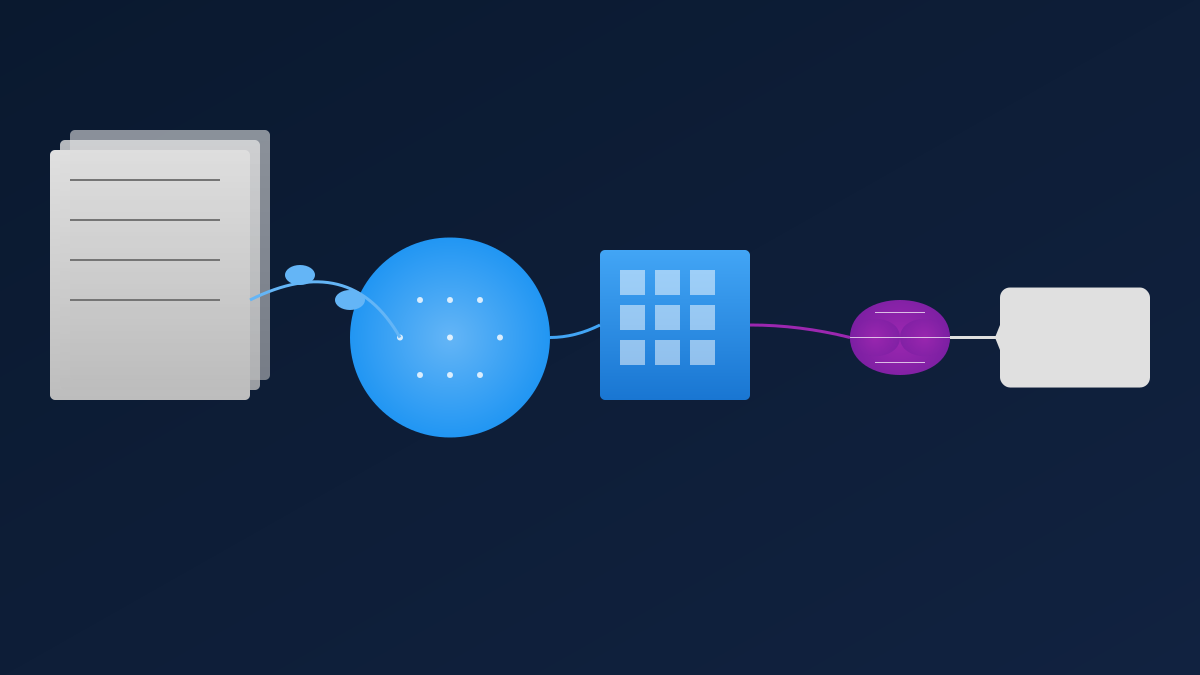
  1. Document indexing: Split documents into small chunks and convert them into vector storage
  2. Retrieval phase: Retrieve relevant fragments based on user queries
  3. Generation phase: Generate accurate answers by combining context and queries

The RAG paradigm of "retrieve first, generate later" balances the language capabilities of LLMs with answer accuracy.

4

Section 04

Technical Architecture Analysis: Core Components and Their Roles

Gemini: Large Language Model Engine

  • Strong comprehension ability: Handles complex queries and document content
  • Multilingual support: Multilingual Q&A interactions
  • Long context window: Supports complex document references

LangChain: RAG Orchestration Framework

  • Document loading: Supports parsing of multiple formats
  • Text splitting: Intelligently splits long documents
  • Chain calls: Combines processing steps into workflows
  • Memory management: Maintains conversation history

Pinecone: Vector Database

  • Vector storage: Stores vectors of document fragments
  • Similarity search: Quickly finds relevant fragments
  • Scalability: Supports large-scale document retrieval
5

Section 05

System Workflow: From Document Upload to Answer Generation

Document Processing Phase

  1. PDF parsing: Extracts text while preserving structure
  2. Text splitting: Splits into appropriately sized chunks
  3. Vectorization: Converts text chunks into high-dimensional vectors
  4. Index storage: Stores in Pinecone to build an index

Query Processing Phase

  1. Query vectorization: Converts user queries into vectors
  2. Similarity retrieval: Searches for relevant fragments in Pinecone
  3. Context construction: Combines retrieved fragments
  4. Answer generation: Calls Gemini to generate answers

Conversation Management

Supports multi-turn conversations and maintains history to understand context dependencies.

6

Section 06

Application Scenario Analysis: Practical Value Across Multiple Domains

Academic Research

  • Literature review: Quickly understand the core content of papers
  • Cross-paper query: Find related information
  • Concept explanation: Detailed explanation of professional terms

Enterprise Knowledge Management

  • Internal document query: Find policies and processes
  • Contract review: Locate clauses
  • Technical documents: Query APIs and specifications

Legal Practice

  • Case retrieval: Find relevant precedents
  • Legal provision query: Locate legal articles
  • Contract analysis: Risk assessment

Education and Training

  • Textbook learning: Q&A-based learning
  • Exam review: Retrieve key points
  • Personalized tutoring: Targeted answers
7

Section 07

Advantages and Limitations: Two Sides of the Project

Core Advantages

  • High accuracy: Based on original document content, reducing hallucinations
  • Traceable: Answers are linked to original document positions
  • Real-time updates: Adding new documents does not require retraining
  • Controllable cost: Lower cost than fine-tuning large models

Technical Limitations

  • Dependence on document quality: PDF parsing errors affect subsequent steps
  • Context limitations: Constrained by model window length
  • Retrieval failure: No relevant fragments lead to incorrect answers
  • Complex reasoning: Limited ability for cross-document comprehensive reasoning
8

Section 08

Summary and Outlook: Development Directions of RAG Technology

DocMind_Ai is a typical modern RAG application that integrates Gemini, LangChain, and Pinecone to improve PDF information accessibility and provide a reference architecture for developers.

Future trends of RAG technology:

  • Multimodal RAG: Supports multimodal content such as images and tables
  • Agentic RAG: Introduces agents to actively plan queries
  • Graph RAG: Combines knowledge graphs to enhance reasoning capabilities
  • Adaptive RAG: Dynamically adjusts retrieval and generation strategies