Zing Forum

Reading

Daily Paper Update: Automated Academic Paper Tracking and Structured Abstract System

An open-source automated academic paper tracking project that periodically crawls papers from top conferences/platforms like arXiv, NeurIPS, and ICML, generates structured abstracts, and helps researchers efficiently keep up with cutting-edge research trends.

学术论文文献追踪arXiv机器学习自动化摘要GitHub Actions开源工具研究效率
Published 2026-04-28 11:39Recent activity 2026-04-28 11:48Estimated read 6 min
Daily Paper Update: Automated Academic Paper Tracking and Structured Abstract System
1

Section 01

[Introduction] Daily Paper Update: Automated Academic Paper Tracking and Structured Abstract System

This article introduces an open-source automated academic paper tracking project—Daily Paper Update. The project periodically crawls papers from top platforms/conferences like arXiv, NeurIPS, and ICML, generates structured abstracts, and helps researchers efficiently keep up with cutting-edge trends. Key features include automated operation driven by GitHub Actions, multi-dimensional intelligent analysis, structured and readable output, and an open-source collaboration mechanism.


2

Section 02

Project Background and Pain Points

In the field of AI and machine learning, academic papers are produced at an extremely fast pace: arXiv adds hundreds of new papers daily, and top conferences like NeurIPS and ICML accept over 10,000 papers annually. Traditional manual retrieval methods are time-consuming and labor-intensive, and it's easy to miss important work. Daily Paper Update aims to solve this problem by providing automated tracking and structured abstract services.

3

Section 03

System Architecture and Workflow

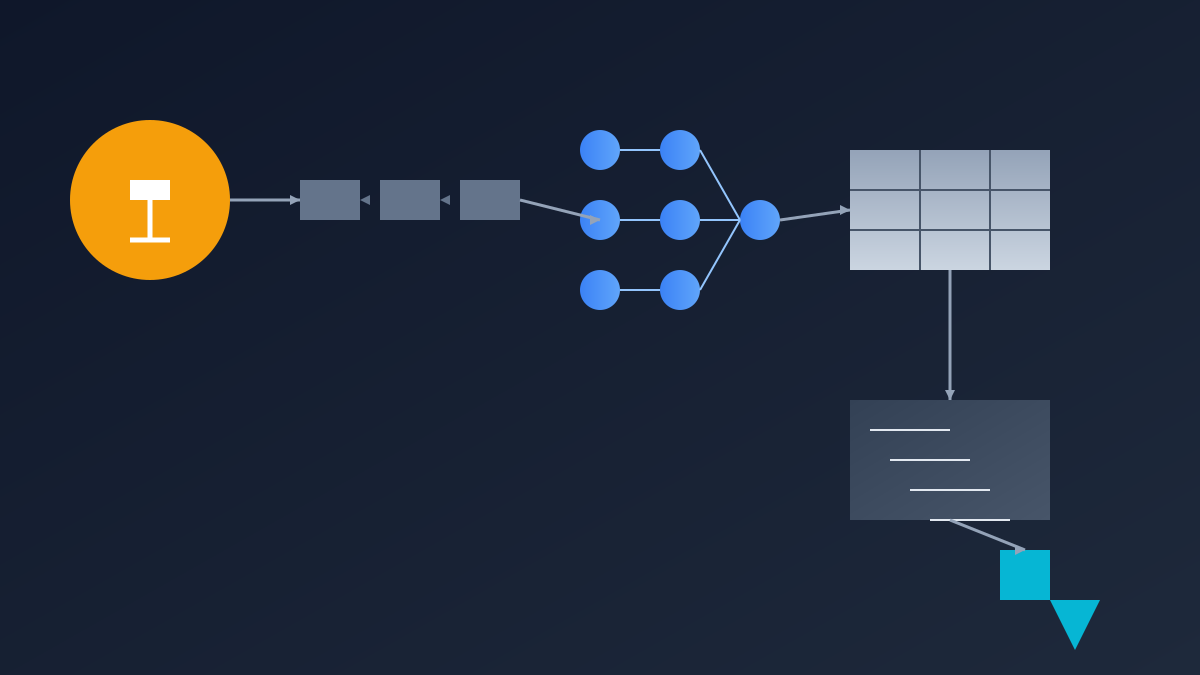
The system is driven by GitHub Actions and runs every 2 hours. Core components include:

  1. Data Collection Layer: Crawls paper information from platforms/conferences like arXiv, NeurIPS, ICML, ICLR, ACL, and CVPR via scripts;
  2. Intelligent Analysis Layer: Performs keyword/topic detection, methodology analysis, complexity rating (high/medium/low), and statistical indicator calculation;
  3. Structured Output Layer: Organizes each paper into Markdown format containing timestamp, title, authors, links, category tags, statistical information, key topics, research methods, charts (attempted extraction), and original abstract.
4

Section 04

Content Organization and Technical Features

Content Organization: Uses a time-hierarchical directory structure (e.g., 2025/september/02-09-2025_14-30.md), making it easy to browse by time or directly access content from specific dates. Technical Features:

  • Automation: Unattended operation via GitHub Actions;
  • Structured Readability: Uses emojis and templates to enhance content readability;
  • Multi-dimensional Classification: Covers mainstream directions like ML/AI, NLP, CV, RL;
  • Open-source Collaboration: MIT license, supports community PR contributions.
5

Section 05

Application Scenarios and Value

The project is suitable for multiple roles:

  • Researchers: Quickly filter papers that need in-depth reading, improving literature research efficiency;
  • Engineers: Obtain the latest model architectures, training techniques, and application cases;
  • Students: Cultivate sensitivity to academic literature and build domain cognition;
  • Technical Managers: Track industry trends and assist in technical roadmap planning.
6

Section 06

Limitations and Improvement Directions

Limitations:

  • Limited coverage (mainly arXiv and a few top conferences);
  • Automated abstracts lack the depth of manual interpretation;
  • Limited success rate in chart extraction;
  • No personalized recommendation function. Improvement Directions: Expand data sources, introduce large language models to generate richer abstracts, implement personalized push, optimize chart extraction technology, etc.
7

Section 07

Conclusion

Daily Paper Update is a concise and practical open-source tool that solves the pain points of academic literature tracking through automation technology, helping researchers free themselves from massive papers and focus on in-depth reading and research. For practitioners who want to keep up with AI cutting-edge trends, it is a resource worth paying attention to and using.

