Zing Forum

Reading

CodeBase RAGBot: Simplify Codebase Exploration with RAG Technology

An open-source tool combining Retrieval-Augmented Generation (RAG) and large language models, helping developers quickly understand and navigate GitHub codebases via a natural language conversational interface.

RAG大语言模型代码库探索GitHubStreamlit向量数据库PineconeGroq开发者工具AI辅助编程
Published 2026-05-17 21:13Recent activity 2026-05-17 21:18Estimated read 6 min
CodeBase RAGBot: Simplify Codebase Exploration with RAG Technology
1

Section 01

Introduction: CodeBase RAGBot—Simplify Codebase Exploration with RAG Technology

CodeBase RAGBot is an open-source tool that combines Retrieval-Augmented Generation (RAG) and large language models. It helps developers quickly understand and navigate GitHub codebases through a natural language conversational interface. It addresses the pain point of traditional code search tools, which only support keyword matching and lack context understanding, enabling machines to 'read' code and interact with developers to improve development efficiency.


2

Section 02

Background: Traditional Pain Points in Codebase Understanding

When developers take over new projects or large codebases, traditional code search tools only return isolated results via keyword matching, lacking deep understanding of code context and module relationships. Faced with tens of thousands of lines of code, developers need to spend a lot of time reading documents and tracking call chains, which affects onboarding speed and maintenance efficiency. How to enable machines to understand code and interact naturally has become the key to improving efficiency.

3

Section 03

Core Technical Architecture: RAG and Efficient Tech Stack

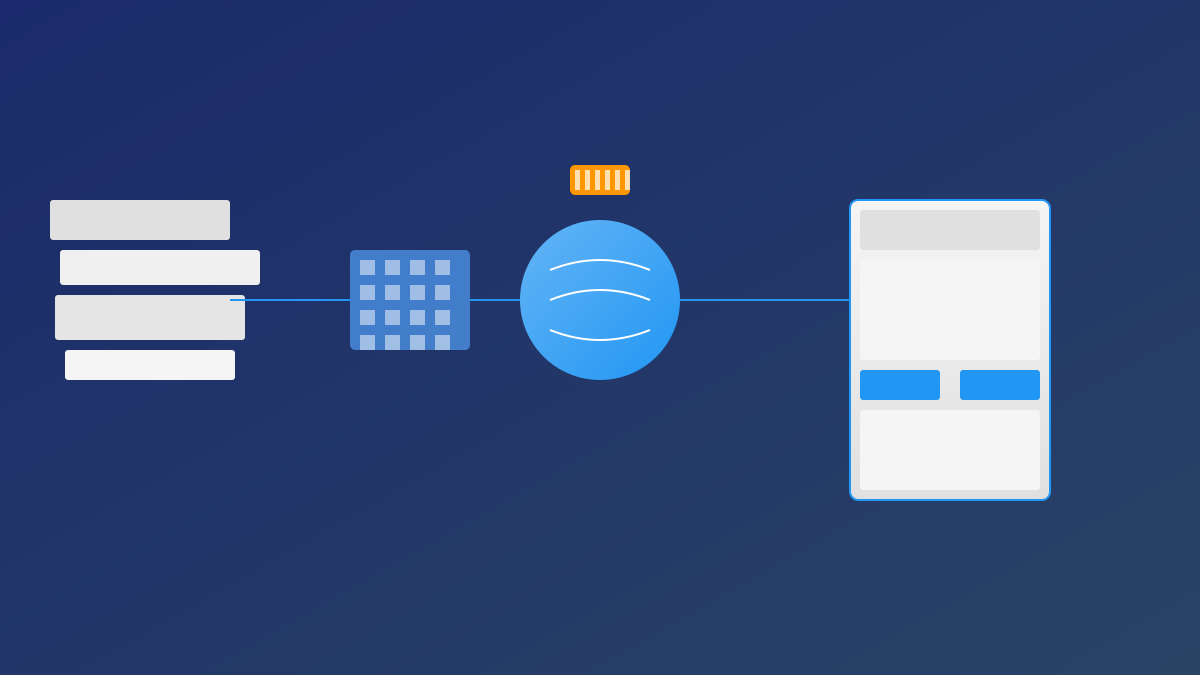
CodeBase RAGBot is based on the RAG architecture: when a user asks a question, it first retrieves relevant code snippets from the vector database, then inputs them into the large model to generate answers based on actual code, ensuring factual accuracy and traceability. The tech stack includes: Streamlit for the frontend, Sentence Transformers for text embedding, Pinecone for the vector database, Groq's llama-3.1-70b-versatile as the large model, and GitPython for repository management. It also implements intelligent context management, preserving key information through chunking and compression.

4

Section 04

Application Scenarios: Boost Development Efficiency in Multiple Scenarios

  1. Quick onboarding for new members: Acting as an intelligent mentor, it helps new developers quickly understand project architecture, core modules, etc., reducing familiarization time; 2. Code review assistance: Quickly understand the context of modified code, check design patterns and potential conflicts; 3. Legacy project maintenance: Help maintainers rebuild code cognition and sort out business logic; 4. Open-source project learning: Interactively ask questions to understand implementation details and design decisions.
5

Section 05

Usage Flow: Simple and Intuitive Steps

  1. Environment preparation: Install Python 3.8+, configure Pinecone and Groq API keys; 2. Launch the application: Run streamlit run main.py; 3. Input repository: Enter the GitHub repository URL in the interface; 4. Wait for processing: The system automatically clones the repository, analyzes the structure, and builds the vector index; 5. Start conversation: Ask questions about the code via the chat interface.
6

Section 06

Technical Limitations and Future Outlook

Limitations: Relies on Pinecone and Groq APIs, requiring adaptation for private deployment; deep understanding of some language ecosystems needs improvement; processing efficiency and cost for ultra-large repositories need optimization. Outlook: Support local model deployment to reduce dependencies; enhance understanding of code change history; integrate IDE plugins for a seamless development experience.

7

Section 07

Conclusion: A New Direction for AI-Assisted Development

CodeBase RAGBot represents an important direction for AI-assisted software development, enabling machines to understand code and collaborate with developers. As technology evolves, more intelligent tools will change the way developers interact with code. This open-source project is not only practical but also provides a reference architecture for code intelligence applications, making it worth trying for developers.

