Zing Forum

Reading

Deep Learning-Based Potato Disease Identification System: CNN Empowers Smart Agriculture

This article introduces an open-source project that uses Convolutional Neural Networks (CNN) to achieve automatic detection of potato leaf diseases, and discusses the application value and technical implementation path of deep learning in smart agriculture.

深度学习卷积神经网络CNN智慧农业作物病害识别计算机视觉马铃薯农业AI图像分类
Published 2026-05-29 20:46Recent activity 2026-05-29 20:48Estimated read 6 min
Deep Learning-Based Potato Disease Identification System: CNN Empowers Smart Agriculture
1

Section 01

CNN-Based Potato Disease Identification System: An AI Solution for Smart Agriculture

This article introduces the GitHub open-source project Potato_Disease_Predictor, which uses Convolutional Neural Networks (CNN) to realize automatic detection of potato leaf diseases. It aims to solve the pain points of traditional manual identification and explore the application value and technical path of deep learning in smart agriculture. The project is maintained by samruddhiwaikar29 and was released on May 29, 2026.


2

Section 02

Project Background and Agricultural Pain Points

Potato is the fourth largest food crop in the world, and diseases are the main problem in planting. Early diseases appear on leaves, and timely identification can reduce yield losses. Traditional manual identification requires professional knowledge, is inefficient, and easily misses the prevention and control window. Deep learning and computer vision provide a new solution for disease identification.

3

Section 03

Overview of Technical Solution

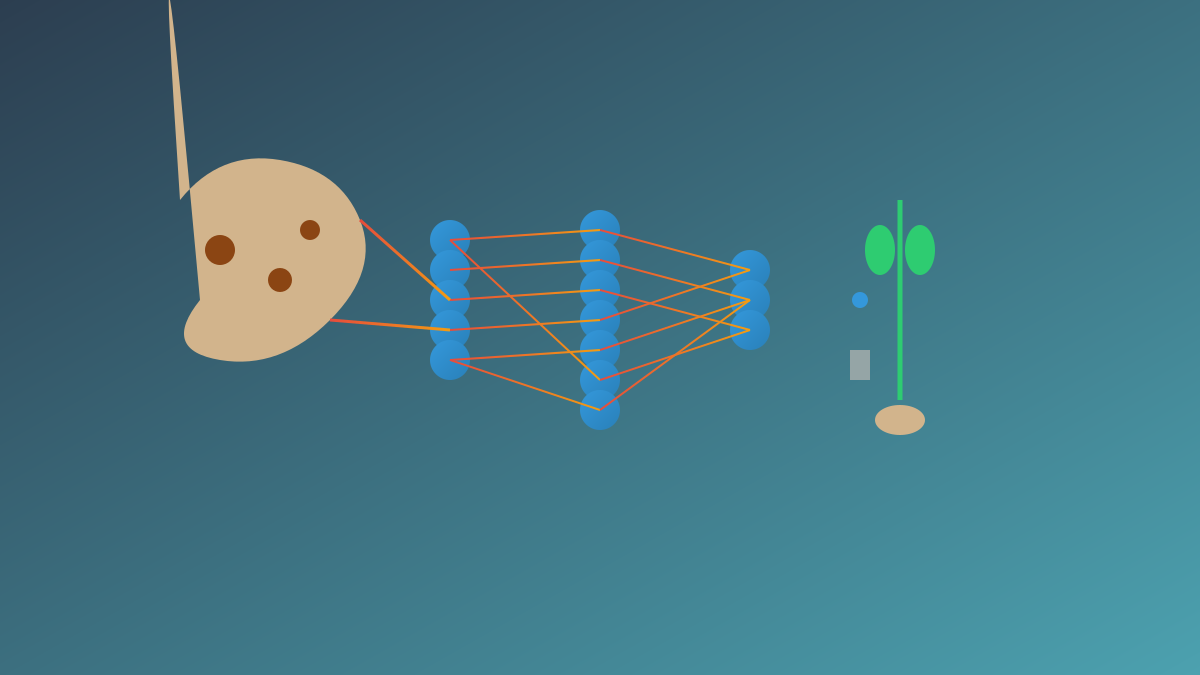
The project core uses a CNN model to automatically learn image features. System flow: collect leaf images → input into the trained CNN model for inference → output disease category and confidence, which can be completed in real time on mobile/edge devices. Disease classification includes three categories: early blight (caused by Alternaria solani, with concentric ring lesions), late blight (caused by Phytophthora infestans, fast spreading), and healthy leaves.

4

Section 04

Model Training and Data Strategy

Training data needs to cover different growth stages, light conditions, disease severity levels, varieties, and planting areas. Data augmentation techniques (rotation, flipping, scaling, brightness adjustment) can expand samples and improve the generalization ability and robustness of the model.

5

Section 05

Application Value in Smart Agriculture

Application value includes: real-time monitoring (instant diagnosis via mobile phone photo), lowering technical thresholds (ordinary farmers get professional services), precise pesticide application (targeted selection of pesticides), and large-scale application (low deployment cost to serve large areas).

6

Section 06

Key Technical Implementation Points

Key links: image preprocessing (unified size, normalization, handling scale changes); model architecture selection (lightweight networks like MobileNet/EfficientNet are suitable for mobile terminals); class imbalance handling (oversampling, class weighting); model interpretability (Grad-CAM visualization of attention areas).

7

Section 07

Limitations and Improvement Directions

Current challenges: data coverage (whether it covers diseases in the target area), environmental adaptability (performance under complex conditions), early identification (sensitivity of initial symptom detection), and classification accuracy for concurrent multiple diseases. Improvement directions: multi-source data pre-training, semi-supervised learning using unlabeled data, multi-task models for pest and disease detection, and building farm management decision support systems.

8

Section 08

Conclusion

This project is a microcosm of deep learning empowering traditional agriculture. The popularization of edge computing and model lightweight technology promotes AI tools from the laboratory to the field. Developers have rich application scenarios and data opportunities, while farmers lower the threshold of professional knowledge. This two-way effort promotes the development of smart agriculture.

