Zing Forum

Reading

ANN-SVD: Fusion of Neural Networks and Singular Value Decomposition to Accelerate PDE Solving

This article introduces the ANN-SVD framework, an innovative method combining artificial neural networks with Singular Value Decomposition (SVD) to accelerate the numerical solution of partial differential equations (PDEs). By applying Thin, Compact, and Truncated SVD at different levels, this framework significantly improves the convergence speed and computational efficiency of neural networks.

神经网络奇异值分解偏微分方程科学计算机器学习低秩近似PINNs数值方法
Published 2026-05-05 11:43Recent activity 2026-05-05 11:49Estimated read 9 min
ANN-SVD: Fusion of Neural Networks and Singular Value Decomposition to Accelerate PDE Solving
1

Section 01

ANN-SVD Framework: Fusion of Neural Networks and SVD to Accelerate PDE Solving (Introduction)

This article introduces the ANN-SVD framework, an innovative method that deeply integrates artificial neural networks (especially Physics-Informed Neural Networks, PINNs) with Singular Value Decomposition (SVD) to address the efficiency bottleneck in the numerical solution of partial differential equations (PDEs). By applying three SVD modes—Thin, Compact, and Truncated—to the weight matrices inside the network, this framework significantly improves convergence speed, computational efficiency, and optimizes parameter scale, providing an efficient solution for high-dimensional and complex PDE problems.


2

Section 02

Challenges in PDE Solving and Limitations of PINNs (Background)

Partial differential equations (PDEs) are core mathematical tools for describing natural phenomena, widely used in fields such as fluid mechanics and electromagnetism. Traditional numerical methods (e.g., finite difference method, finite element method) face the dilemma of exponentially increasing computational costs when dealing with high-dimensional or complex boundary problems. In recent years, Physics-Informed Neural Networks (PINNs) have brought new ideas to PDE solving, but pure PINNs have problems such as slow training, difficult convergence, and parameter redundancy. How to balance flexibility and efficiency has become a research hotspot in this field.

3

Section 03

Core Ideas of the ANN-SVD Framework and SVD Application Modes (Methodology)

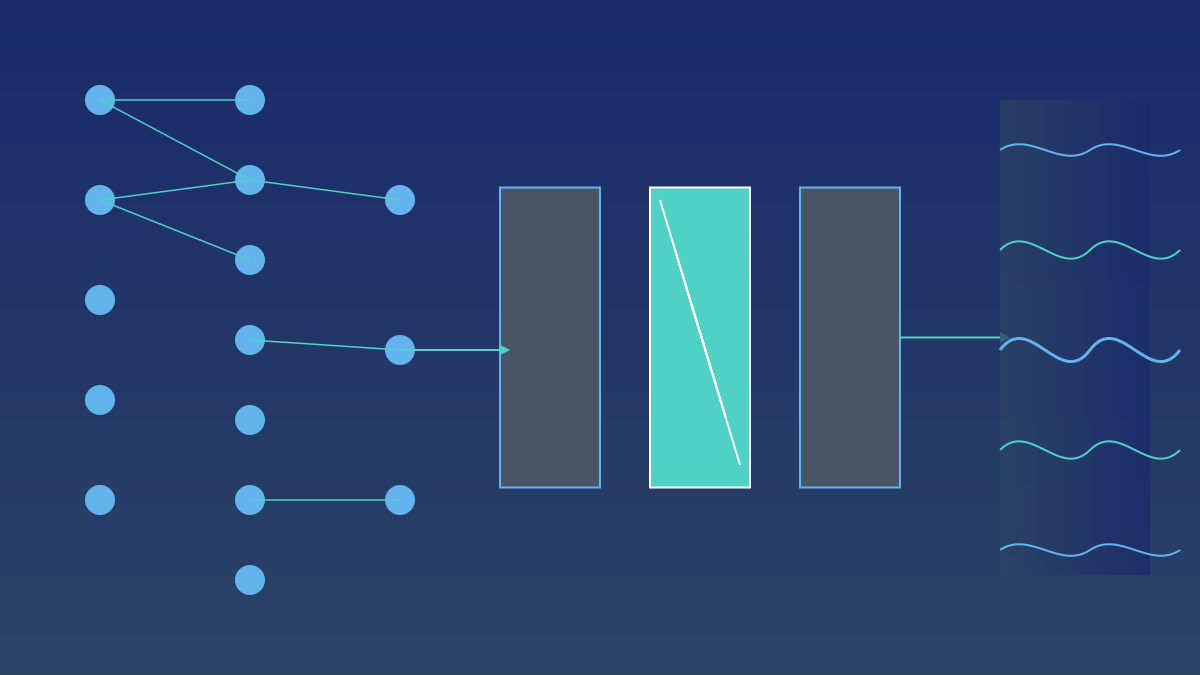
The ANN-SVD framework was proposed by Kurniati et al. Its core innovation is to use SVD as an internal structural operation of the network, directly acting on the weight matrices between hidden layers (utilizing the low-rank structure of weight matrices). The framework provides three SVD application modes:

  1. Thin SVD: When the weight matrix has dimensions m×n and m>n, it is decomposed into U_r·Σ_r·V_r^T, retaining all valid information while reducing storage and computational complexity;
  2. Compact SVD: Retains the top k largest singular values and their vectors, significantly compressing the parameter scale;
  3. Truncated SVD: Controls the retention of singular values through a threshold, balancing accuracy and computational efficiency.
4

Section 04

Implementation Mechanism of ANN-SVD in Neural Networks

ANN-SVD integrates the SVD operation into the weight matrix between the first and second hidden layers (the weights at this stage have a clear low-rank structure). The specific implementation process is as follows:

  1. Initialize the weight matrix W between the first and second layers;
  2. Calculate the output of the first layer: h₁ = σ(W₁·x + b₁);
  3. Perform the selected SVD decomposition (Thin/Compact/Truncated) on W₂;
  4. Use the decomposed components to calculate h₂ = σ(U·Σ·V^T·h₁ + b₂);
  5. Update the singular values and vectors through backpropagation, continuously maintaining the low-rank structure.
5

Section 05

Performance Improvement Effects of ANN-SVD (Evidence)

The ANN-SVD framework brings multi-dimensional performance improvements:

  • Parameter efficiency: Compact SVD can reduce parameters from mn to k(m+n+1), and when k<<min(m,n), the compression ratio reaches an order of magnitude improvement;
  • Computational acceleration: The complexity of matrix multiplication is reduced from O(mn) to O(k(m+n)), suitable for large-scale PDE problems;
  • Convergence stability: Low-rank constraints provide implicit regularization, reducing the complexity of the optimization landscape and lowering the risk of local optima;
  • Memory optimization: Parameter compression makes larger-scale networks or finer-grained discretization possible.
6

Section 06

Application Scenarios and Method Comparison

ANN-SVD is particularly suitable for the following scenarios: high-dimensional PDEs (alleviating the curse of dimensionality), parameterized PDEs (sharing low-rank structures across instances), inverse problems (accelerating forward solving), and real-time inference (reducing latency). Comparison with other methods:

Method Core Idea Advantages Limitations
Traditional FEM/FDM Grid discretization Mature and stable Curse of dimensionality
Standard PINNs Pure neural network Mesh-free, flexible Slow training, difficult convergence
ANN-SVD NN+SVD hybrid Balance between efficiency and accuracy Requires parameter tuning to select SVD mode
DeepONet Operator learning Learns solution operators Needs large amounts of training data
Fourier Neural Operator Frequency domain learning Resolution-invariant Complex implementation
7

Section 07

Usage Recommendations and Future Directions

Usage Recommendations:

  1. SVD mode selection: Start with Thin SVD as a baseline, then gradually try Compact and Truncated SVD to observe the accuracy-efficiency trade-off;
  2. Rank selection: For Compact/Truncated SVD, the rank k or threshold τ can start from 10-20% of the matrix dimension, and adjust according to the validation error;
  3. Optimizer matching: Use adaptive optimizers such as Adam and adjust the learning rate;
  4. Hardware considerations: GPUs are more efficient for batch processing multiple matrices, while CPUs can be used for single small matrices. Future Directions: Adaptive rank adjustment, multi-layer SVD expansion, combination with other decompositions (e.g., QR), and in-depth theoretical analysis of the impact of low-rank constraints on expressive power.

