Zing Forum

Reading

AMPLIFAI Challenge: Multi-Phase Liver Imaging AI Annotation Dataset

This article introduces the AMPLIFAI medical imaging challenge, which provides a finely annotated dataset of multi-phase liver CT/MRI images, aiming to advance AI technologies for automatic detection and segmentation of liver lesions.

医学影像肝脏CT多期相扫描AI挑战赛影像分割病变检测深度学习计算机视觉医疗AI
Published 2026-06-06 05:04Recent activity 2026-06-06 05:20Estimated read 6 min
AMPLIFAI Challenge: Multi-Phase Liver Imaging AI Annotation Dataset
1

Section 01

Introduction: AMPLIFAI Challenge - Multi-Phase Liver Imaging AI Annotation Dataset

This article introduces the AMPLIFAI medical imaging challenge maintained by the University of Michigan Intelligent Healthcare Computing Center (UM-IHC-CA2i). The project provides a finely annotated dataset of multi-phase liver CT/MRI images, aiming to advance AI technologies for automatic detection and segmentation of liver lesions. The dataset is available on GitHub (link: https://github.com/UM-IHC-CA2i/amplifai-challenge) and was released on June 5, 2026.


2

Section 02

Background: Data Bottlenecks in Medical Imaging AI and the Value of Multi-Phase Imaging

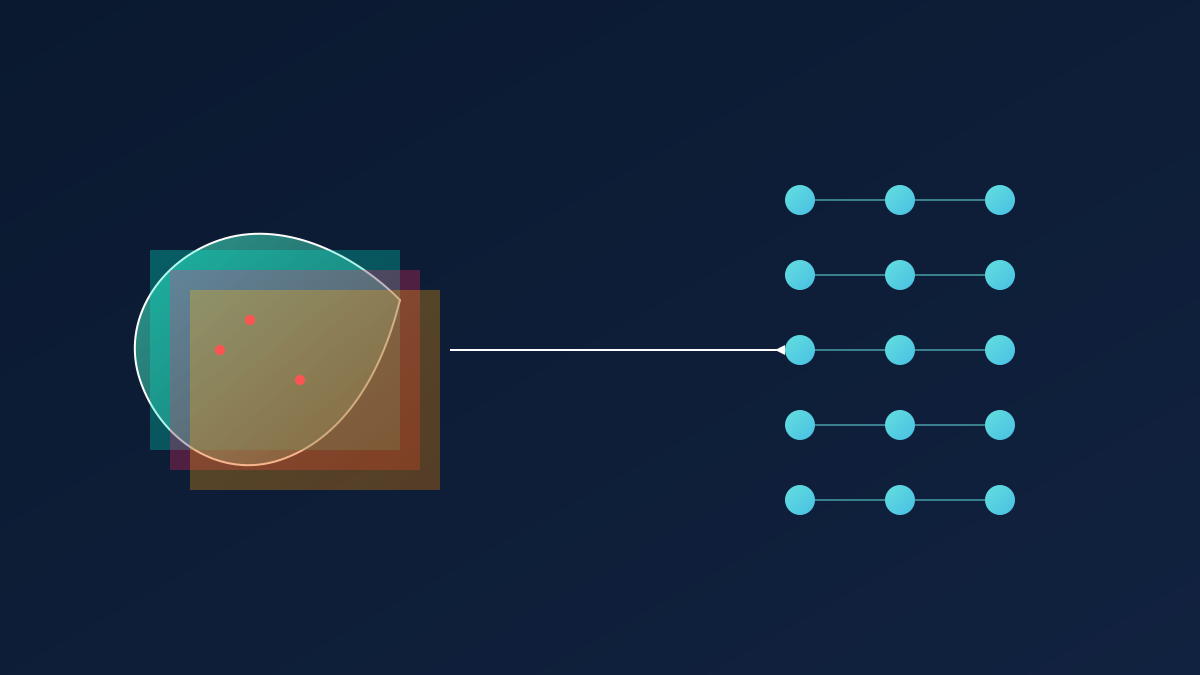
The scarcity of high-quality annotated datasets in the field of medical AI restricts technological development, especially since annotating 3D medical images is time-consuming and costly. Liver CT/MRI multi-phase scans (scans at different time points after contrast agent injection) leverage the liver's dual blood supply, so different lesions exhibit distinct enhancement features in each phase: the plain scan phase assesses calcification and hemorrhage; the arterial phase shows lesions supplied by the hepatic artery (e.g., hepatocellular carcinoma); the portal venous phase evaluates overall structure; and the delayed phase identifies specific lesions (e.g., hemangiomas). Multi-phase information is crucial for physician diagnosis and AI model learning.

3

Section 03

Core Features of the AMPLIFAI Dataset

  1. Multi-Phase Registration: Provides registered images of different phases for the same patient, addressing issues of respiratory motion and organ deformation; 2. Fine Annotation: Professional physicians annotate liver contours, lesion areas, lesion types (e.g., hepatocellular carcinoma, metastases), and vascular structures; 3. Clinical Relevance: Covers common clinical lesion types to ensure model transferability to real-world scenarios.
4

Section 04

Challenge Task Design

Four tasks are set: 1. Liver Segmentation (a basic step to handle blurred boundaries and lesion interference); 2. Lesion Detection (output candidate positions and confidence scores to identify tiny lesions); 3. Lesion Segmentation (pixel-level delineation of lesion boundaries); 4. Multi-Phase Fusion Analysis (classify lesions by integrating multi-phase information).

5

Section 05

Technical Challenges and Innovation Directions

Core challenges include: 1. Multi-Modal Fusion (designing networks to capture complex temporal features); 2. Few-Shot Learning (applying techniques like transfer learning and data augmentation); 3. 3D Convolutional Networks (balancing performance and computational cost); 4. Uncertainty Quantification (assisting physicians in manual review).

6

Section 06

Significance for the Medical Imaging AI Community

  1. Standardized Evaluation: Unifies benchmark datasets and metrics to facilitate result comparison; 2. Technological Advancement: Challenging tasks incentivize the development of advanced algorithms; 3. Clinical Translation: Real clinical data promotes the implementation of research outcomes; 4. Educational Value: Provides training data and reference implementations for learners.
7

Section 07

How to Participate in the AMPLIFAI Project

Participation steps: 1. Visit the GitHub repository to obtain dataset links, task descriptions, and benchmark code; 2. Download annotated data following the protocol; 3. Develop algorithms based on the training set; 4. Evaluate on the test set and submit results; 5. Write a report or paper to share the method.

8

Section 08

Conclusion: The Future of Data-Driven Medical AI

AMPLIFAI embodies the trend of open data sharing in medical imaging AI, breaking the data bottleneck for algorithmic innovation. It is an ideal starting point for beginners and a platform for senior researchers to showcase their technologies. In the future, more similar projects will accelerate the development of medical AI, improve diagnostic accuracy and efficiency, and benefit patients.

