Zing Forum

Reading

Explainable AI-Driven Land Use Classification: A New Paradigm of Sentinel-2 Satellite Remote Sensing and Deep Learning Integration

This article introduces a land use and land cover (LULC) classification system combining explainable artificial intelligence (XAI) with Sentinel-2 satellite imagery, and explores paths to enhance the transparency, reliability, and decision support capabilities of deep learning models in remote sensing applications.

可解释人工智能土地利用分类Sentinel-2卫星遥感影像深度学习LULCGrad-CAMSHAP地理信息系统环境监测
Published 2026-05-14 20:56Recent activity 2026-05-14 20:58Estimated read 4 min
Explainable AI-Driven Land Use Classification: A New Paradigm of Sentinel-2 Satellite Remote Sensing and Deep Learning Integration
1

Section 01

[Introduction] Explainable AI-Driven New Paradigm for Sentinel-2 Remote Sensing Land Use Classification

This article introduces a land use and land cover (LULC) classification system combining explainable artificial intelligence (XAI) with Sentinel-2 satellite imagery, aiming to solve the "black box" problem of traditional deep learning models and improve the transparency, reliability, and decision support capabilities of remote sensing applications.


2

Section 02

Background: Black Box Dilemma of Remote Sensing AI and Technical Advantages of Sentinel-2

Traditional deep learning models have achieved breakthroughs in LULC classification accuracy, but their lack of interpretability affects decision credibility. The Sentinel-2 satellite constellation (operated by ESA) features high resolution (10-60 meters), multi-spectral (13 bands), and short revisit cycle (5 days), providing rich spectral features for models and facilitating ground object recognition.

3

Section 03

Methods: Technical Architecture and Interpretability Solutions

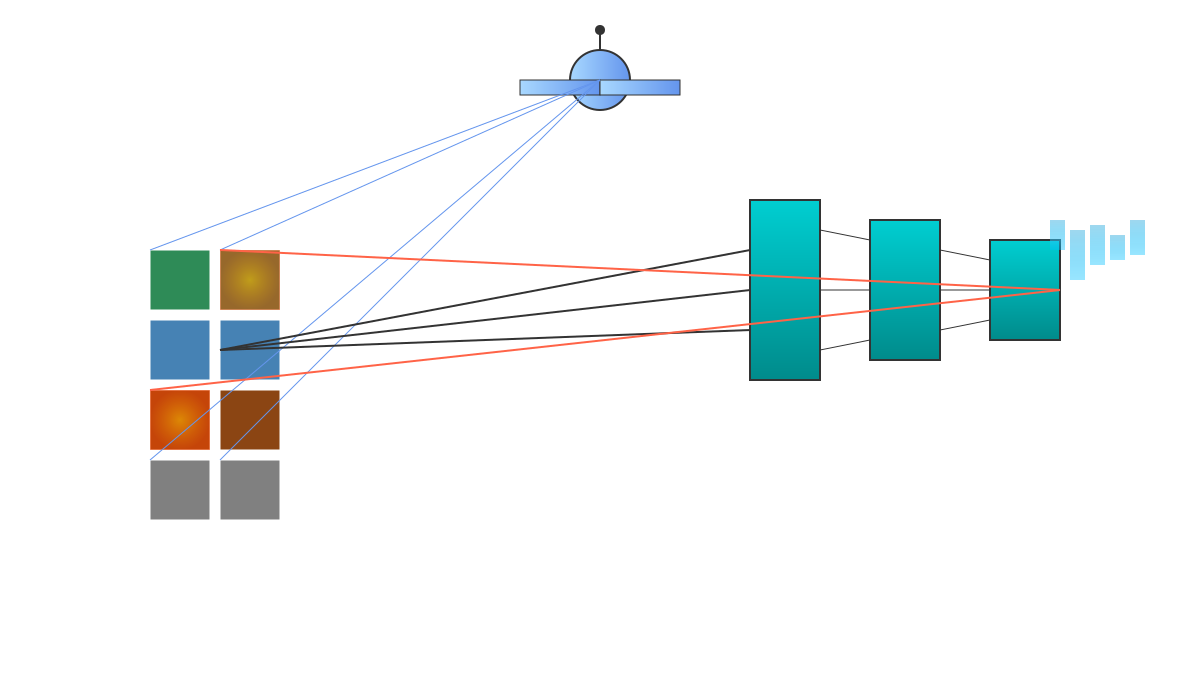
The technical process includes data preprocessing (atmospheric correction, cloud masking, etc.), feature engineering (deriving indices like NDVI/EVI/NDWI), and model architecture (CNN/U-Net + attention mechanism, compared with traditional algorithms such as random forest). Interpretability techniques used are Grad-CAM (heatmap visualization of decision areas), SHAP (quantification of feature contributions), and LIME (local model approximation).

4

Section 04

Evidence: Validation of Effects in Multi-Domain Application Scenarios

This system functions in multiple scenarios: monitoring crop growth and adjusting farming strategies in precision agriculture; assisting construction land supervision and ecological red line demarcation in urban planning; supporting carbon sink assessment and biodiversity analysis in climate change research. Interpretability evidence enhances decision reliability.

5

Section 05

Conclusion: Explainable AI Enhances Credibility and Value of Remote Sensing Classification

Explainable AI technology effectively solves the black box problem of remote sensing models and enhances decision transparency; Sentinel-2's multi-spectral data provides high-quality input for models; the integrated classification system of the two has important value in both academic research and practical decision-making.

6

Section 06

Suggestions and Outlook: Challenges and Future Development Directions

Current challenges include high computational cost of interpretation, insufficient method standardization, and difficulty in converting technical explanations into business language. Future efforts need to promote multi-source data fusion (optical/radar/hyperspectral), combine time-series analysis with knowledge graphs, and improve classification accuracy and interpretability.

