Zing Forum

Reading

Generative AI for Heart Disease Education: A Personalized Health Science Popularization System Based on RAG and LLM

This article introduces a healthcare project combining generative AI and machine learning, which uses Retrieval-Augmented Generation (RAG) technology and Large Language Models (LLMs) to provide personalized health education services for heart disease patients, exploring the innovative application of AI in the field of medical science popularization.

生成式AI检索增强生成RAG心脏疾病教育医疗AI个性化健康大语言模型医学科普
Published 2026-05-06 12:43Recent activity 2026-05-06 12:58Estimated read 6 min
Generative AI for Heart Disease Education: A Personalized Health Science Popularization System Based on RAG and LLM
1

Section 01

Introduction to the Generative AI Heart Disease Education Project

This article introduces a personalized heart disease health education system that combines Retrieval-Augmented Generation (RAG) technology and Large Language Models (LLMs). The project aims to address the one-size-fits-all problem in traditional medical science popularization, provide patients with tailored, scientifically accurate health knowledge, explore the innovative application of AI in the field of medical science popularization, and achieve the integration of technology and humanistic care.


2

Section 02

Background and Challenges of Heart Disease Education

Cardiovascular disease is the number one health killer globally, but public awareness is insufficient. Traditional health education faces three major challenges: first, it is difficult to balance the professionalism of medical knowledge with patients' understanding; second, patients have large differences in background (age, medical history, literacy, etc.), so unified materials cannot meet their needs; third, health information requires high credibility, and the cost of misinformation is huge.

3

Section 03

RAG Architecture: Core Method to Ensure Content Accuracy

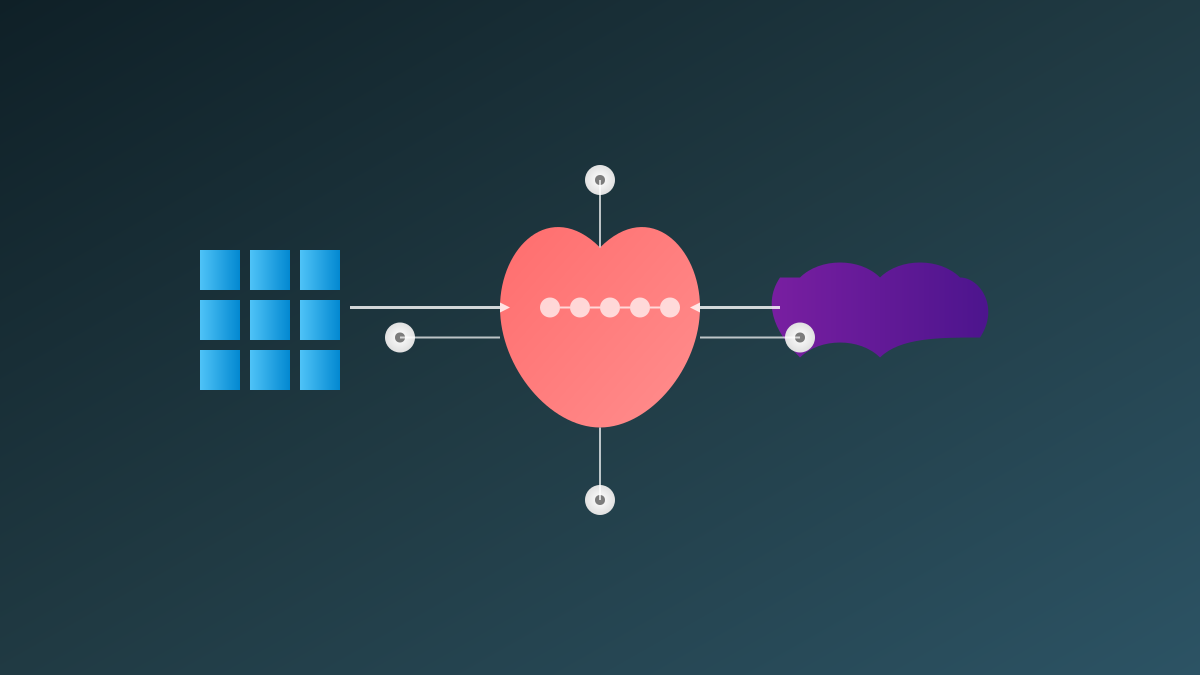
The project adopts the RAG architecture, combining the generative ability of LLMs with the retrieval of external authoritative knowledge bases. The process is: receive patient queries → retrieve relevant medical literature fragments → inject context to guide LLM to generate answers, reducing the risk of "hallucinations". The knowledge base integrates multi-source materials such as cardiology guidelines and clinical pathways, which have been professionally reviewed; the vector database supports semantic retrieval, so relevant content can be found even if the expressions are not completely consistent.

4

Section 04

Implementation Path of Personalization Mechanism

The system achieves personalization through multiple dimensions: 1. Patient portrait modeling (collect basic information, medical history, lifestyle, etc. to build a health portrait); 2. Health literacy assessment (dynamically adjust content complexity); 3. Context awareness (adjust content focus according to treatment stages); 4. Preference learning (optimize recommendations through user feedback).

5

Section 05

Advantages and Risks of Generative AI in Medical Scenarios

Advantages: Natural interactivity (ask questions in daily language and get fluent answers); content generability (instant customization to cover long-tail needs). Risks: Strict verification of content accuracy is required, and a confidence assessment mechanism must be established; privacy protection needs the highest standards, and sensitive health data requires security measures.

6

Section 06

Application Scenarios and Clinical Value

Application scenarios include hospitals (assist doctors in education and improve the efficiency of doctor-patient communication), chronic disease management (continuous health guidance), and community medical care (make up for the lack of primary resources). Clinical value: Improve the quality of patient education, enhance treatment compliance, reduce readmission rates, improve quality of life, and reduce labor costs at the same time.

7

Section 07

Limitations and Future Directions

Current limitations: It is difficult to maintain the timeliness of medical knowledge; multi-modal content generation (schematic diagrams, animations) needs to be improved; clinical effectiveness needs to be verified by randomized controlled trials. Future directions: Integrate with wearable devices to achieve dynamic education; support multiple languages; continuously improve content by combining with a doctor crowdsourcing review mechanism.

8

Section 08

Conclusion: A Medical Future with Technology for Good

This project demonstrates the positive application of AI in the medical field. It does not replace doctors but amplifies their value, allowing professional knowledge to reach more patients. The combination of technology and humanistic care will make the medical future warmer, enhancing human dignity and quality of life.

