Zing Forum

Reading

In-depth Analysis of ai-rag-system: A Document Analysis System Based on Retrieval-Augmented Generation

This article introduces an open-source implementation of a RAG (Retrieval-Augmented Generation) system, covering core modules such as document retrieval, re-ranking, and structured output, providing a reference for building enterprise-level AI document analysis applications.

RAG检索增强生成文档分析向量检索重排序开源项目GitHub
Published 2026-03-31 20:33Recent activity 2026-03-31 21:18Estimated read 5 min
In-depth Analysis of ai-rag-system: A Document Analysis System Based on Retrieval-Augmented Generation
1

Section 01

Introduction: Core Analysis of the Open-Source RAG System ai-rag-system

This article introduces the open-source RAG system ai-rag-system, covering core modules such as document retrieval, re-ranking, and structured output. It demonstrates the design ideas and best practices for key components of the RAG architecture, providing a reference for building enterprise-level AI document analysis applications. This project is open-sourced by matthew-donovan-pro and aims to demonstrate a complete document analysis pipeline.


2

Section 02

Background: RAG Systems Address Pain Points in Enterprise AI Document Analysis

With the rapid development of Large Language Models (LLMs), enterprises hope to combine internal documents with AI capabilities. However, general-purpose LLMs have issues such as severe hallucinations, inability to access the latest information, and lack of traceability. Retrieval-Augmented Generation (RAG) technology effectively addresses these pain points by retrieving relevant context from the knowledge base before generation.

3

Section 03

Core Architecture: Retrieval, Re-ranking, and Structured Output

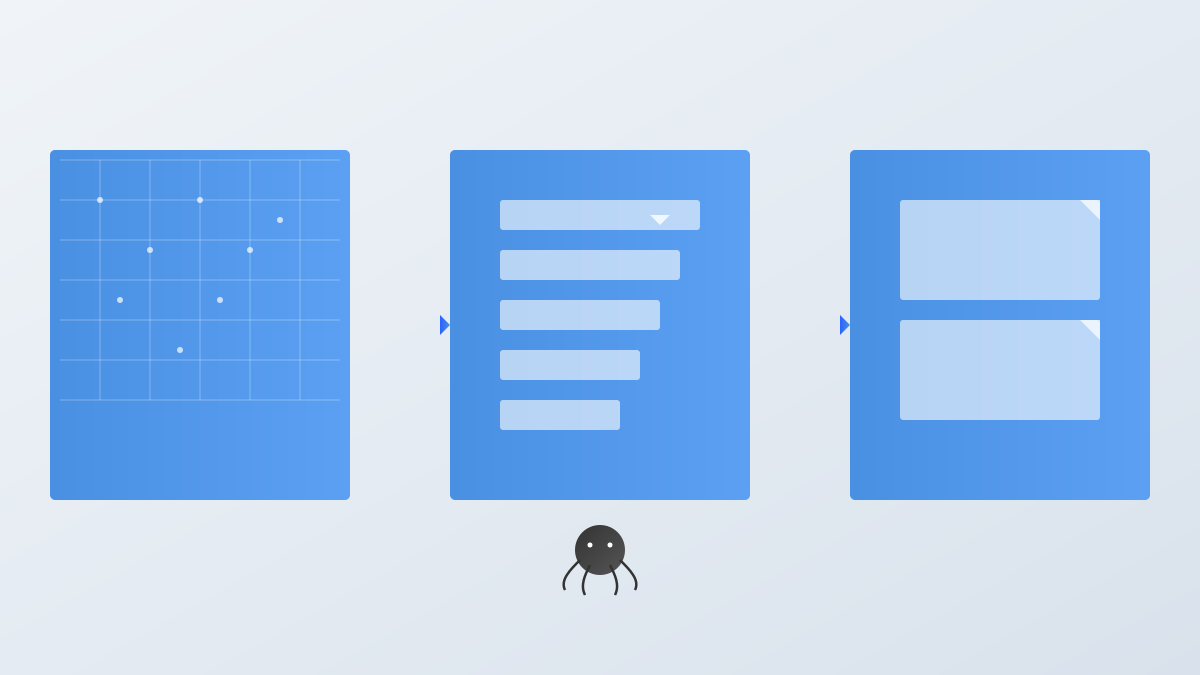
  1. Document Retrieval Module: Based on vector similarity, it splits documents into semantic chunks and generates embedding vectors to enable efficient semantic search and understand the deep meaning of queries;
  2. Re-ranking Mechanism: Drawing on the two-stage retrieval paradigm, it performs secondary fine-ranking on the initial screening results to improve precision;
  3. Structured Output: Returns results in a predefined JSON format, including meta-information such as answers, reference sources, and confidence levels, facilitating downstream parsing and verification.
4

Section 04

Technical Highlights: Modularity, Configurability, and Observability

  1. Modular Design: The retrieval, ranking, and generation components are decoupled, supporting replacement of vector databases (e.g., FAISS → Milvus/Pinecone) and re-ranking models;
  2. Configurability: Provides configuration options for chunking strategies, retrieval parameters, generation parameters, etc., to adapt to different scenarios;
  3. Observability: Built-in logging and tracing mechanisms record metrics such as retrieval time and recall count, helping with tuning and troubleshooting.
5

Section 05

Application Scenarios and Practical Recommendations

  1. Enterprise Knowledge Base Q&A: Connect to internal wikis, manuals, etc., allowing employees to quickly obtain information;
  2. Customer Service Assistance: Retrieve product documents and historical work orders in real time to provide script suggestions;
  3. Compliance Review: Assist in locating regulatory clauses to ensure business compliance.
6

Section 06

Optimization Directions and Advanced Thoughts

  1. Multi-source Recall: Combine vector, keyword, and graph retrieval, and integrate ranking to improve results;
  2. Query Rewriting and Expansion: Generate related queries or synonyms via LLMs to improve recall rate;
  3. Context Compression: Streamline long document fragments to avoid window overflow and noise.
7

Section 07

Summary and Outlook

ai-rag-system demonstrates the basic framework and key design of a RAG system. Although there is room for improvement in production-level features (concurrency, caching, permissions), its clear structure and modular concept provide a good starting point for developers. With the rise of new paradigms such as multi-modal RAG and Agentic RAG, RAG technology is still evolving. Deeply understanding its principles and practices is a necessary path to building reliable enterprise AI applications.

