Zing Forum

Reading

Enterprise AI Knowledge Assistant: Building a Scalable RAG Document Retrieval Platform

Introduces an open-source enterprise-level RAG platform that supports semantic search, multilingual embedding, quantized LLM, and low-memory inference optimization to help enterprises intelligently retrieve knowledge from large-scale documents.

RAG企业知识管理语义搜索FAISS量化LLM多语言嵌入文档检索本地部署
Published 2026-05-24 18:44Recent activity 2026-05-24 18:49Estimated read 6 min
Enterprise AI Knowledge Assistant: Building a Scalable RAG Document Retrieval Platform
1

Section 01

[Introduction] Enterprise AI Knowledge Assistant: Overview of the Open-Source RAG Document Retrieval Platform

Enterprise AI Knowledge Assistant is an open-source enterprise-level RAG document retrieval platform maintained by Tanishaa19, with source code hosted on GitHub (link: https://github.com/Tanishaa19/Enterprise-AI-Knowledge-Assistant). This platform aims to address the shortcomings of traditional keyword search in enterprise knowledge management, as well as data privacy and cost issues with cloud-based LLMs. It supports semantic search, multilingual embedding, quantized LLM, and low-memory inference optimization, and can run in local or private cloud environments, providing enterprises with a secure and efficient intelligent knowledge retrieval solution.


2

Section 02

Project Background and Motivation: Addressing Core Pain Points in Enterprise Knowledge Management

In today's enterprise environment, the accumulation of massive documents makes it difficult for employees to quickly find the information they need. Traditional keyword search cannot meet complex semantic queries, and relying on cloud-based LLMs has data privacy and cost issues. This project was born to build an intelligent retrieval system that protects data privacy and can run in local/private cloud environments. It adopts the RAG architecture combined with semantic search and quantized LLM to provide a secure, efficient, and scalable knowledge retrieval solution.

3

Section 03

Core Technical Architecture: Semantic Search, Multilingual Embedding, and Quantized LLM

The core technical architecture includes: 1. Semantic search and vector retrieval: Using FAISS as the vector database to achieve millisecond-level large-scale document fragment retrieval; 2. Multilingual embedding model: Based on Transformer pre-trained models, mapping text in different languages to a unified semantic space to support cross-language queries; 3. Quantized LLM and low-memory inference: Compressing models through model quantization (e.g., converting 32-bit to 8/4-bit), combined with optimized inference engines (batch processing, caching, etc.), reducing resource consumption and supporting operation on consumer-grade GPUs/CPUs.

4

Section 04

System Design and Implementation: Modular Architecture and RAG Workflow

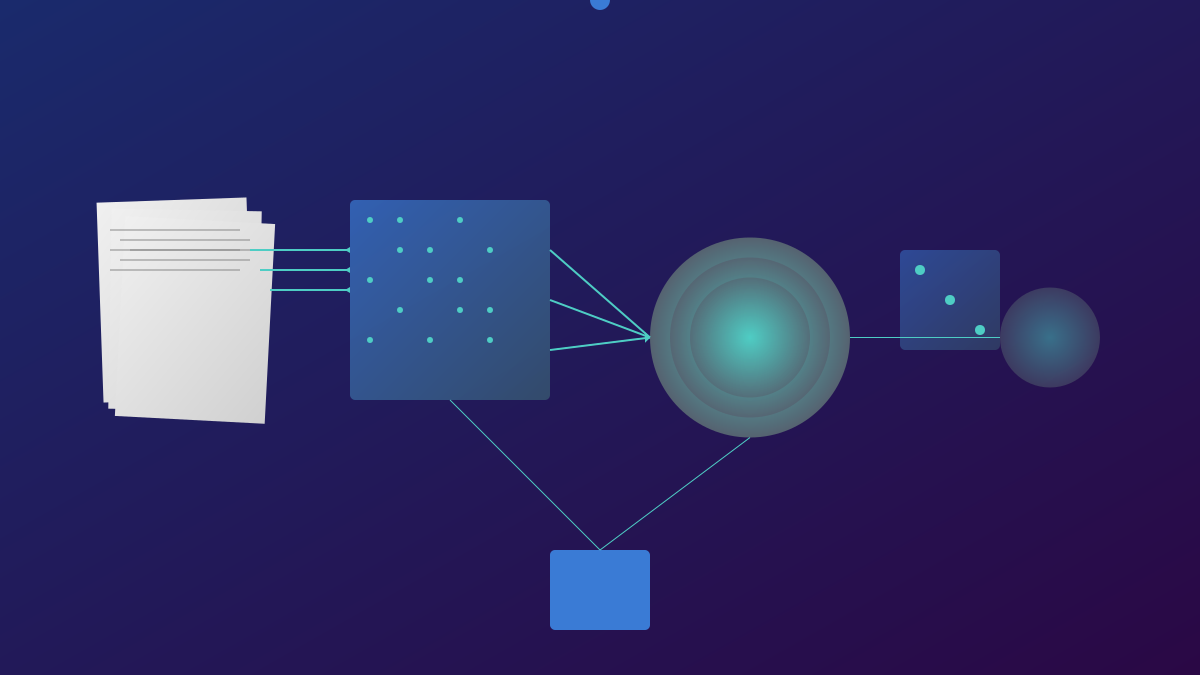
The system adopts a modular design, divided into document processor, embedding generator, vector storage, retrieval engine, and generation module, improving maintainability, scalability, and replaceability. Document processing workflow: Parse formats like PDF/Word/TXT → Text cleaning → Intelligent chunking → Embedding generation → Index construction. RAG workflow: Query understanding → Semantic retrieval → Context construction → Answer generation → Result return (with source annotation to avoid hallucinations).

5

Section 05

Performance Optimization and Evaluation: Ensuring Retrieval and Generation Quality

Performance optimization strategies: Hybrid retrieval (dense vectors + sparse keywords), re-ranking mechanism, query expansion. The evaluation framework supports quantitative analysis: Retrieval metrics (Recall@K, Precision@K, NDCG), generation metrics (BLEU, ROUGE, BERTScore), end-to-end evaluation, continuously monitoring and optimizing system bottlenecks.

6

Section 06

Deployment Flexibility and Typical Application Scenarios

Flexible deployment modes: Local deployment (data never leaves the enterprise), private cloud deployment (Kubernetes elastic scaling), hybrid deployment (sensitive data processed locally + general capabilities called from the cloud). Typical application scenarios: Internal knowledge base Q&A, customer service assistance, compliance review, R&D knowledge management.

7

Section 07

Project Significance and Future Outlook

The significance of this project lies in leveraging LLM capabilities while protecting data sovereignty, making it suitable for enterprises handling sensitive data. Future outlook: With the advancement of multilingual models and quantization technologies, the deployment threshold will be further reduced. We look forward to more efficient models, precise retrieval algorithms, and user-friendly enterprise integration solutions, making AI knowledge assistants a standard for enterprises.

