Zing Forum

Reading

Fully Automated AI Video Creation Pipeline: A Gemini-Based Automated Operation System for YouTube Educational Channels

This project demonstrates a fully autonomous AI video creation system that uses Gemini 2.5 Flash to generate course scripts, synthesizes voice-over educational videos via MoviePy and gTTS, and automatically uploads them to YouTube, enabling zero-human-intervention content production.

GeminiYouTube自动化AI内容生成视频制作GitHub Actions教育科技内容创作多模态AI
Published 2026-06-08 16:43Recent activity 2026-06-08 16:52Estimated read 5 min
Fully Automated AI Video Creation Pipeline: A Gemini-Based Automated Operation System for YouTube Educational Channels
1

Section 01

Introduction: Core Overview of the Fully Automated AI Video Creation Pipeline Project

This project presents an end-to-end fully automated YouTube educational video creation system based on Gemini, achieving a zero-human-intervention process from topic planning, script generation, video synthesis to automatic upload. The system uses Gemini 2.5 Flash to generate course scripts, synthesizes voice-over educational videos via MoviePy and gTTS, triggers scheduled runs with GitHub Actions, and finally uploads automatically to YouTube.


2

Section 02

Background: Exploration and Challenges of Content Creation Automation

With the rapid development of generative AI technology, content creation automation has become a hot topic in the tech community, but end-to-end pipelines without human intervention still pose challenges (including multi-modal AI coordination, automated orchestration, error handling, platform integration, etc.). This project is a typical representative in this direction, building an autonomous YouTube educational video system where no human is involved from topic selection to publication, demonstrating the potential of AI in real-world application scenarios.

3

Section 03

Methodology: Seven-Step Closed-Loop Process and Tech Stack Analysis

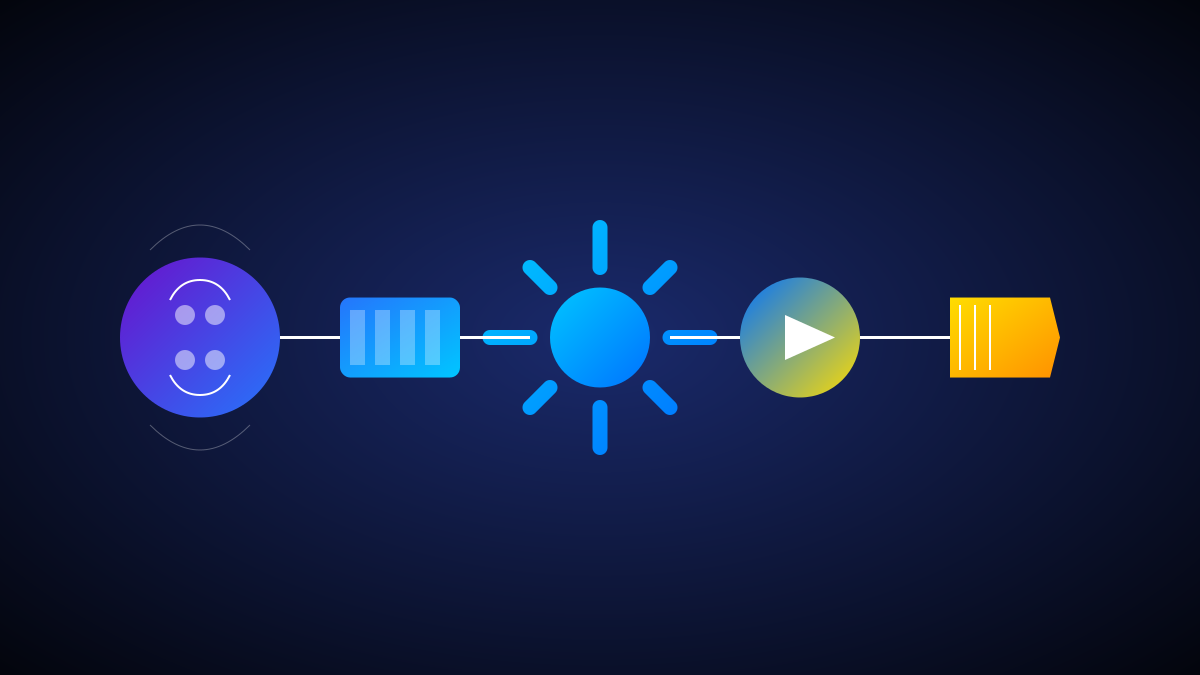
Seven-Step Closed-Loop Process: 1. Read content_plan.json to select the topic to process; 2. Call Gemini to generate scripts, summaries, and metadata; 3. Use gTTS to generate voice narration and Pexels API to obtain materials; 4. Generate both horizontal and vertical format videos via MoviePy; 5. Automatically generate custom thumbnails; 6. Upload videos using YouTube Data API; 7. Update the status in content_plan.json and submit.

Tech Stack: AI Generation Layer (Gemini 2.5 Flash), Voice Synthesis Layer (gTTS), Video Rendering Layer (MoviePy/PIL), Material Acquisition Layer (Pexels API), Automated Orchestration Layer (GitHub Actions).

4

Section 04

Evidence: Course System and Actual Operation Status

The project currently produces the "AI for Developers" course series, covering topics such as generative AI basics, prompt engineering, RAG, etc., with progress managed via content_plan.json. Deployment requires configuring keys like Google API, Pexels API, YouTube OAuth, etc. It is automatically triggered by GitHub Actions at 7 UTC every day and supports manual trigger for testing.

5

Section 05

Conclusion: Innovative Value and Limitations of the Project

Innovative Value: Verifies the feasibility of end-to-end content automation, improves creation efficiency, and allows creators to focus on high-level planning.

Limitations: Insufficient content depth (hard to compare with manual original content), single visual performance (mainly static images), and long-term sustainability challenges (algorithm recommendation and user trust).

6

Section 06

Recommendations: Insights and Practical Directions for Developers

Insights: Practice of multi-modal AI integration, application of Serverless architecture (GitHub Actions) to reduce operational costs. Recommendations: Start with a simplified version and gradually expand functions; attach importance to error handling and monitoring; adapt to scenarios like education and marketing based on open-source projects.

