Zing Forum

Reading

AI-Powered Bank Customer Churn Prediction System: An End-to-End Machine Learning Solution

A complete machine learning and data analysis project that helps enterprises optimize customer retention strategies by predicting customer churn risk and providing actionable business insights. The project integrates predictive modeling, customer behavior analysis, and business intelligence reporting.

机器学习客户流失预测银行Power BI数据科学商业智能Python分类模型
Published 2026-06-13 00:45Recent activity 2026-06-13 00:48Estimated read 7 min
AI-Powered Bank Customer Churn Prediction System: An End-to-End Machine Learning Solution
1

Section 01

Introduction: AI-Powered Bank Customer Churn Prediction System End-to-End Solution

This article introduces an AI-powered bank customer churn prediction system, an end-to-end machine learning solution. The project integrates predictive modeling, customer behavior analysis, and business intelligence reporting to help enterprises optimize customer retention strategies. The project is sourced from the open-source project by GitHub user KomalPatil25, released on June 12, 2026. Its core value lies in building a complete closed loop from data preprocessing to result visualization, combined with Power BI dashboards to support business decision-making.


2

Section 02

Project Background and Business Value

Project Background

Customer churn is a major challenge in the banking industry; the cost of acquiring new customers is more than 5 times that of retaining existing ones. Traditional methods rely on business rules or simple statistics, which struggle to capture complex customer behavior patterns.

Business Value

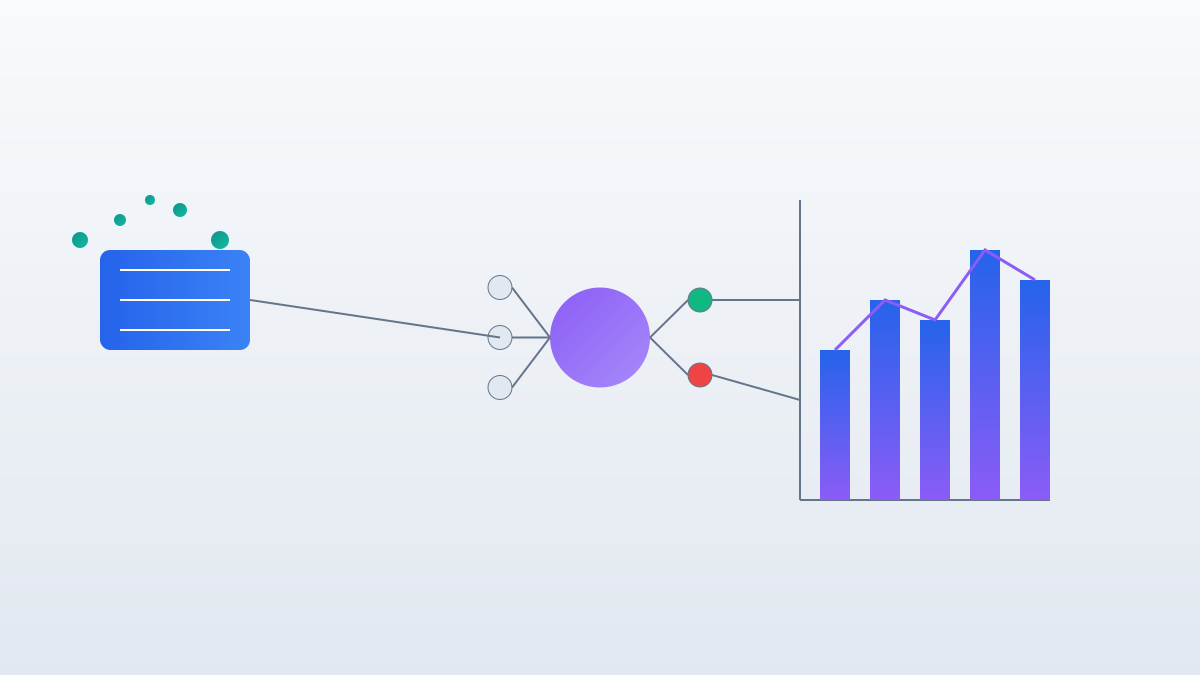
This project adopts an end-to-end architecture, forming a closed loop from data preprocessing to model training and result visualization. By integrating Power BI dashboards, business teams can intuitively understand model outputs and make decisions quickly.

3

Section 03

Technical Architecture and Core Components

Data Layer

Processes multi-dimensional data of bank customers (demographics, account behavior, transaction history, etc.), performing missing value/outlier handling and feature engineering.

Model Layer

Uses supervised learning classifiers, compares algorithms such as logistic regression, random forests, and gradient boosting trees, and selects the optimal model for deployment.

Visualization Layer

Power BI dashboards display prediction results, customer segmentation, risk distribution, and key driving factors to help understand the reasons for high-risk customers.

4

Section 04

Key Implementation Details

Feature Engineering Strategy

Includes behavioral features (transaction frequency, average amount, etc.), demographic features (age, account type, etc.), interaction features (number of customer service contacts, etc.), and time features (account duration, etc.).

Model Evaluation Methods

For imbalanced data, uses metrics such as AUC-ROC, precision-recall curve, and F1 score for evaluation.

Interpretability Design

Integrates SHAP or LIME technologies to provide feature importance explanations, helping businesses understand the basis of model decisions.

5

Section 05

Business Application Scenarios

  • Proactive Customer Retention: After identifying high-risk customers, win them back through personalized offers, service upgrades, etc.
  • Resource Optimization: Stratify by risk score, allocate budgets to high-value, high-response customers to maximize ROI.
  • Product Strategy Optimization: Analyze common characteristics of churned customers to guide product improvements.
6

Section 06

Implementation Challenges and Best Practices

  • Data Quality and Privacy: Address data missing/inconsistent issues and comply with privacy regulations such as GDPR.
  • Model Drift: Establish monitoring mechanisms to regularly evaluate model performance and retrain.
  • Business Integration: Integrate with CRM and marketing automation platforms, and provide user-friendly operation interfaces.
7

Section 07

Future Development Directions

  • Real-Time Prediction: Shift from post-hoc batch processing to real-time streaming prediction to quickly respond to changes in customer behavior.
  • Deep Learning: Explore neural networks for automatic feature representation learning.
  • Causal Inference: Predict the actual effects of intervention measures.
  • Personalized Recommendations: Combine recommendation systems to customize retention plans.
8

Section 08

Summary and Insights

This system is a model of combining machine learning with business practice. Key insights include:

  1. End-to-End Thinking: A complete chain is more important than a single algorithm.
  2. Interpretability First: Business users need to understand the basis of decisions.
  3. Continuous Iteration: Models need continuous optimization after deployment.

It is a full-process learning case for practitioners and shows decision-makers the path to transform AI into business value.

