Zing Forum

Reading

Dual-Agent AI Gatekeeper Architecture: Building an Enterprise-Grade Cryptocurrency Quantitative Trading System

Explore an automated cryptocurrency trading system that integrates multi-timeframe technical analysis and two-stage large language model orchestration, and learn how it achieves intelligent risk control and dynamic decision-making through the hierarchical collaboration of Haiku and Sonnet.

加密货币量化交易大语言模型Claude风险管理机器学习自动交易技术分析
Published 2026-05-19 12:15Recent activity 2026-05-19 12:20Estimated read 6 min
Dual-Agent AI Gatekeeper Architecture: Building an Enterprise-Grade Cryptocurrency Quantitative Trading System
1

Section 01

[Introduction] Dual-Agent AI Gatekeeper Architecture: Core Analysis of an Enterprise-Grade Cryptocurrency Quantitative Trading System

This article explores an automated cryptocurrency trading system that integrates multi-timeframe technical analysis and two-stage large language model orchestration. It achieves intelligent risk control and dynamic decision-making through the hierarchical collaboration of Haiku and Sonnet, while also featuring a learning loop and strict backtesting validation, providing a reference paradigm for AI-assisted quantitative trading.


2

Section 02

Background: Challenges and Needs of Cryptocurrency Quantitative Trading

The high volatility and 24/7 trading nature of the cryptocurrency market make it a testing ground for quantitative strategies, but traditional strategies struggle to adapt to rapid changes, and pure AI systems are prone to hallucinations and delayed out-of-control issues. This project attempts to build an asynchronous systematic trading architecture that balances technical indicators and AI's dynamic learning capabilities.

3

Section 03

Methodology: Dual-Agent Hierarchical Collaboration Architecture Design

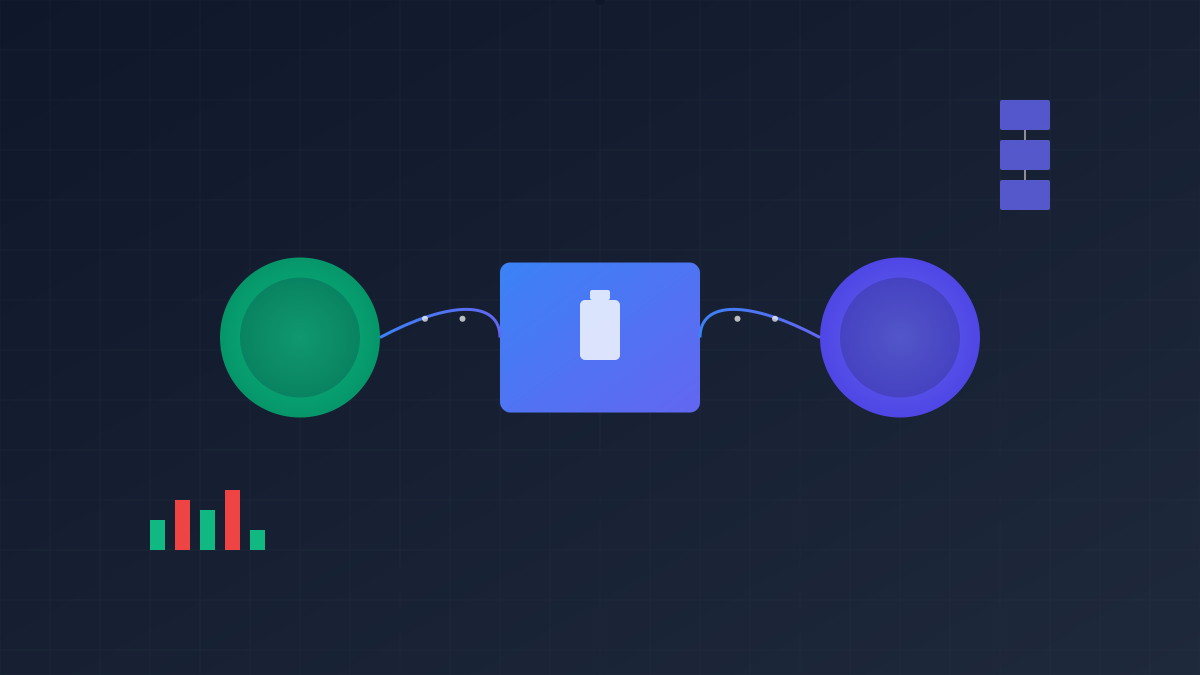
The core of the system is the hierarchical collaboration of two Claude models:

  • Haiku: A lightweight signal filter that screens news every 30 minutes, with low cost (average $0.04 per month), triggering in-depth analysis
  • Sonnet: A deep decision engine that integrates technical indicators, news, and sentiment three times a day, dynamically setting take-profit/stop-loss levels and making trading decisions The hierarchical design optimizes costs (average $4.24 per month for AI calls) and balances signal quality and efficiency.
4

Section 04

Technical Implementation: Indicator Calculation and Multi-Layer Risk Control Mechanism

The tech stack includes:

  1. Signal Generation: Comprehensive scoring of 10 classic indicators (RSI, MACD, etc.)
  2. Risk Control Mechanism:
    • Automatically stop trading if portfolio drawdown exceeds 15%
    • Pause opening new positions if daily loss reaches 5%
    • Prohibit long positions if F&G index <15
    • Dynamically adjust position size (0.5-2.0x) based on Sonnet's confidence level
  3. Order Execution: Prioritize placing a limit order at 0.1% below the market price; switch to market order if not filled within 30 seconds.
5

Section 05

Learning Mechanism: AI System Evolving from Loss Feedback

Losses trigger a Haiku-driven learning loop:

  1. Identify market conditions, indicator signals, and decision contexts leading to losses
  2. Extract structured learning context
  3. Automatically adjust the weights of technical indicators The system optimizes decisions through real trading feedback rather than simply avoiding market conditions.
6

Section 06

Evidence: Backtesting Results and Risk Warnings

Backtesting compares signal-free and signal-based modes. With optimal parameters (ATR take-profit 4.2x, stop-loss 2.8x, confidence level 0.65), it achieved a 112.50% return rate in 588 trades with a 43.5% win rate. The author emphasizes that the system is experimental, has not been tested in long-term live trading, and requires small capital testing and log monitoring.

7

Section 07

Security and Deployment: Key Points of Enterprise-Grade Engineering Practice

Security Measures:

  • Store API keys in environment variables; add .env to .gitignore
  • Configure Binance IP whitelist
  • Restrict API to spot trading only and prohibit withdrawals Deployment: Separate the signal system (scheduler.py) and trading controller (bot_controller.py) for easy maintenance and troubleshooting.
8

Section 08

Conclusion and Recommendations: New Paradigm of AI-Assisted Trading and Usage Notes

The project demonstrates a new paradigm of human-AI collaboration: AI handles pattern recognition and computation, while the hierarchical architecture and risk control maintain controllability. It is of reference value to developers. When using it, small capital testing, continuous log monitoring, and attention to cryptocurrency trading risks are required.

