Zing Forum

Reading

AI Thought Visualization: When Language, Sound, and Images Converge into Poetic Expression

This article introduces an innovative AI project that explores how to transform multimodal inputs into structured concepts and reinterpret them through generative art and poetry, showcasing a new dimension of human-computer interaction.

多模态AI生成艺术AI可视化跨模态融合创意AI诗歌生成人机交互AI可解释性
Published 2026-05-22 10:13Recent activity 2026-05-22 10:20Estimated read 7 min
AI Thought Visualization: When Language, Sound, and Images Converge into Poetic Expression
1

Section 01

[Introduction] AI Thought Visualization: A Poetic Exploration of Breaking the Black Box

This article introduces the innovative AI project ai-thought-visual, which aims to transform AI's internal representations into human-perceivable art and poetry forms, break the "black box" of AI decision-making, explore new dimensions of human-computer interaction, and make abstract AI "thoughts" visible, tangible, and understandable.


2

Section 02

Project Background: The Dilemma and Vision of AI Black Boxes

The decision-making process of artificial intelligence is often regarded as a "black box"; the operation between input and output is elusive, limiting user trust and system understanding. The ai-thought-visual project attempts to break this barrier: by transforming AI's internal representations into artistic forms, it makes abstract "thoughts" visible. This is not only a technical project but also an exploration of the boundary between human and machine cognition.

3

Section 03

Methodology: Fusion Processing of Multimodal Inputs

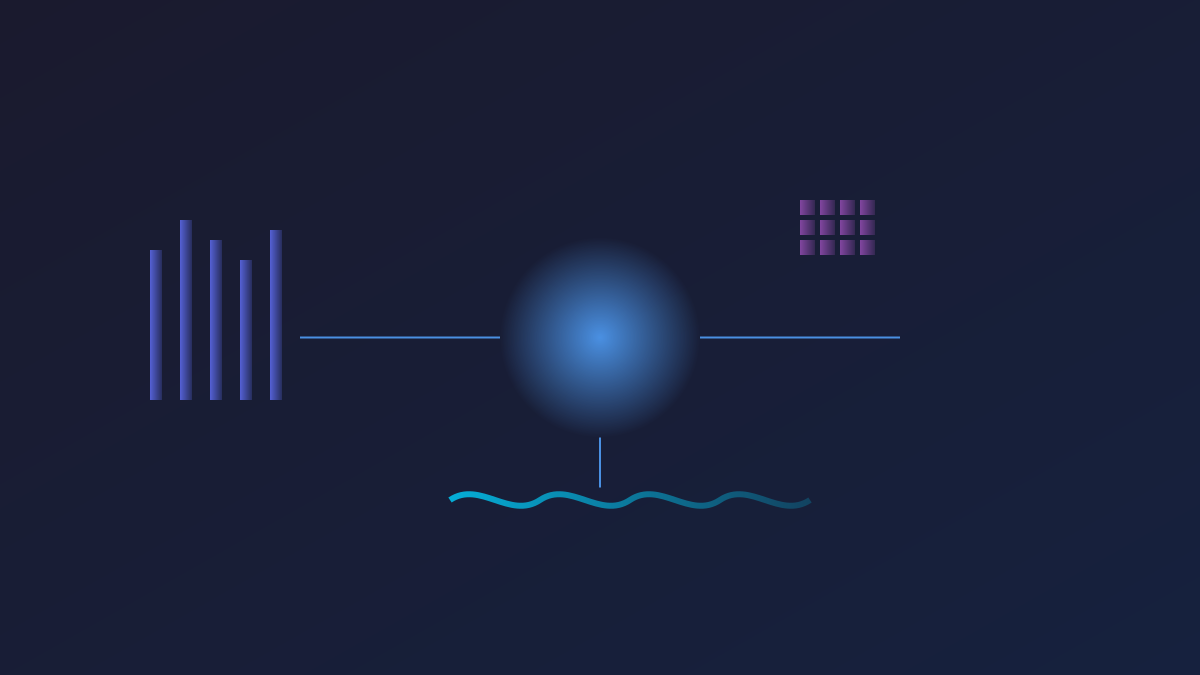
The core innovation of the project lies in processing three types of inputs simultaneously:

  • Language: Extract conceptual entities, emotional tendencies, and logical relationships through natural language processing, and convert them into a multi-dimensional semantic network;
  • Sound: Analyze acoustic features such as intonation, speech rate, and pauses in voice, and map them to emotional dimension values;
  • Image: Recognize objects and scenes via computer vision, abstract them into symbolic concept nodes, and associate them with other modalities.
4

Section 04

Methodology: Generation of Structured Concept Graphs

The technical challenges of multimodal fusion include:

  • Alignment Mechanism: Resolve the inconsistency of time scales across different modalities;
  • Fusion Strategy: Allocate modality weights according to scenarios;
  • Conflict Resolution: Reconcile conflicting information from different modalities. Finally, a multi-layer semantic network (concept graph) is generated, where nodes represent concepts, edges represent relationships, and weights reflect the strength of associations.
5

Section 05

Achievements: Transformation from Concepts to Art and Poetry

Visual Transformation of Generative Art

  • Parametric Graphics: Concept nodes are mapped to geometric shapes; the strength of relationships determines line thickness/color, and semantic distance affects spatial layout;
  • Style Transfer: Learn the style of reference images (Impressionism, Cubism, etc.) and apply it to visualization;
  • Dynamic Evolution: Show the process of concept birth, reinforcement, and decline.

Reconstruction of Poetic Text

  • Imagery Selection: Select expressive imagery groups from the concept graph;
  • Rhythm and Meter: Adjust the length of verses based on speech rhythm, and emotional analysis influences vocabulary selection;
  • Structural Organization: Draw on the topological features of the concept graph, with the central concept as the theme and edge concepts as embellishments.
6

Section 06

Application Scenarios and User Value

The project has value in multiple fields:

  • Educational Assistance: Transform complex knowledge into intuitive visual graphs to help understand abstract concepts;
  • Creative Inspiration: Provide cross-modal inspiration for artists/writers;
  • Emotional Expression: Offer users a new way of expression to externalize their inner world;
  • AI Interpretability: Allow developers and users to intuitively see how AI "understands" inputs, enhancing trust.
7

Section 07

Technical Challenges and Future Directions

Key Challenges

Accuracy of cross-modal alignment, controllability of generated results, and computational efficiency.

Future Directions

  • Introduce more modalities such as touch and smell;
  • Develop interactive editing tools;
  • Explore real-time streaming processing to support live performances;
  • Establish an evaluation system to quantify the fidelity of visualization.
8

Section 08

Conclusion: The Intersection of Technology and Humanities

The ai-thought-visual project shows that artificial intelligence is not only an efficiency tool but also can be a creative partner. When technology meets humanities and algorithms merge with poetry, we may find a new way to understand the essence of intelligence—not by dismantling the black box, but by endowing it with expressive ability, allowing it to speak in its own way.

