Zing Forum

Reading

Document Chatbot: A Generative AI Application That Lets Documents 'Speak'

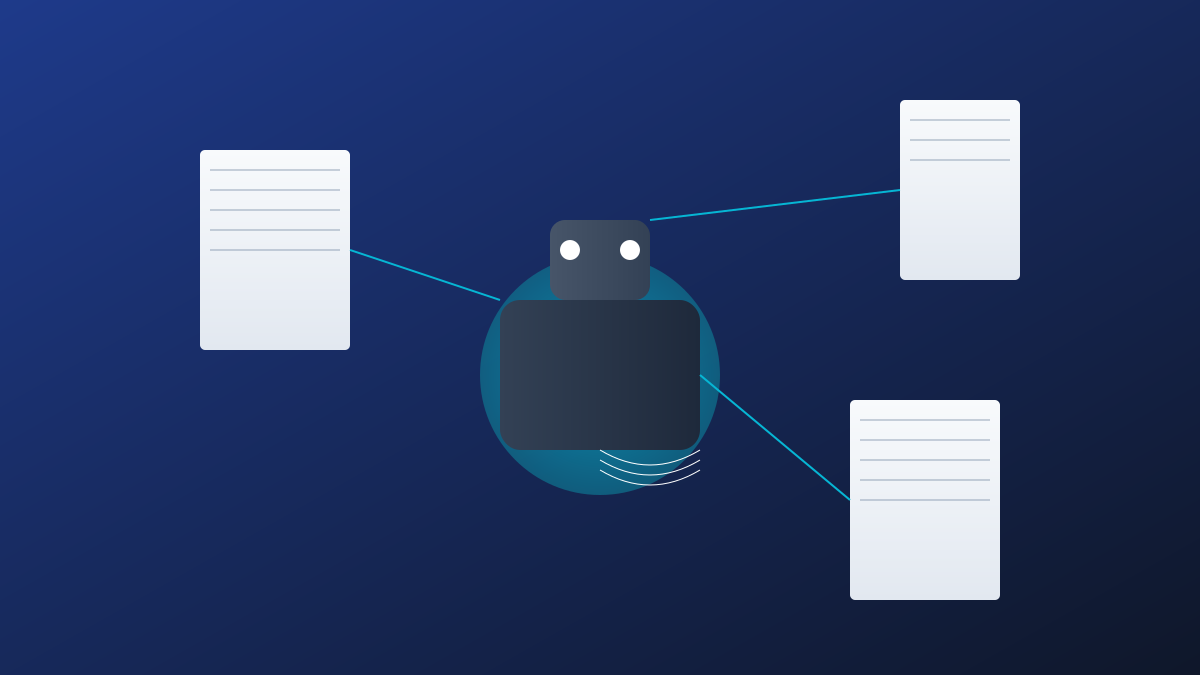
A generative AI-based document dialogue system that allows users to upload documents and interact with their content via natural language Q&A, enabling intelligent document understanding and information extraction.

文档问答RAG生成式AI向量检索知识管理对话系统文档理解信息检索
Published 2026-06-10 22:05Recent activity 2026-06-10 22:30Estimated read 8 min
Document Chatbot: A Generative AI Application That Lets Documents 'Speak'
1

Section 01

Document Chatbot: Introduction to the Generative AI Application That Lets Documents 'Speak'

The Document Chatbot is a generative AI application that enables natural language interaction between users and documents via the RAG architecture, addressing the pain point of low efficiency in traditional document reading. The original author/maintainer is lasithadilshan, and the project was released on GitHub (link: https://github.com/lasithadilshan/document-chatbot) on June 10, 2026. This system allows users to upload documents and extract information through Q&A, transforming 'reading documents' into 'conversing with documents'.


2

Section 02

Project Background: Efficiency Bottlenecks in Document Processing

In the era of information explosion, documents are the main carrier of knowledge transfer, but traditional reading methods are inefficient—users have to flip through pages and manually search for keywords to find the information they need. The Document Chatbot is designed to solve this pain point, allowing users to interact with documents in a natural dialogue way, ask questions directly to get accurate answers, and turn 'reading documents' into 'conversing with documents'.

3

Section 03

Core Method: Application of RAG Architecture

The Document Chatbot is based on the RAG (Retrieval-Augmented Generation) architecture, combining information retrieval and text generation: Document Indexing Phase: When a document is uploaded, it is split into text chunks, converted into vectors using an embedding model, stored in a vector database, and a semantic index is established. Query Processing Phase: 1. Vectorize the query; 2. Semantically retrieve relevant text chunks; 3. Build context; 4. Input into a large language model to generate an answer. Advantages of RAG: Factual accuracy (based on document content), timeliness (handles new documents), traceability (points out sources), cost-effectiveness (no fine-tuning required).

4

Section 04

Application Scenarios and Value

The Document Chatbot is suitable for multiple scenarios:

  • Academic Research: Upload papers to quickly query methods, datasets, and experimental comparisons, saving time on literature reviews.
  • Enterprise Knowledge Management: Employees query technical documents, product policies, and project leaders to improve organizational efficiency.
  • Legal & Compliance: Lawyers query contract clauses, similar cases, and version differences to enhance work efficiency.
  • Customer Service: Import product documents/FAQs to quickly respond to customers, ensuring consistency and accuracy.
5

Section 05

Key Technical Implementation Points

Building a reliable system requires considering:

  • Document Parsing & Splitting: Support formats like PDF/Word/Markdown; splitting strategies (paragraphs, fixed characters, semantic boundaries) affect accuracy.
  • Embedding Model Selection: Consider language support, domain adaptation, and computational efficiency (e.g., Sentence-BERT, OpenAI Embedding API).
  • Vector Database: Need to support vector dimensions, similarity algorithms (cosine/Euclidean distance), and scalability (e.g., ChromaDB, Pinecone).
  • Large Language Model: Open-source (Llama, Qwen) or commercial APIs (GPT-4, Claude), balancing cost, latency, and privacy.
  • Dialogue History Management: Maintain conversation history, incorporate it into query context, and handle window limits.
6

Section 06

Challenges and Optimization Directions

Practical applications face challenges and optimizations:

  • Retrieval Accuracy: Optimize splitting strategies and embedding models; introduce reordering and hybrid retrieval (keyword + semantic).
  • Complex Query Handling: Need multi-hop retrieval and chain-of-thought capabilities.
  • Hallucination Control: Control via prompt engineering, output constraints, and manual review; mark confidence levels.
  • Large-Scale Document Processing: Optimize performance using distributed vector databases, approximate nearest neighbor algorithms, and hierarchical indexing.
7

Section 07

Differences from General Chatbots

Differences between Document Chatbot and General Chatbots:

Dimension General Chatbot Document Chatbot
Knowledge Source Model training data User-uploaded documents
Answer Scope General knowledge Limited to document content
Factual Accuracy May be outdated or incorrect Based on original document content
Traceability Hard to verify Can locate original source
Privacy Data may be used for training Data processed locally
8

Section 08

Future Trends and Conclusion

Future Development Trends:

  • Multi-modal support: Understand content like images, tables, and charts.
  • Active learning: Optimize answers from user feedback and suggest document supplements.
  • Multi-document association: Cross-document queries, compare views, and synthesize information.
  • Personalized interaction: Adjust answer depth based on user role/background.

Conclusion: The Document Chatbot changes the way of knowledge interaction from passive reading to active dialogue, improving efficiency. It is valuable for individuals to learn efficiently and for enterprises to activate knowledge assets. It is expected to become a standard tool for knowledge workers, letting documents 'speak'.
