Zing Forum

Reading

Neural Networks Playing Snake: Practical Exploration of Reinforcement Learning in Game AI

This article introduces an open-source project that trains neural networks to play the Snake game autonomously. It demonstrates how to use reinforcement learning to help AI master game strategies, providing an intuitive case for understanding the decision-making mechanisms of artificial intelligence.

强化学习神经网络游戏AI贪吃蛇深度学习智能体训练
Published 2026-05-05 01:45Recent activity 2026-05-05 01:55Estimated read 6 min
Neural Networks Playing Snake: Practical Exploration of Reinforcement Learning in Game AI
1

Section 01

[Main Post/Introduction] Neural Networks Playing Snake: Practical Exploration of Reinforcement Learning in Game AI

This article introduces an open-source project that trains neural networks to play the Snake game autonomously. By using reinforcement learning, it enables AI to master game strategies, providing an intuitive case for understanding the decision-making mechanisms of artificial intelligence. The project uses the classic Snake game as an experimental platform to demonstrate the core mechanisms of reinforcement learning, making it an ideal practical case for RL beginners and a reference for game AI and AI research.


2

Section 02

Project Background and Reinforcement Learning Basics

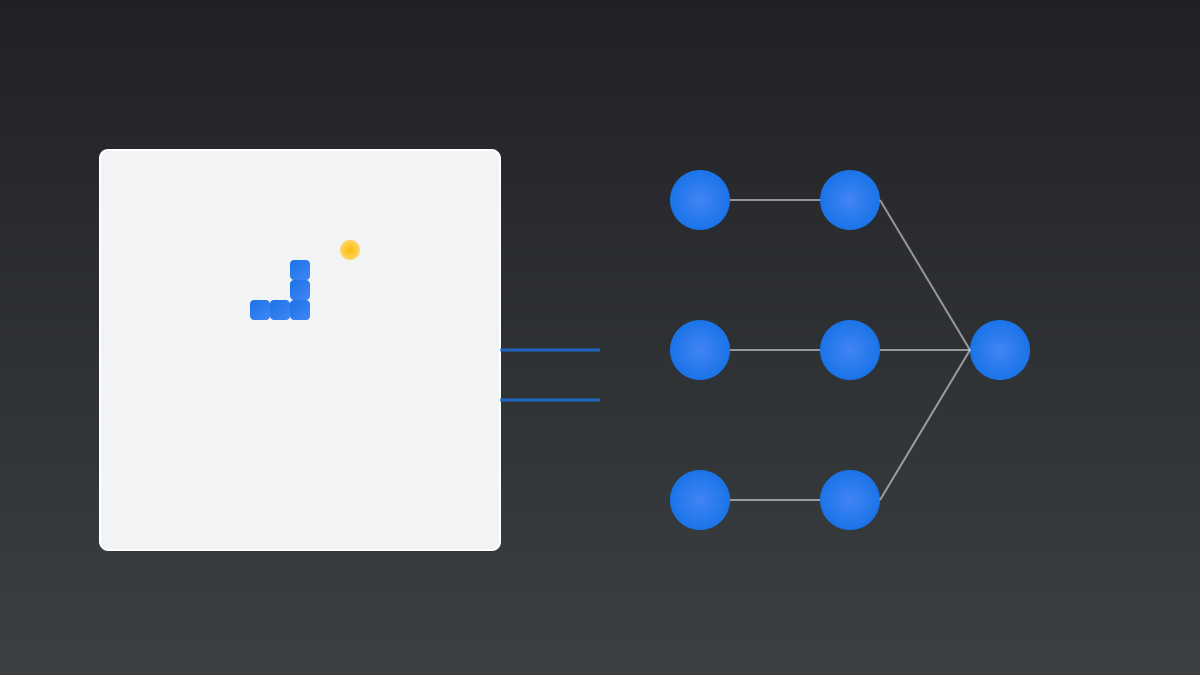
The Snake game has simple rules (control the snake to eat food and avoid collisions), making it an ideal platform for AI research. Reinforcement learning is a branch of machine learning that uses no labeled data; agents learn optimal strategies through interaction with the environment and reward signals. In Snake: Agent = snake controlled by a neural network, Environment = game board, State = positions of the snake and food, etc., Action = movement in four directions, Reward = positive reward for eating food, negative reward for hitting walls, Goal = maximize long-term cumulative reward.

3

Section 03

Technical Implementation: Network Architecture and State Representation

A neural network (MLP or CNN) is used as the function approximator. The input layer receives state encoding (relative position between snake head and food, danger perception, direction encoding, snake body information), which is transformed through hidden layers to output action values/probabilities. Key aspects of state representation: relative position features (distance and direction between snake head and food), danger perception (obstacles around the snake head), direction encoding (one-hot vector to avoid 180-degree turns), and snake body information (path planning).

4

Section 04

Training Algorithms and Optimization Strategies

Classic RL algorithms (Q-learning, DQN) are used for training. Training process: multiple game rounds; experience replay (storing interaction experiences and sampling randomly) to break data correlation; target network for stable training (periodically syncing with the main network); ε-greedy strategy to balance exploration (random actions) and exploitation (optimal actions).

5

Section 05

Training Process and Result Demonstration

The training is divided into three stages: In the initial stage, the snake frequently hits walls; in the middle stage, it learns to survive and plan paths; after convergence, it achieves high scores but still makes mistakes. The project provides a visual interface (to observe AI movement), training curves (changes in average reward/highest score), and loss function curves to assist in debugging and evaluation.

6

Section 06

Application Value and Expansion Directions

Educational value: The complete code framework lowers the entry barrier for RL; Game development: Provides a technical path for NPC intelligent behavior; Research: Serves as a foundation for verifying new algorithms. Expansion directions: Multi-agent confrontation, transfer learning to variant games, curriculum learning (from easy to difficult), model architecture comparison (MLP/CNN/RNN/Transformer).

7

Section 07

Technical Details and Conclusion

The project is implemented in Python, using Pygame for rendering and interaction, and PyTorch/TensorFlow for building the network. Installation is simple: clone the repository → install dependencies → run the script. Pre-trained models are provided. Conclusion: The project demonstrates the core principles of RL and is an ideal platform for entry-level learning, teaching, and research. We look forward to the application of RL in more complex tasks.

