Zing Forum

Reading

Quantum-Classical Hybrid Neural Networks: Exploration of Running AI on Real Quantum Computers

A complete project documenting the journey from qubit fundamentals to building production-grade hybrid quantum-classical neural networks, successfully deployed on IBM's 156-qubit Heron r2 processor.

量子计算机器学习混合神经网络PennyLaneQiskitTransformerIBM Quantum
Published 2026-06-09 02:14Recent activity 2026-06-09 02:17Estimated read 6 min
Quantum-Classical Hybrid Neural Networks: Exploration of Running AI on Real Quantum Computers
1

Section 01

Introduction: Exploration of Quantum-Classical Hybrid Neural Network Project and Deployment on Real Hardware

This project, published by Harvey (@quantum-harvey) on GitHub, documents the complete journey from qubit fundamentals to building production-grade hybrid quantum-classical neural networks, and has been successfully deployed on IBM's 156-qubit Heron r2 processor. The project includes four progressive modules, combining toolchains like PennyLane and Qiskit to explore practical paths in the intersection of quantum computing and AI.


2

Section 02

Project Background and Significance

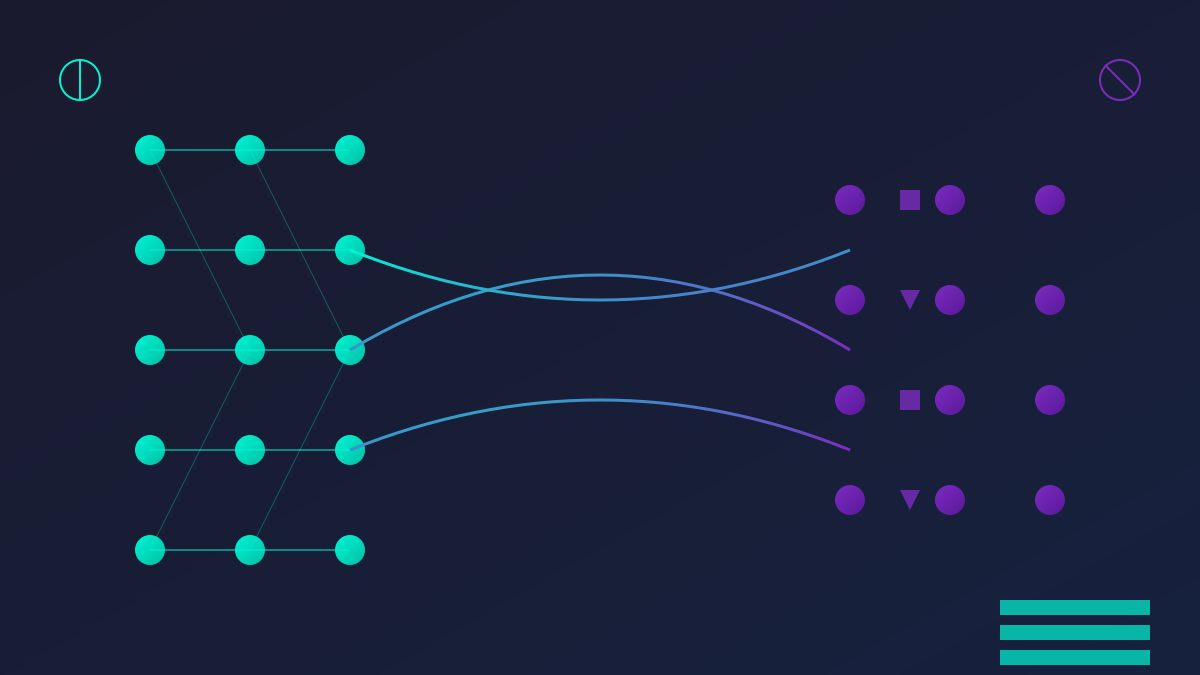
The intersection of quantum computing and AI is developing rapidly. Traditional neural networks rely on classical architectures, while quantum computing can theoretically accelerate specific tasks exponentially. Currently in the NISQ (Noisy Intermediate-Scale Quantum) era, qubits are limited and susceptible to noise, so hybrid quantum-classical architectures have become a bridge connecting theory and reality—using quantum circuits to handle subtasks, and classical networks for error correction and decision-making.

3

Section 03

Project Overview and Module Structure

The quantum-hybrid-ai project is a systematic learning and practice project, with all models verified on real quantum hardware. It includes four modules: 1. Quantum Fundamentals Module (Bell state, superposition, entanglement experiments); 2. Quantum Random Number Generator (cryptographic-grade true random numbers); 3. Hybrid AI v1.0 (basic hybrid architecture); 4. Quantum Transformer v4.0 (combining multi-head attention with quantum computing).

4

Section 04

Core Technical Implementation Details

Hybrid Architecture Design

Combines PennyLane and PyTorch: PennyLane provides differentiable quantum programming, while PyTorch handles classical backpropagation to enable end-to-end training.

Quantum Transformer Innovation

Maps the dot-product attention of traditional Transformers to quantum circuits, using multiple quantum heads to process feature subspaces in parallel, exploring quantum advantages in NLP scenarios.

Real Hardware Deployment

Successfully run on IBM Heron r2 (156 qubits), addressing engineering challenges like circuit compilation optimization, noise mitigation, and measurement error correction—marking a step from proof-of-concept to practical application.

5

Section 05

Technology Stack and Toolchain

  • Quantum frameworks: Qiskit (IBM Quantum Platform interface), PennyLane (quantum machine learning)
  • Deep learning: PyTorch
  • Hardware platform: IBM Quantum Heron r2 (156 qubits)
  • Development language: Python 3.12
6

Section 06

Practical Value and Insights of the Project

Reference value for researchers and engineers:

  1. Demonstrates feasible paths for hybrid architectures; progressive modules help beginners learn;
  2. Real hardware deployment experience bridges the simulator-reality gap, guiding understanding of practical issues like noise and circuit depth;
  3. Quantum Transformer provides new ideas for NLP, and cross-domain integration drives innovation.
7

Section 07

Summary and Future Outlook

This project represents an important step for quantum machine learning from the lab to practical use, proving that in the NISQ era, meaningful ML workloads can be run on real hardware via hybrid architectures. As quantum hardware evolves (more qubits, lower error rates), hybrid architectures are expected to become part of AI infrastructure. Developers are advised to pay attention to and experiment with quantum machine learning.

