Zing Forum

Reading

Neural Symbolic AI: A Technical Exploration of Enabling Deep Learning to "Think"

Explore how neural symbolic AI combines the pattern recognition capabilities of neural networks with the logical rigor of symbolic reasoning to build interpretable and robust artificial intelligence systems.

神经符号AINeuro-Symbolic AI可解释AI深度学习符号推理PyTorch机器学习人工智能
Published 2026-05-10 14:53Recent activity 2026-05-10 14:59Estimated read 6 min
Neural Symbolic AI: A Technical Exploration of Enabling Deep Learning to "Think"
1

Section 01

Neural Symbolic AI: Exploring Trustworthy AI by Integrating Deep Learning and Symbolic Reasoning (Introduction)

Neural symbolic AI aims to bridge the gap between neural networks (strong in pattern recognition but black-box) and symbolic reasoning (logically rigorous and interpretable but hard to handle ambiguity), building AI systems that are both powerful and trustworthy. This article introduces an open-source project maintained by kryptologyst, implemented in Python and PyTorch, which includes three core model architectures, multiple rule-based datasets, and a Streamlit demo interface, demonstrating the value of integrating data-driven learning and rule-based reasoning.


2

Section 02

Background: Paradigm Disputes in the AI Field and the Birth of Neural Symbolic AI

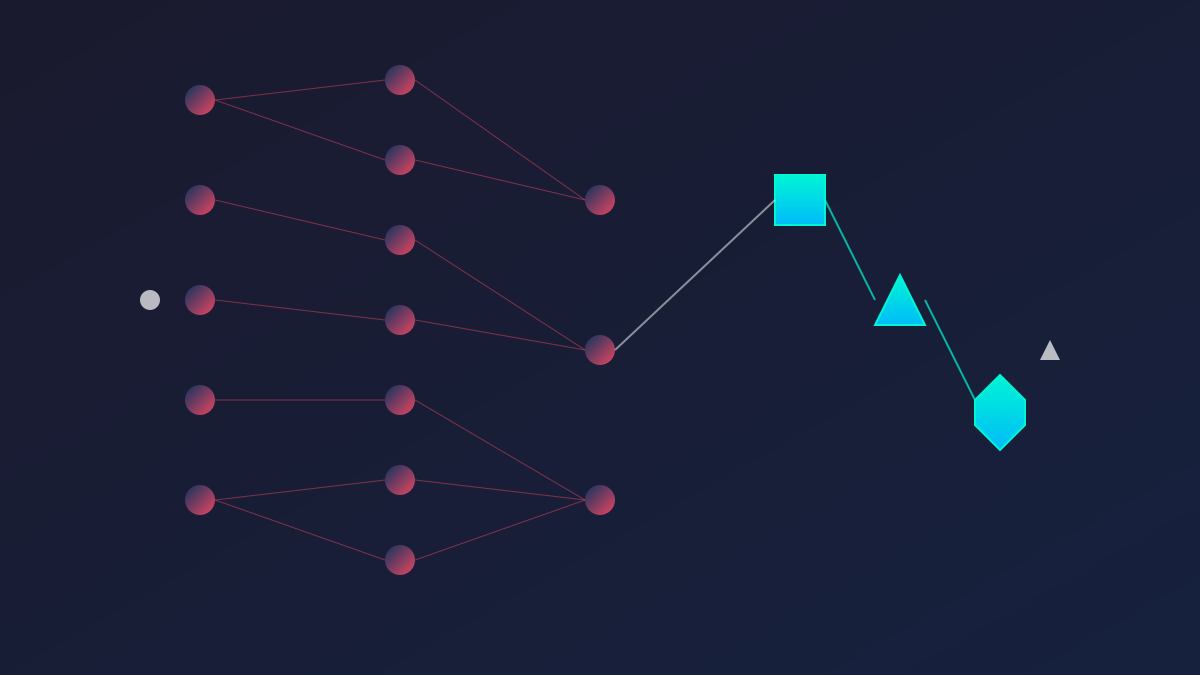
There are two paradigms in the AI field: neural networks excel at pattern recognition but have black-box decision-making; symbolic reasoning is based on rule logic, highly interpretable but struggles with real-world ambiguity. As a cutting-edge direction, neural symbolic AI integrates the advantages of both—letting neural networks handle perceptual learning and symbolic systems handle reasoning and interpretation—to create more reliable AI systems.

3

Section 03

Methodology: Analysis of Three Neural Symbolic Model Architectures in the Project

The project implements three progressive models: 1. Simple neural network (feedforward, purely data-driven, used as a baseline); 2. Symbolic neural module (core hybrid architecture, introducing a symbolic rule layer on top of a neural network); 3. Graph neural symbolic network (combining symbolic reasoning based on graph structures to handle complex structured knowledge).

4

Section 04

Evidence: Rule-based Datasets and Performance Comparison Results

Rule-based Datasets

  • Sum Threshold Rule: If the sum of features exceeds a threshold, it is classified as category 1 (tests basic numerical logic);
  • XOR Rule: Only one feature >0.5 is category 1 (tests non-linear reasoning);
  • Circle Rule: Points inside the unit circle are category 1 (tests geometric concept learning).

Performance Comparison

Model Type Accuracy F1 Score AUC
Logistic Regression 0.85-0.95 0.80-0.90 0.90-0.98
Random Forest 0.90-0.98 0.85-0.95 0.95-0.99
Simple Neural Network 0.88-0.96 0.82-0.92 0.92-0.98
Symbolic Neural Network 0.92-0.98 0.88-0.95 0.94-0.99

The symbolic neural network performs best or near-best in all metrics while maintaining interpretability.

5

Section 05

Core Value: Interpretability Design of Neural Symbolic AI

The interpretability of neural symbolic AI is reflected in:

  • Display decision boundaries: Visualize the model's category classification regions;
  • Symbolic explanation graph: Explicitly present applied rules and reasoning paths;
  • Training history visualization: Track the process of the model mastering rules.

This interpretability is crucial in key scenarios such as medical diagnosis and financial risk control, where users need to know the 'why' behind decisions.

6

Section 06

Application Scenarios and Future Outlook

Application scenarios of neural symbolic AI include:

  • Healthcare: Auxiliary diagnosis requires accuracy and interpretability;
  • Financial risk control: Risk assessment requires a transparent reasoning process;
  • Robot decision-making: Follow logical constraints to ensure safety;
  • Educational assistance: Provide clear explanations to aid learning.

The future direction is to balance AI performance and trustworthiness to meet the needs of high-risk decision-making scenarios.

7

Section 07

Conclusion: The Inevitable Path to Trustworthy AI

Neural symbolic AI represents an important direction in AI development, shifting from purely pursuing performance to balancing performance and trustworthiness. This open-source project provides a starting point for researchers and developers to understand the principles and application potential of neural symbolic methods, making it a noteworthy cutting-edge AI resource.

