Zing 论坛

正文

AgentProp:用图论和度量维度实现多智能体工作流的精准控制

AgentProp将AI智能体工作流建模为有向加权图,通过度量维度理论和随机零强制传播算法,实现故障定位、验证器优化放置和运行时控制,在实测中降低33.8%的token消耗和41%的成本。

多智能体系统图论度量维度工作流优化故障定位验证器放置随机零强制传播模型成本控制可观察性
发布时间 2026/06/07 07:45最近活动 2026/06/07 07:57预计阅读 5 分钟
AgentProp:用图论和度量维度实现多智能体工作流的精准控制
1

章节 01

AgentProp: Graph Theory-Based Precise Control for Multi-Agent Workflows

AgentProp is an open-source project (Apache 2.0 license, v0.1.0a3) that models multi-agent AI workflows as directed weighted graphs. It leverages metric dimension theory and random zero-forcing propagation algorithms to achieve fault location, verifier optimization placement, and runtime control. In practical tests, it reduces token consumption by 33.8% and cost by 41% while maintaining task success rates.


2

章节 02

Background & Core Problem

Traditional multi-agent systems often use simple chain or tree structures, lacking systematic topology analysis. When an agent produces an error, it propagates downstream, but a verifier's failure may have multiple upstream root causes—leading to ambiguous fault localization. AgentProp solves this by introducing graph theory's metric dimension concept to provide mathematically provable fault diagnosis guarantees.

3

章节 03

Core Concepts & Technical Architecture

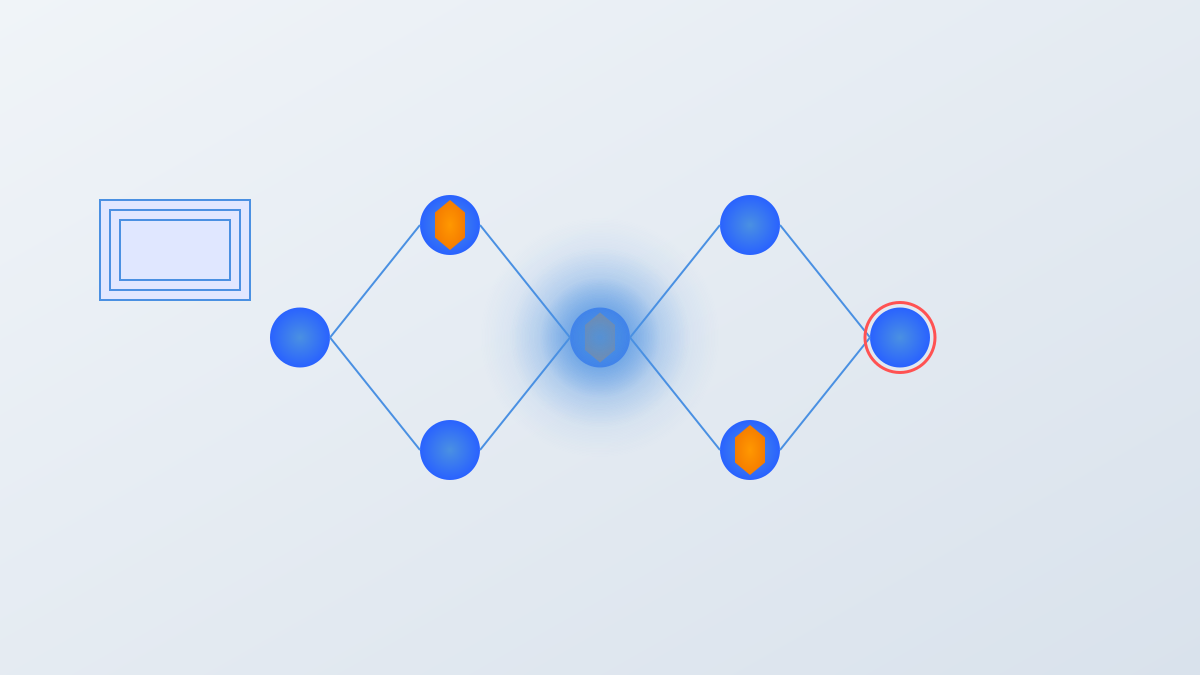
  • Metric Dimension & Resolving Set: Verifiers act as 'landmarks'; a resolving set ensures each node has a unique distance vector to verifiers, enabling precise fault location (even with one verifier failure via fault-tolerant metric dimension).
  • AgentGraph: Directed weighted graph with nodes (agents, tools, verifiers, etc.) and edges (weighted by information cost or failure probability), supporting serialization and visualization.
  • Key Components: Propagation models (independent cascade, linear threshold, random zero-forcing, etc.), RZF centrality (for large graphs), runtime controller (adaptive strategies like retry/stop), and quality cascade model (correctness/compression propagation).
4

章节 04

Performance Results & Integration

  • Benchmark: Terminal-Bench 2.1 tests show 33.8% lower token use, 41% cost reduction, and 14.8% faster runtime (success rate maintained).
  • Optimizations: Memoized distance calculations, lazy CELF seed selection, auto strategy choice based on graph size, etc.
  • Integration: Supports LangGraph, AutoGen, CrewAI, etc. Quick usage via CLI (analyze/optimize workflows), Python API, or FastMCP server.
5

章节 05

Limitations & Future Directions

  • Current Limitations: Alpha-stage software (early benchmark evidence, requires basic graph theory knowledge).
  • Future Plans: Explore GNN-based propagation models, integrate reinforcement learning into controllers, expand validation across more benchmarks, and enhance visualization tools.
6

章节 06

Practical Value & Industry Implications

  • Applicable Scenarios: Complex multi-agent systems, cost-sensitive applications, high-reliability systems, and audit-required workflows.
  • Not Applicable: Simple linear workflows, prototype development, or resource-constrained environments.
  • Industry Shift: Promotes moving from 'prompt engineering' to 'graph engineering'—emphasizing structural importance, theoretical guarantees, observability-first design, and cost-quality balance.

