Zing Forum

Reading

Agentic Services Orchestrator: A Multi-Stage Intelligent Service Workflow Orchestration Framework

An intelligent service orchestration skill developed by CompleteTech LLC, used to coordinate agent service workflows across professional skills, covering the entire lifecycle stages such as discovery, sales, delivery, and operations, while maintaining professional boundaries and approval nodes.

AI代理工作流编排Codex技能多阶段流程审批门控服务生命周期CompleteTechOpenAI代理协调企业AI
Published 2026-05-25 02:15Recent activity 2026-05-25 02:23Estimated read 6 min
Agentic Services Orchestrator: A Multi-Stage Intelligent Service Workflow Orchestration Framework
1

Section 01

[Introduction] Agentic Services Orchestrator: A Multi-Stage Intelligent Service Workflow Orchestration Framework

This article introduces the Agentic Services Orchestrator skill developed by CompleteTech LLC, a Codex-based framework for coordinating the full-lifecycle workflows of cross-professional AI agents (covering stages like discovery, sales, delivery, operations, etc.). Its core goal is to address orchestration challenges in multi-agent collaboration while maintaining clear professional boundaries and approval gates at key nodes. The project is sourced from GitHub and was released on May 24, 2026.


2

Section 02

Background: Core Challenges in AI Agent Workflow Orchestration

With the improvement of large model capabilities, enterprises have started applying AI agents to handle complex business processes. However, multi-agent collaboration faces three major issues: how to effectively orchestrate each agent, how to ensure agents work within their expertise domains, and how to set up key approval nodes. This framework is designed to solve these problems and provide a structured coordination solution.

3

Section 03

Architecture and Workflow Design

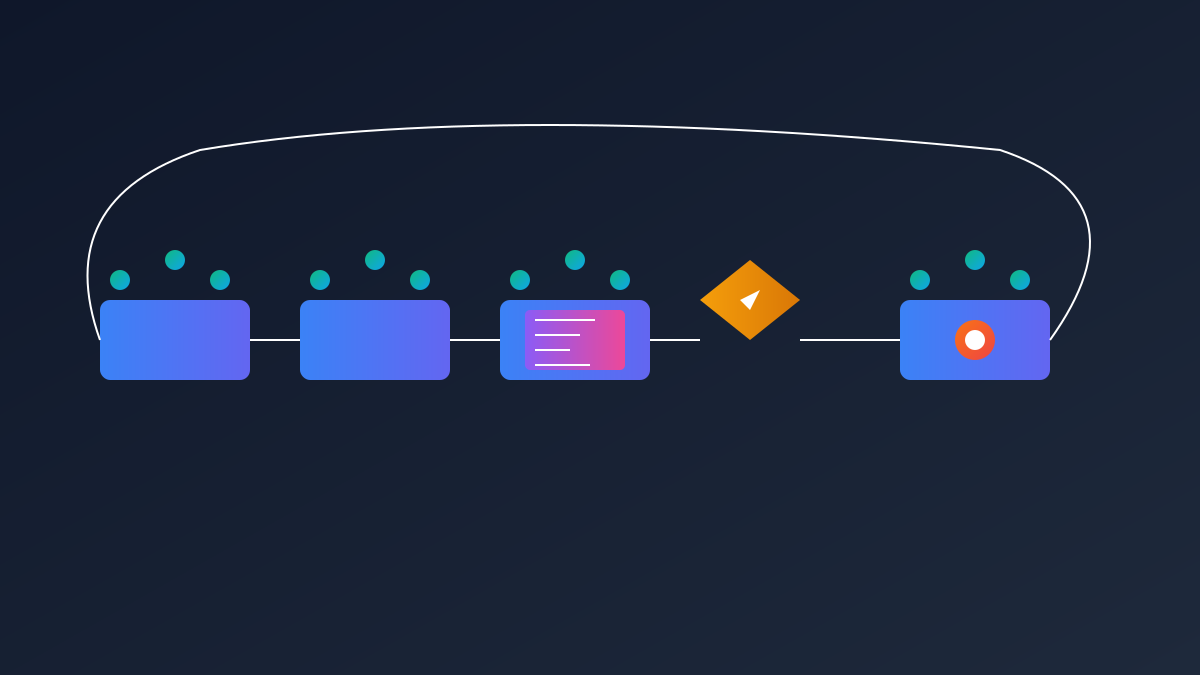
This framework is part of the Codex skill library, with core responsibility for coordinating lifecycle routing without replacing professional skills. Its workflow covers the complete service lifecycle: Request → Requirement Judgment → Discovery → Email Proposal → Contract & Invoice → Delivery Security → Customer Success → Case Certification. The design philosophy emphasizes the independence of professional skills and collaboration through standardized interfaces. A Mermaid flowchart illustrates the flow logic of each stage.

4

Section 04

Core Function Analysis

  1. Intelligent Routing and Serialization: Analyze the nature of requests, select and sort professional skills, and support non-linear processes (skip/iteration/parallel); 2. Boundary Maintenance: Ensure each skill works within its expertise domain (e.g., Discovery handles requirement research, Delivery handles technical implementation); 3. State Maintenance and Handover: Transfer context information (facts, pending issues, etc.) to avoid information loss; 4. Approval Gates: Set up manual approvals at key nodes such as public use, contract signing, invoice issuance, and production release.
5

Section 05

Application Scenario Examples

Applicable to various enterprise-level scenarios: 1. Software Development Services: Full-process coordination from requirement discovery to case certification; 2. Consulting Services: Management consulting project diagnosis, solution design to effect evaluation; 3. Content Creation Services: Creative planning, approval, delivery to communication effect verification.

6

Section 06

Limitations and Improvement Directions

Limitations: Dependent on the OpenAI Codex platform; migrating to other frameworks (e.g., LangChain) requires additional work; manual approval may become a bottleneck in high-throughput scenarios; lack of detailed exception handling strategies. Improvement Directions: Support conditional branching and loop workflows; add execution history tracking; integrate monitoring and alerting; support multi-tenancy and permission isolation.

7

Section 07

Conclusion: Pragmatic Practice of Enterprise AI Agent Orchestration

This framework demonstrates a pragmatic approach to enterprise AI agent orchestration, focusing on solving practical collaboration problems and balancing automation with human supervision. It has reference value for enterprises exploring AI agent applications. In the future, similar orchestration layers will become standard components of enterprise AI architectures, and CompleteTech's practice provides early experience for the industry.

