Zing Forum

Reading

ZubairHub: A One-Stop Streamlit Multi-Function Application Development Practice

Explore the ZubairHub project, a comprehensive Streamlit application integrating social graph visualization, object detection, document parsing, text extraction, and generative AI interaction, demonstrating how to build multi-capability AI applications using a single framework.

StreamlitAI应用目标检测OCR社交图谱Gemini多模态Python
Published 2026-06-14 13:43Recent activity 2026-06-14 13:53Estimated read 7 min
ZubairHub: A One-Stop Streamlit Multi-Function Application Development Practice
1

Section 01

ZubairHub: Guide to One-Stop Streamlit Multi-Function AI Application Development Practice

This article explores the ZubairHub project, a comprehensive Streamlit application integrating social graph visualization, object detection, document parsing, OCR text extraction, and generative AI interaction. Maintained by azzubair01, the source code is hosted on GitHub (link: https://github.com/azzubair01/zubairhub) and was released on 2026-06-14. Its core value lies in demonstrating how to build multi-capability AI applications using a single framework, reflecting the potential of tool combinations in the Python ecosystem and Streamlit's rapid prototyping capabilities.


2

Section 02

Project Background and Problem Solving

In AI application development, developers often face a dilemma: develop separate applications for each function or integrate them into a unified platform? ZubairHub provides a practical answer—building a multi-function integrated application based on Streamlit, offering diverse AI capabilities in one interface to solve the efficiency issues of decentralized development.

3

Section 03

Analysis of Core Function Modules

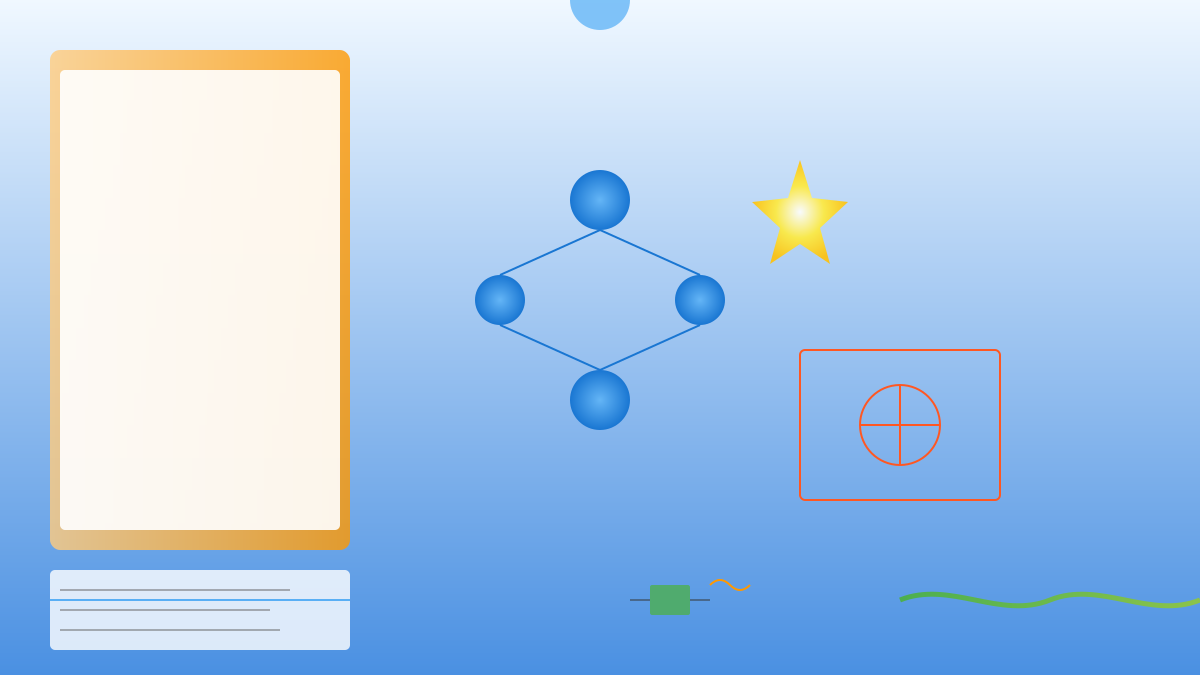
ZubairHub adopts a modular design with sidebar function switching:

  1. Social Graph Visualization: Build family relationship graphs using NetworkX, supporting custom node attributes and interactive browsing;
  2. Object Detection: Implement image object recognition based on OpenCV, labeling detection boxes and categories;
  3. Document Parsing: Process XML/HTML via lxml to extract structured data (tables, lists, etc.);
  4. Text Extraction: Integrate Tesseract OCR to recognize text from scanned documents (multi-language support);
  5. Generative AI Interaction: Connect to Google Gemini API, supporting plain text/multi-modal (text + image) dialogue;
  6. Personal Data Conversion: Provide format conversion, field mapping, and batch processing tools.
4

Section 04

Tech Stack and Architecture Design

Tech Stack: Core frameworks are Streamlit (interface interaction) and Python 3.x; functional libraries include NetworkX (graph algorithms), OpenCV-Python (CV processing), Pytesseract (OCR), lxml (document parsing), and Google-GenAI (Gemini integration). Local execution only requires installing dependencies (pip install -r requirements.txt) and launching (streamlit run app.py). Architecture Features: Single-file modularity (easy to maintain and extend), unified interaction paradigm (sidebar selection → operation → result), progressive loading (activate functions on demand), error isolation (modules run independently).

5

Section 05

Typical Use Cases and Community Participation

Use Cases:

  • AI Prototype Validation: Quickly test function effects without complex independent applications;
  • Teaching Demonstration: Showcase various AI technologies to help students understand capability boundaries;
  • Personal Data Processing: Use OCR and document parsing tools for daily file conversion;
  • Multimodal Exploration: Experience text + image interaction via Gemini. Community Participation: Support Issue submission (problems/suggestions), Pull Request (code contributions), and function expansion; the author provides LinkedIn and email contact information.
6

Section 06

Limitations and Improvement Directions

Current Limitations:

  • Performance Bottleneck: Streamlit's single-threaded model is limited under high concurrency;
  • State Management: Lack of persistent user state and data storage;
  • Mobile Adaptation: Interface is mainly designed for desktop browsers;
  • Function Depth: Basic implementation requires fine-tuning for professional scenarios. Improvement Directions: Introduce caching mechanisms, add user authentication, integrate databases (SQLite/PostgreSQL), encapsulate APIs, and implement containerized deployment (Docker images).
7

Section 07

Practical Insights and Conclusion

Insights:

  • Value of Rapid Prototyping: Streamlit can quickly build fully functional demonstration systems, saving development time;
  • Art of Tool Combination: Integrate mature tools from different fields (OpenCV, Tesseract, etc.) to create greater value;
  • Balance Between Features and Simplicity: Maintain code maintainability while offering rich functions. Conclusion: ZubairHub is a pragmatic project focused on one-stop AI capability usage. It is suitable for developers building AI demos, users needing toolkits, and beginners learning multi-tech stack integration. In the rapid development of AI technology, presenting technical value in a concise and intuitive way is meaningful in itself.

