Zing Forum

Reading

Multimodal Fraud Detection System: A Comprehensive Solution Integrating XGBoost, NLP, and Graph Neural Networks

A multimodal fraud detection solution based on 590,000 transaction data entries, integrating gradient boosting, natural language processing (NLP), and graph analysis technologies, achieving an ROC-AUC of 0.9375 and an 82% fraud recall rate.

欺诈检测XGBoostNLP图神经网络LightGBM机器学习风控
Published 2026-06-10 05:08Recent activity 2026-06-10 05:20Estimated read 5 min
Multimodal Fraud Detection System: A Comprehensive Solution Integrating XGBoost, NLP, and Graph Neural Networks
1

Section 01

Introduction: Core Solution and Value of the Multimodal Fraud Detection System

This project was published by aditya-ailsinghani on GitHub on June 9, 2026 (original link: https://github.com/aditya-ailsinghani/Multimodal-Fraud-Detection). Its core is a multimodal fraud detection solution integrating XGBoost, natural language processing (NLP), and graph neural networks. Validated on 590,000 transaction data entries, it achieves an ROC-AUC of 0.9375 and an 82% fraud recall rate, providing a comprehensive solution for identifying complex fraud patterns.


2

Section 02

Background and Challenges: Pain Points in Financial Fraud Detection

Financial fraud detection is a core challenge in the risk control field. Traditional single-dimensional detection methods struggle to handle complex fraud techniques. Modern fraud involves multi-dimensional information such as transaction amounts, time patterns, device fingerprints, and email content. How to effectively integrate heterogeneous data sources and build a detection system that balances explicit rules and implicit correlations is a topic of common concern in industry and academia.

3

Section 03

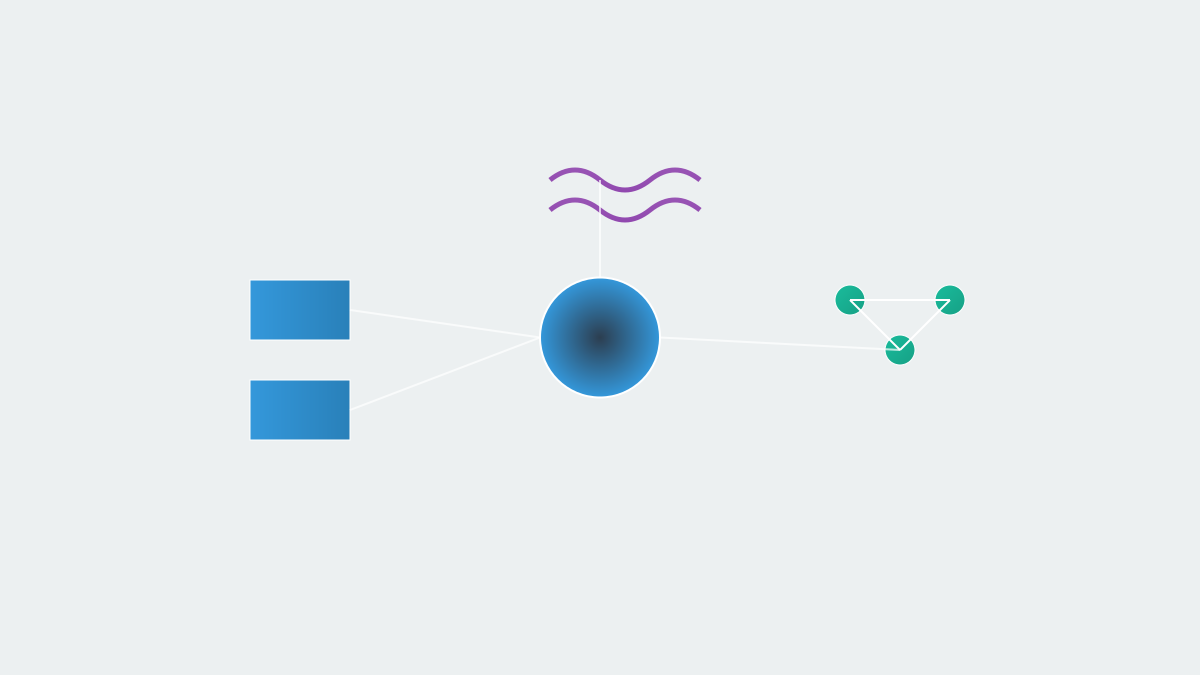
Technical Architecture: Collaborative Design of Three Modalities

XGBoost Base Model

As the cornerstone of the system, it processes traditional structured features, automatically learns non-linear interactions, and provides feature importance analysis.

NLP Text Analysis Layer

It parses transaction-related texts (such as emails and device descriptions), converts them into vectors via text embedding, and mines hidden fraud signals.

Graph Analysis Network Layer

It builds a user-device-transaction-location heterogeneous graph based on NetworkX. Graph neural networks learn high-order neighborhood information of nodes to identify gang-related fraud patterns.

4

Section 04

Model Fusion Strategy: LightGBM-Driven Late Fusion

LightGBM is used as the fusion layer framework. Instead of simply concatenating multimodal features, it uses a carefully designed late fusion strategy to preserve the independent expression ability of each modality, achieve end-to-end optimization, and allow different modal features to complement each other at the decision-making level.

5

Section 05

Performance: Key Metrics on 590,000 Data Entries

On the test set of 590,000 transaction data entries, the fusion model achieved excellent results:

  • ROC-AUC: 0.9375 (excellent discriminative ability)
  • Fraud recall rate: 82% (identifies most real fraud transactions) These metrics are highly competitive in scenarios with extremely imbalanced fraud samples, and high recall rate is crucial for business value.
6

Section 06

Practical Significance: Application Prospects in Multiple Scenarios

The project's architecture design is transferable, and the multimodal fusion approach can be applied to:

  • E-commerce platform risk control systems
  • Bank credit card anti-fraud
  • Insurance claim review
  • Real-time risk control for payment platforms
7

Section 07

Conclusion: Reference Value and Technical Potential of the Project

Multimodal-Fraud-Detection demonstrates the application potential of modern machine learning in the risk control field. By integrating three technical routes—XGBoost, NLP, and graph analysis—it effectively identifies complex fraud patterns, making it a highly valuable learning case for risk control algorithm researchers and application developers.

