Zing Forum

Reading

Modular House Price Prediction System: A Complete Machine Learning Engineering Practice Based on XGBoost

This article introduces a modular house price prediction system using the XGBoost regression algorithm. It demonstrates a complete machine learning project engineering practice through independent pipelines for data cleaning, feature engineering, visualization, model training, and evaluation.

房价预测XGBoost机器学习回归分析特征工程Python模块化设计数据清洗模型评估
Published 2026-05-26 01:45Recent activity 2026-05-26 01:52Estimated read 6 min
Modular House Price Prediction System: A Complete Machine Learning Engineering Practice Based on XGBoost
1

Section 01

Introduction: Overview of the Engineering Practice of the Modular House Price Prediction System

The HOUSE-PRICE-PREDICTOR project introduced in this article is a modular house price prediction system based on the XGBoost regression algorithm. It demonstrates a complete machine learning project engineering practice through independent pipelines for data cleaning, feature engineering, visualization, model training, and evaluation. The project uses a modular architecture design, which improves code maintainability and reusability, and has practical commercial application value.


2

Section 02

Project Background and Significance: Commercial Value of House Price Prediction and Advantages of Modular Design

House price prediction is a classic and commercially valuable application scenario in machine learning. Traditional evaluation relies on empirical judgment, while machine learning models can provide more objective and accurate results by analyzing historical data. This project adopts a modular architecture, splitting the workflow into multiple independent stages, clarifying responsibility boundaries and interfaces, improving code maintainability and reusability, and laying the foundation for team collaboration and expansion.

3

Section 03

Technical Architecture and Core Components: Six-Stage Pipeline and Python Tech Stack

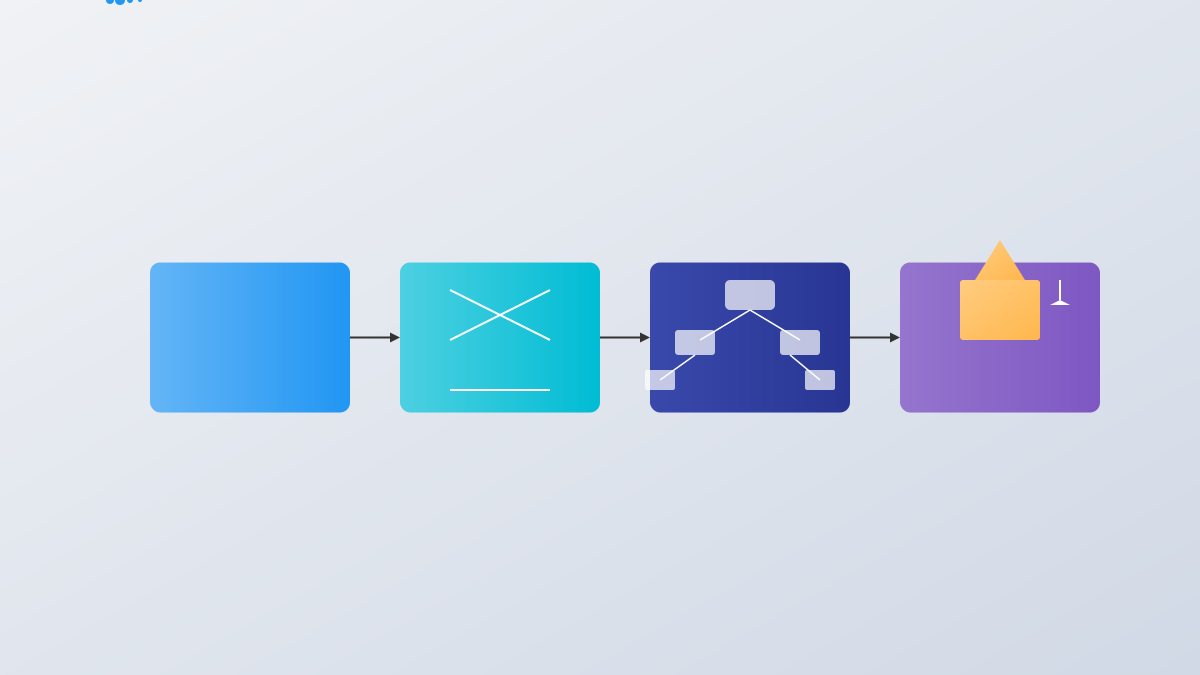
The project uses a six-stage pipeline architecture: 1. Data cleaning (handling missing values, outliers, etc.); 2. Feature engineering (selection, transformation, encoding, etc.); 3. Visualization analysis (distribution exploration, correlation heatmap, etc.); 4. Model training (XGBoost training, hyperparameter tuning); 5. Model evaluation (multi-dimensional indicator calculation). The core tech stack is based on Python: Pandas/NumPy for data processing, Scikit-learn/XGBoost for machine learning, Matplotlib/Seaborn for visualization, and Streamlit is planned for web application deployment.

4

Section 04

Key Features and Prediction Logic: Multi-Dimensional Feature System and Advantages of XGBoost Algorithm

The model input features include physical attributes (building area, floor, number of bathrooms, etc.) and location transaction features (geographic location, decoration status, property type, etc.). The advantages of choosing XGBoost: high efficiency and accuracy (gradient boosting reduces overfitting), regularization mechanism (L1/L2 controls complexity), automatic handling of missing values, and providing feature importance evaluation to support business decisions.

5

Section 05

Model Evaluation System: Multi-Dimensional Indicators and Generalization Ability Guarantee

Core evaluation indicators include R² Score (ability to explain data variation), MAE (Mean Absolute Error), MSE (Mean Squared Error), and RMSE (Root Mean Squared Error). The evaluation strategy uses training/test set division to ensure generalization ability, and cross-validation to divide the dataset multiple times and take the average result to reduce random bias.

6

Section 06

Highlights of Engineering Practice: Modular Design and Data Quality Control

Modular design makes each stage independently testable, reusable, extensible, and maintainable; the data cleaning stage handles missing values and outliers to ensure data quality; feature engineering deeply excavates the potential of raw data and avoids multicollinearity through correlation heatmaps.

7

Section 07

Application Scenarios and Commercial Value: Decision Support for Multiple Roles

Homebuyers can evaluate a reasonable price range to assist in bargaining; developers can refer to pricing strategies to guide product design; investors can batch evaluate targets to screen advantageous properties and assess return on investment.

8

Section 08

Future Development Directions and Summary: Project Expansion and Engineering Practice Insights

Future plans include implementing web application deployment, automatic hyperparameter tuning, multi-algorithm comparison, model persistence, and real-time prediction API. The project demonstrates a complete machine learning engineering practice, the modular design concept is worth learning, and it provides an end-to-end practical reference path for beginners.

