Zing Forum

Reading

Wwise-MCP: An MCP Server Enabling AI to Directly Control Game Audio Engines

Wwise-MCP is an open-source Model Context Protocol (MCP) server that connects large language models (LLMs) with the Audiokinetic Wwise audio engine, enabling developers to automate complex audio workflows via natural language commands.

WwiseMCPModel Context Protocol游戏音频AI自动化WAAPI游戏开发工具LLM集成
Published 2026-05-17 01:40Recent activity 2026-05-17 01:48Estimated read 6 min
Wwise-MCP: An MCP Server Enabling AI to Directly Control Game Audio Engines
1

Section 01

[Introduction] Wwise-MCP: The Bridge Between AI and Game Audio Engines

Wwise-MCP is an open-source Model Context Protocol (MCP) server that bridges large language models (LLMs) and the Audiokinetic Wwise audio engine, allowing developers to automate complex audio workflows through natural language commands. This project aims to address the pain points of Wwise's steep learning curve and numerous repetitive operations, making audio design more efficient.


2

Section 02

Project Background and Core Issues

In game development, Wwise—an industry-standard interactive audio engine—has a vast interface and feature set, leading to a steep learning curve for beginners and a lot of repetitive tasks for experienced developers. Traditional workflows require manual configuration of sound containers, RTPCs, event trigger logic, etc., which is time-consuming and error-prone. The Wwise-MCP project, developed by the BilkentAudio team, stems from the insight of 'letting LLMs directly control Wwise'—it connects the two via an MCP server to enable natural language-driven audio configuration.

3

Section 03

Technical Architecture Analysis

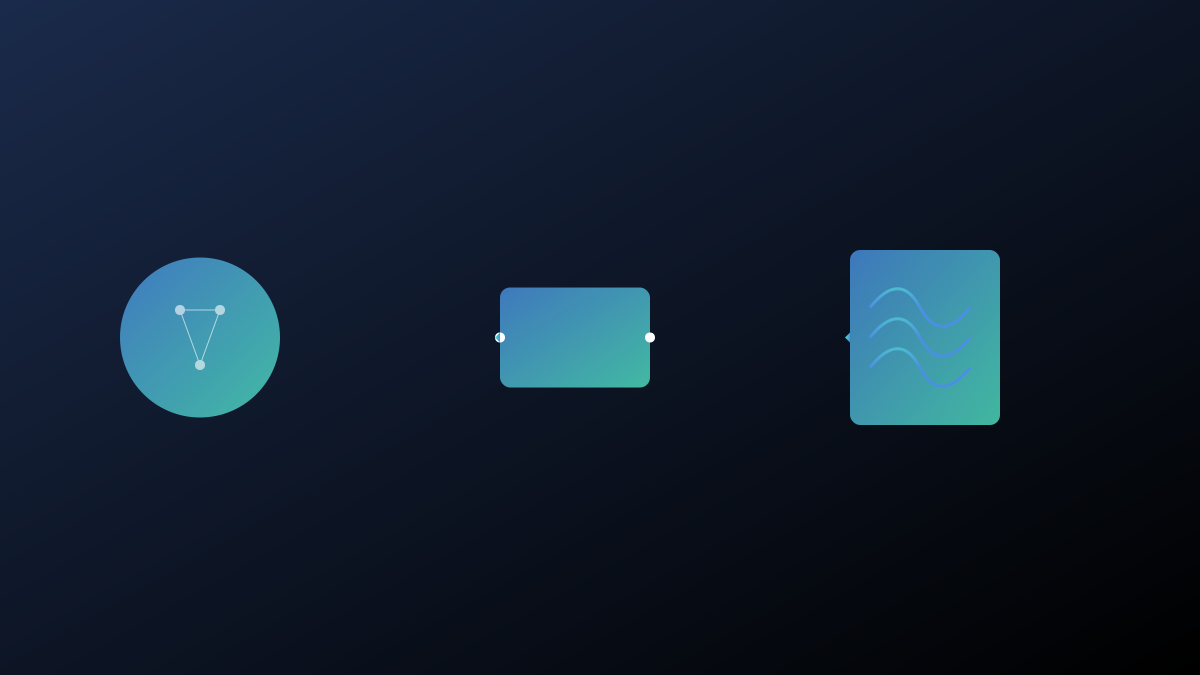
The core architecture of Wwise-MCP consists of three key components:

1. Model Context Protocol (MCP) Implementation: Following the MCP protocol introduced by Anthropic, it supports seamless integration with MCP-compatible AI clients like Claude Desktop and Cursor, ensuring compatibility and scalability.

2. Wwise Authoring API (WAAPI) Encapsulation: A custom Python WAAPI library wraps Wwise's official programming interface, enabling LLMs to call tools to perform specific operations.

3. Toolset Design: Covers multiple aspects including project structure query, audio container management, RTPC settings, event editing, mixing configuration, and sound bank generation.

4

Section 04

Practical Application Scenario Example

Take the footstep system of an action game as an example: The traditional workflow requires manually creating random containers, importing samples, setting RTPCs, and configuring events. With Wwise-MCP, developers only need to describe their requirements (e.g., 'Create a footstep system for three materials—concrete, grass, and metal—each containing 5 random samples, with volume varying between 0.5x and 1.5x based on speed'). The AI then automatically completes the configuration by calling tools via MCP, saving time, reducing error rates, and allowing designers to focus on creativity.

5

Section 05

Impact on Game Audio Development

Wwise-MCP drives the evolution of game audio toolchains and brings impacts in multiple aspects:

  • Lower Entry Barrier: Beginners can quickly understand projects through natural language without memorizing complex operations and terminology;
  • Improve Iteration Efficiency: Multiple audio configuration variants can be generated instantly during the rapid prototyping phase;
  • Standardize Workflows: AI follows best practice templates to ensure consistent project structure;
  • Cross-team Collaboration: Non-audio professionals can request changes via natural language, reducing communication costs.
6

Section 06

Limitations and Future Outlook

Currently, Wwise-MCP is in the early development stage (GitHub shows WIP status), with some advanced features not fully implemented and APIs that may change. AI-generated configurations still require manual review (especially for complex interactive music or fine mixing)—it is an auxiliary tool rather than a replacement for human designers. In the future, as the MCP ecosystem matures and LLM capabilities improve, similar tools may extend to game development areas like level design and animation.

7

Section 07

Conclusion: Redefining Game Development Tools

Wwise-MCP is a forward-looking open-source project that successfully connects AI with a mature game audio engine. It is not just an efficiency tool but also a window to future work styles—tools evolve from passive software to intelligent partners that actively understand intent, promoting deep integration of AI and human creativity.

