Zing Forum

Reading

Logical Agents in the Wumpus World: A Modern Web Implementation of a Classic AI Problem

This article introduces a web-based dynamic Wumpus logical agent project, exploring the application of knowledge representation, reasoning, and decision-making in AI agent design, as well as the modernization of classic AI teaching cases.

Wumpus世界逻辑智能体知识表示命题逻辑推理AI教学Web可视化符号AI
Published 2026-05-02 02:15Recent activity 2026-05-02 02:29Estimated read 5 min
Logical Agents in the Wumpus World: A Modern Web Implementation of a Classic AI Problem
1

Section 01

Introduction to the Web Project of Wumpus World Logical Agents

The GitHub project introduced in this article implements a web-based dynamic Wumpus logical agent, modernizing the classic AI teaching case. The project explores the application of knowledge representation, logical reasoning, and decision-making in agent design. Through web visualization, it allows learners to intuitively observe the agent's reasoning process, connects classic symbolic AI with modern technologies, and helps in understanding AI concepts.


2

Section 02

Wumpus World: Background of a Classic AI Teaching Scenario

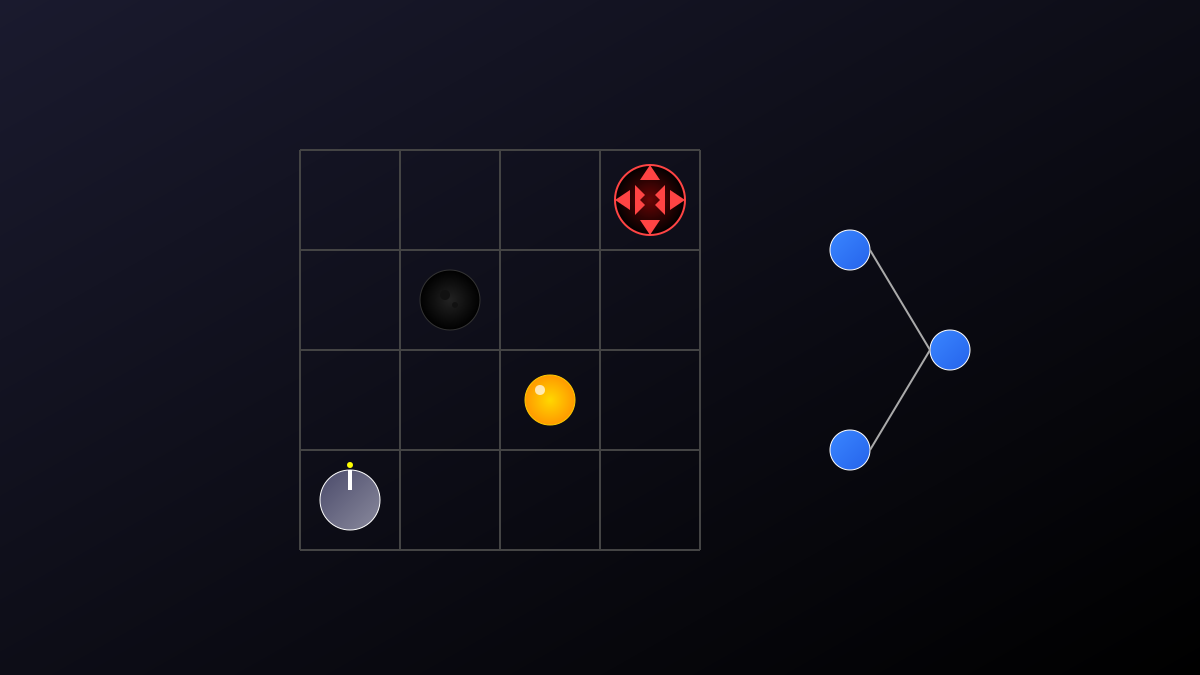
The Wumpus World is a virtual environment designed by symbolic AI pioneers, originating from the classic textbook Artificial Intelligence: A Modern Approach (AIMA). It is a standard case for teaching knowledge representation, logical reasoning, and agent design. Set in a grid world, it includes Wumpus monsters, bottomless pits, and gold. The agent needs to navigate, reason, survive, and find the treasure in a partially observable environment, which condenses the core challenges of AI: reasoning and decision-making under limited perception.

3

Section 03

Project Overview and Formal Definition of the Environment

Developed by f240789, this project implements a dynamic Wumpus logical agent with web visualization. Formal definition of the environment: 4×4 grid, agent starts at [1,1] facing right; perceptions include stench (adjacent to Wumpus), breeze (adjacent to pit), etc.; actions include moving forward, turning, grabbing, etc.; performance evaluation is based on scores (finding gold +1000, death -1000, etc.).

4

Section 04

Design Principles and Methods of Logical Agents

Knowledge representation uses propositional logic: boolean variables like P[i,j] (pit), W[i,j] (Wumpus), with rules such as "breeze ↔ adjacent to pit". Reasoning mechanisms include forward chaining (deriving new facts from known ones) and constraint propagation (maintaining grid cell states). Decision strategies prioritize safety, balance exploration and exploitation, and calculate expected utility for risk assessment.

5

Section 05

Technology and Educational Value of the Web Implementation

Web implementation tech stack: front-end uses HTML5 Canvas/SVG + JS (or React/Vue), back-end optionally uses Python framework + WebSocket, AI engine is a propositional logic reasoner. Visualization value: real-time state display, transparent reasoning process, support for interactive experiments. Educational value: covers AI concepts like knowledge representation and reasoning, provides a programming practice path from basic to advanced.

6

Section 06

Implications for Real-World Applications and Directions for Dynamic Expansion

Implications from Wumpus World: reasoning in uncertain environments (robot navigation, medical diagnosis, etc.); complementarity between knowledge-driven and data-driven AI (neuro-symbolic AI). Directions for dynamic expansion: moving hazards (Wumpus movement), changing environments, multi-agent collaboration, continuous space simulation, etc.

7

Section 07

Project Significance and Conclusion

The Wumpus World carries universal AI principles. This project pays tribute to the classic and invites learners to experience it. For AI learners: understand core issues of knowledge, reasoning, and decision-making; for web developers: present classic algorithms using modern technologies. The project makes abstract AI concepts visible and interactive. Finally, a question: Is your agent ready?

